Existing law, the California Financing Law, prohibits a person from engaging in the business of a finance lender or broker without obtaining a license from the Commissioner of Financial Protection and Innovation. This bill would deem a lender to be a licensed finance lender or broker without obtaining a license if the lender does not make or broker residential mortgage loans or consumer loans, makes 5 or fewer commercial loans annually, and the principal amount of all loans made by the lender in the preceding and current calendar year have each exceeded $350,000.
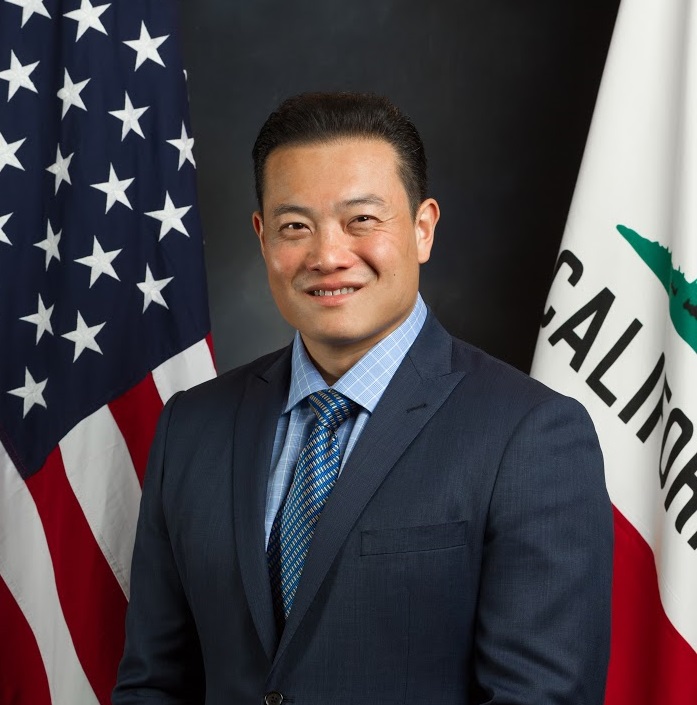
Asm. Phillip Chen
Sponsored bills
Existing law, the Radiologic Technology Act, prohibits a person from administering or using diagnostic or therapeutic X-rays on human beings in this state, unless that person either qualifies for a specified exemption or has been certified or granted a permit by the State Department of Public Health, as specified, is acting within the scope of that certification or permit, and is acting under the supervision of a healing arts licensee. A person who violates a provision of the Radiologic Technology Act or regulation of the department adopted pursuant to that act is guilty of a misdemeanor. This bill would prohibit a person from holding themselves out as a radiologist assistant unless the person meets certain requirements, including that they have passed the radiologist assistant examination, as specified, and that they maintain current registration with prescribed entities. The bill would require a radiologist assistant to work only under the supervision of a radiologist and would prohibit a radiologist assistant from functioning in that capacity independent of a supervising radiologist. The bill, among other things, would authorize a radiologist assistant to communicate and document initial clinical and imaging observations or procedures only to a radiologist for the radiologist's use. The bill would authorize a supervising radiologist to delegate to a radiologist assistant, as the radiologist determines appropriate to the assistant's competence, those tasks or services that a radiologist usually performs and is qualified to perform. By imposing additional prohibitions and requirements under the Radiologic Technology Act, the violation of which is a crime, the bill would impose a state-mandated local program. The California Constitution requires the state to reimburse local agencies and school districts for certain costs mandated by the state. Statutory provisions establish procedures for making that reimbursement. This bill would provide that no reimbursement is required by this act for a specified reason.
Existing law, the Control, Regulate and Tax Adult Use of Marijuana Act (AUMA) , an initiative measure, authorizes a person who obtains a state license under AUMA to engage in commercial adult-use cannabis activity pursuant to that license and applicable local ordinances. AUMA authorizes legislative amendment of its provisions with a 23 vote of both houses, without submission to the voters, to further its purposes and intent, except as provided. Existing law, the Medicinal and Adult-Use Cannabis Regulation and Safety Act (MAUCRSA) , among other things, consolidates the licensure and regulation of commercial medicinal and adult-use cannabis activities, and requires the Department of Cannabis Control to administer its provisions. MAUCRSA grants to the department the sole authority to create, issue, deny, renew, discipline, condition, suspend, or revoke licenses for commercial cannabis activity. This bill would also grant to the department the sole authority to transfer, assign, or reassign those licenses. The bill would declare that its provisions further the purpose and intent of AUMA.
The Control, Regulate and Tax Adult Use of Marijuana Act (AUMA) , an initiative measure approved as Proposition 64 at the November 8, 2016, statewide general election, authorizes a person who obtains a state license under AUMA to engage in commercial adult-use cannabis activity pursuant to that license and applicable local ordinances. Existing law, the Medicinal and Adult-Use Cannabis Regulation and Safety Act (MAUCRSA) , among other things, consolidates the licensure and regulation of commercial medicinal and adult-use cannabis activities. MAUCRSA establishes the Department of Cannabis Control within the Business, Consumer Services, and Housing Agency to administer the act, and requires the department to be under the supervision and control of a director. Existing law requires every sale or transport of cannabis or cannabis products from one licensee to another licensee to be recorded on a sales invoice or receipt and prescribes the information included on those receipts, including the cost to the purchaser. Existing law provides grounds for disciplinary action under MAUCRSA, including failure to comply with the provisions of MAUCRSA or any rule or regulation adopted pursuant to MAUCRSA. This bill would, except as specified, require a licensee to pay for goods and services sold or transferred by another licensee no later than 15 days following the final date set forth in the invoice. The bill would require a licensee who sold or transferred goods to another licensee and who has not received payment in full 15 days after the final date set forth in the invoice to report the unpaid invoice to the department, as specified. The bill would require the department to notify a licensee of this report, and would require the department to issue a notice of warning, or, in its discretion, issue a citation or take disciplinary action against the licensee if the licensee fails to pay the outstanding invoice in full by 30 days after this notification, as specified. The bill would prohibit the licensee from purchasing goods and services from another licensee on credit until the licensee pays the outstanding invoice in full.
(1) Existing law, the Ortiz-Pacheco-Poochigian-Vasconcellos Cal Grant Program, establishes the Cal Grant A and B Entitlement awards, the California Community College Expanded Entitlement awards, the California Community College Transfer Entitlement awards, the Competitive Cal Grant A and B awards, the Cal Grant C awards, and the Cal Grant T awards under the administration of the Student Aid Commission, and establishes eligibility requirements for these awards for participating students attending qualifying institutions. Existing law requires a Cal Grant C award to be used only for occupational or technical training in a course of not less than 4 months. Existing law requires the maximum per-student Cal Grant C award amount to be determined each year in the annual Budget Act. This bill, upon appropriation in the annual Budget Act for this purpose, would set, commencing with the 2025–26 award year, the maximum per-student Cal Grant C award amount at no less than double the maximum per-student Cal Grant C award amount provided for the 2023–24 award year. (2) Existing law, the Cal Grant Reform Act, revises and recasts the provisions establishing and governing the existing Cal Grant Program into a new Cal Grant Program. Existing law authorizes the commission to adopt emergency regulations to implement the Cal Grant Reform Act. Existing law requires the new Cal Grant Program to include a Cal Grant 2 Program with eligibility requirements, as specified. Existing law requires the Cal Grant 2 award to include an access award, covering nontuition expenses, of no less than the maximum per-student amount provided in the 2020–21 award year, as specified. Existing law requires, as a continuation of the Cal Grant C Program, an otherwise eligible student enrolled in a qualifying occupational and technical training program who would have been eligible for aid under the Cal Grant C Program, to be eligible to receive a prorated Cal Grant award as specified in the Budget Act. Existing law specifies that the act becomes operative only if General Fund moneys over the multiyear forecasts beginning in the 2024–25 fiscal year are available to support ongoing augmentations and actions, and if funding is provided in the annual Budget Act to implement the act. This bill would require the prorated Cal Grant award and the per-student Cal Grant 2 access award amounts to be no less than double the maximum award amounts provided for the 2023–24 award year.

Existing law authorizes school districts, county offices of education, and charter schools to provide emergency naloxone hydrochloride or another opioid antagonist to school nurses or voluntary trained personnel, and authorizes those nurses and voluntary trained personnel to use naloxone hydrochloride or another opioid antagonist to provide emergency medical aid to persons suffering, or reasonably believed to be suffering, from an opioid overdose, as provided. This bill would require each individual public school operated by a school district, county office of education, or charter school that has elected to make a school nurse or trained personnel available at the school pursuant to those provisions to maintain at least 2 units of naloxone hydrochloride or another opioid antagonist for purposes of those authorizations.
Existing law makes it a crime to solicit or encourage a minor to commit specified crimes relating to controlled substances, to hire or employ a minor to transport or sell controlled substances, or to sell or give controlled substances to minors and imposes a punishment of imprisonment for a period of 3, 6, or 9 years. Existing law makes a person who is 18 years of age or older who violates these provisions with respect to heroin, cocaine, or cocaine base on the grounds of, or within certain locations, such as a church, synagogue, or a public swimming pool, among others, or on the grounds of, or within 1,000 feet of, public or private schools, as specified, subject to punishment with an additional enhancement in the state prison of one or 2 years. This bill would make the above-described enhancement applicable to offenses involving fentanyl if the person had knowledge that the specific controlled substance involved was fentanyl. By increasing the penalties for a crime, this bill would create a state-mandated local program. The California Constitution requires the state to reimburse local agencies and school districts for certain costs mandated by the state. Statutory provisions establish procedures for making that reimbursement. This bill would provide that no reimbursement is required by this act for a specified reason.
Maddy summaryThis bill designates October 2024 as Menopause Awareness Month in California to highlight the health and societal impacts of menopause on women. It acknowledges that millions of women face symptoms that can affect their daily lives and work, noting that women of color are at higher risk for complications like premature menopause and heart disease. The resolution encourages the state to provide better health information and services to support women's well-being before, during, and after this transition. While the text outlines these goals, the bill itself is a formal recognition rather than a law that creates new funding or mandates specific programs.
Existing law establishes a State Department of Public Health within the California Health and Human Services Agency. Existing law requires the department to license and regulate clinical laboratories and various clinical laboratory personnel, including medical laboratory technicians. Existing law prohibits a person from operating a school, as defined, or conducting any course for the purpose of training or preparing persons to perform duties subject to those provisions, as specified, without having first secured the approval of the department. Existing law imposes on the department specified duties related to the approval and regulation of schools and clinical laboratory scientist programs for instruction in clinical laboratory technique. This bill would authorize the department, upon appropriation by the Legislature, to establish a grant program to provide funding to training programs that both offer training programs for clinical laboratory scientists or medical laboratory technicians, and are approved by the department or accredited by a recognized accrediting program approved by the department. The bill would also authorize the department to award grants to those training programs in the amount of no more than $600,000, to be used within 3 years of receiving a grant.
Existing law requires, upon the immediate approach of an authorized emergency vehicle that is sounding a siren and has a lighted lamp exhibiting red light, that a driver of a vehicle yield the right-of-way to the emergency vehicle, that the operator of a street car immediately stop the street car, and that all pedestrians proceed to the nearest curb or place of safety and remain there until the authorized emergency vehicle has passed. Existing law makes a violation of that provision an infraction, punishable by specified fines. This bill would prohibit a person driving a vehicle upon a highway or a pedestrian from willfully obstructing a highway, including in the course of a protest, in any manner that interferes with the ability of an authorized emergency vehicle to pass and would make a violation of this provision punishable by specified fines. By creating a new crime, this bill would impose a state-mandated local program. The California Constitution requires the state to reimburse local agencies and school districts for certain costs mandated by the state. Statutory provisions establish procedures for making that reimbursement. This bill would provide that no reimbursement is required by this act for a specified reason.