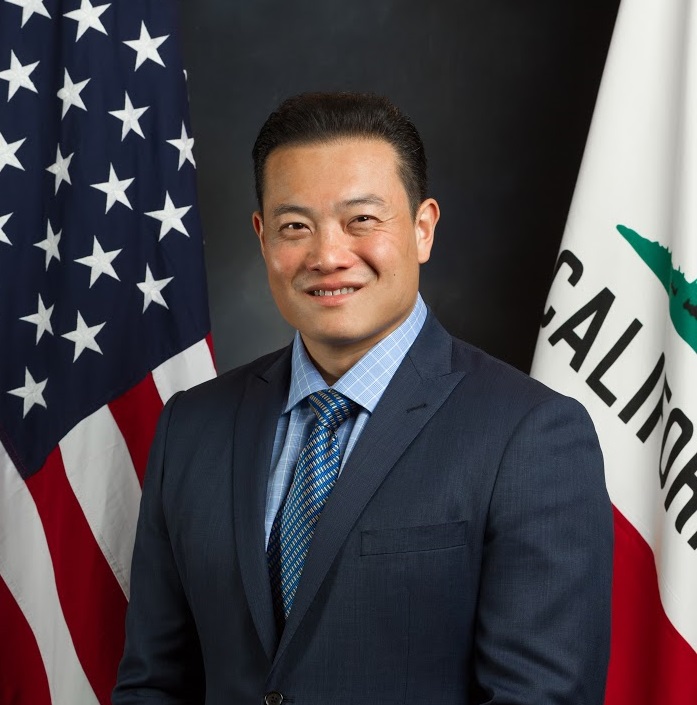
Photo of Phillip Chen
R California Assembly · District 59 On the 2026 ballot

Asm. Phillip Chen

Compare
Total votes
21,436
all sessions
Attendance
81%
3,567 missed
Lower than 85% of chamber peers
With party
98%
of cast votes
Near the chamber average
Bipartisan score
1%
crosses aisle rarely
Near the chamber average
Sponsored
1,732
bills & resolutions
Higher than 82% of chamber peers
Committees
9
assignments
1,732 bills and resolutions

Sponsored bills

Total
1,732
Primary
225
Co-sponsor
1,507
This page
1,732
matching current filters
Co-sponsor AJR 35
Passed · California Assembly · Co-sponsor
Relative to a Polish law on speech related to the Holocaust.

This measure would urge lawmakers in Poland to reverse or revise a recent Polish law on speech related to the Holocaust, would call on Congress to join that effort, and would call for a renewed commitment to Holocaust education in California.

Passed May 30, 2018 1 co-sponsor
Primary AB 2590
In committee · California Assembly · Lead sponsor
Personal income taxes: exclusion: servicemembers.

The Personal Income Tax Law imposes a tax on individual taxpayers measured by the taxpayer's taxable income for the taxable year, but excludes certain items of income from the computation of tax, including an exclusion for compensation for military or naval service performed by a nonresident while domiciled within the state. This bill, for taxable years beginning on or after January 1, 2018, and before January 1, 2028, would exclude from gross income basic pay received by a servicemember on active duty in the United States Armed Forces, in the reserve component of the United States Armed Forces, or in the National Guard, derived from his or her position as a servicemember while he or she is on military orders for 90 or more consecutive days. This bill would take effect immediately as a tax levy.

In committee May 25, 2018 0 co-sponsors
Primary AB 2728
In committee · California Assembly · Lead sponsor
Replacement of corroded or lead-containing plumbing or service lines: loans.

Existing law, the Safe Drinking Water State Revolving Fund Law of 1997, establishes the Safe Drinking Water State Revolving Fund to provide grants or revolving fund loans for the design and construction of projects for public water systems that will enable those systems to meet safe drinking water standards. This bill would, to the extent funding is made available, authorize the State Water Resources Control Board to establish a grant program to provide funding to a county or qualified nonprofit organization, as specified, to provide low-interest loans to defined property owners for the replacement of corroded or lead-containing plumbing and service lines that adversely impact drinking water standards or for the installation of a point-of-use or point-of-entry water treatment system, as specified. The bill would require a county or qualified nonprofit organization that receives a grant pursuant to these provisions to annually provide to the state board specified information relating to the loans awarded and projects funded. The bill would authorize the state board to use a funding source that is authorized for and consistent with the purposes of the program.

In committee May 25, 2018 0 co-sponsors
Primary AB 2536
In committee · California Assembly · Lead sponsor
Orange County Property Crime Task Force.

Existing law establishes local and regional task forces for law enforcement purposes, including, among others, the county sexual assault felony enforcement (SAFE) team program, and county violent crime against women task forces. This bill would establish the Orange County Property Crime Task Force, whose mission would be to identify, arrest, and prosecute the criminals who participate in property crime, and to also increase prevention methods and diversion. The bill would specify the membership of the task force, specify the tasks that the task force would be required to complete, and require the task force to report to the Legislature, as specified. The bill would authorize implementation of the task force only to the extent an appropriation for it is provided in the Budget Act.

In committee May 25, 2018 0 co-sponsors
Primary AB 2711
In committee · California Assembly · Lead sponsor
Property tax revenue allocations: County of Orange: county equity amount.

Existing property tax law requires the county auditor, in each fiscal year, to allocate property tax revenue to local jurisdictions in accordance with specified formulas and procedures, and generally requires that each jurisdiction be allocated an amount equal to the total of the amount of revenue allocated to that jurisdiction in the prior fiscal year, subject to certain modifications, and that jurisdiction's portion of the annual tax increment, as defined. Existing property tax law also reduces the amounts of ad valorem property tax revenue that would otherwise be annually allocated to the county, cities, and special districts pursuant to these general allocation requirements by requiring, for purposes of determining property tax revenue allocations in each county for the 1992–93 and 1993–94 fiscal years, that the amounts of property tax revenue deemed allocated in the prior fiscal year to the county, cities, and special districts be reduced in accordance with certain formulas. Existing property tax law requires that the revenues not allocated to the county, cities, and special districts as a result of these reductions be transferred to the Educational Revenue Augmentation Fund in that county for allocation to school districts, community college districts, and the county office of education. This bill, for the 2019–20 fiscal year and each fiscal year thereafter, would require the auditor of the County of Orange to increase the total amount of ad valorem property tax revenue that is otherwise required to be allocated to the county by the county equity amount, as defined, and to commensurately decrease the amount of ad valorem property tax revenue that is otherwise required to be allocated to the county Educational Revenue Augmentation Fund and, if necessary, the amount of those revenue otherwise required to be allocated to school districts. By imposing new duties upon local officials in the allocation of ad valorem property tax revenues, this bill would impose a state-mandated local program. This bill would make legislative findings and declarations as to the necessity of a special statute for the County of Orange. The California Constitution requires the state to reimburse local agencies and school districts for certain costs mandated by the state. Statutory provisions establish procedures for making that reimbursement. This bill would provide that, if the Commission on State Mandates determines that the bill contains costs mandated by the state, reimbursement for those costs shall be made pursuant to the statutory provisions noted above.

In committee May 25, 2018 0 co-sponsors
Co-sponsor AB 1789
In committee · California Assembly · Co-sponsor
Occupational safety and health: Valley Fever.

The California Occupational Safety and Health Act of 1973 provides the Division of Occupational Safety and Health within the Department of Industrial Relations with the power, jurisdiction, and supervision over all employment and places of employment necessary to enforce and administer all occupational health and safety laws,and standards and to protect employees. The Occupational Safety and Health Standards Board, an independent entity within the department, has the exclusive authority to adopt occupational safety and health standards within the state. Existing law requires every employer to comply with those standards. A violation of these standards and regulations under specific circumstances is a crime. This bill would require the board to adopt occupational safety and health standards for state public works projects to prevent and control coccidioidomycosis, more commonly known as Valley Fever. By expanding the definition of an existing crime, this bill would impose a state-mandated local program. The California Constitution requires the state to reimburse local agencies and school districts for certain costs mandated by the state. Statutory provisions establish procedures for making that reimbursement. This bill would provide that no reimbursement is required by this act for a specified reason.

In committee May 25, 2018 1 co-sponsor
Co-sponsor AB 2896
In committee · California Assembly · Co-sponsor
Fire prevention: state parks: fire hazard reduction.

Existing law requires a person who owns, leases, controls, operates, or maintains an occupied dwelling or occupied structure in, upon, or adjoining a mountainous area, forest-covered land, brush-covered land, grass-covered land, or land that is covered with flammable material within a very high fire hazard severity zone to at all times maintain defensible space of 100 feet from each side and from the front and rear of the structure, as provided. Existing law vests control of the state park system with the Department of Parks and Recreation. Existing law provides that the department has the right to remove and dispose of debris deposited on public beaches, waterways, or lands within the state park system when the deposits create a hazard or impediment to public safety, enjoyment, and use of the public beach, waterway, or land. This bill would, until January 1, 2023, require the department, upon request by a private property owner or by an agency of local government or a local official, to reduce surface fuels or other fire hazards on the department's property that are within 300 feet of a structure on the land of the property owner or local government, as provided. The bill would require the department, in consultation with the Department of Forestry and Fire Protection, to determine the necessary amount of surface fuel or fire hazard reduction work, as prescribed.


In committee May 25, 2018 1 co-sponsor
Showing 1,481 to 1,490 of 1,732 bills