This measure would urge the United States Congress and the President of the United States to permit states to extend burial and memorial benefits in state veterans cemeteries to Republic of Korea veterans and Republic of Vietnam veterans who served in the Vietnam War and who subsequently became United States citizens. The measure would urge the United States Congress and the President of the United States to extend the same benefits in national cemeteries.
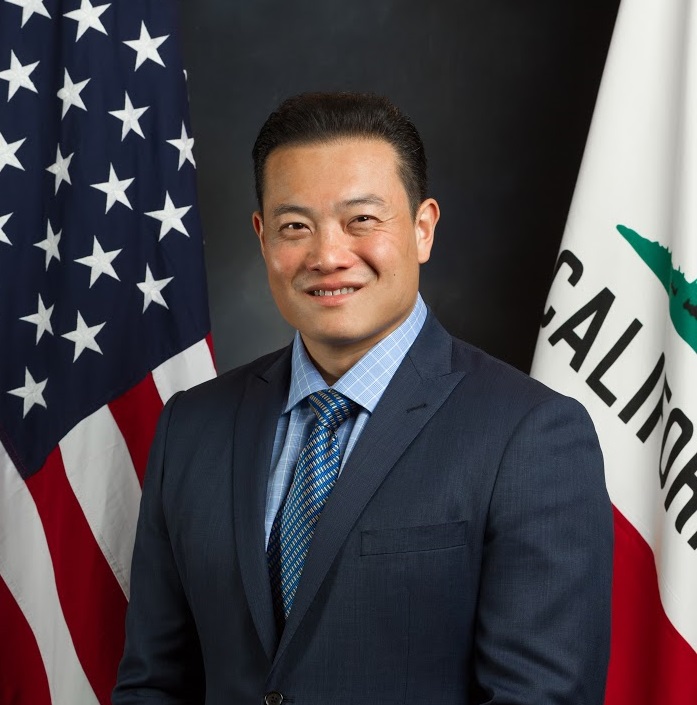
Asm. Phillip Chen
Sponsored bills
This measure would, on June 23, 2021, commemorate the 49th anniversary of the enactment of Title IX, and would urge Californians to continue to work together to achieve the goals set by Title IX, as specified.
This measure would designate the month of June 2021 as Healthy Homes Awareness Month.
Existing law provides for the payment of unemployment compensation benefits to eligible persons who are unemployed through no fault of their own through a federal-state unemployment insurance program administered by the Employment Development Department, subject to oversight by the Director of Employment Development. Under existing law, the expenses of administering the unemployment insurance program are paid from the Unemployment Administration Fund, a continuously appropriated fund. Existing law requires the Department of Justice to maintain state summary criminal history information, including the identification and criminal history of a person, including name, date of birth, social security number, physical description, fingerprints, photographs, dates of arrests, arresting agencies and booking numbers, charges, dispositions, sentencing information, and similar data about the person. Existing law requires the Attorney General to furnish this information to specified persons, agencies, or organizations, including the Department of Corrections and Rehabilitation, if needed in the course of their duties. Existing law makes it a crime for any person authorized by law to receive state summary criminal history information to knowingly furnish the information to a person who is not authorized by law to receive it. This bill would require the Department of Corrections and Rehabilitation to provide the names and social security numbers of current inmates to the Employment Development Department for the purposes of preventing payments on fraudulent claims for unemployment compensation benefits. The bill would require the Department of Corrections and Rehabilitation to provide the information to the Employment Development Department at least every 90 calendar days and upon that department's request. Because this bill would expand the group of persons who can be convicted for knowingly furnishing state summary criminal history information to unauthorized persons, it would impose a state-mandated local program. This bill would require, for the purpose of preventing payments on fraudulent claims for unemployment compensation benefits, for any unemployment compensation benefits paid on and after July 1, 2021, the Director of Employment Development to verify with the information provided by the Department of Corrections and Rehabilitation before making any payment of unemployment compensation benefits that the claimant is not an inmate currently incarcerated in the state prisons. The bill would also prohibit the department from using the information provided by the Department of Corrections and Rehabilitation unless the information of current inmates is equal to or less than 90 calendar days old. This bill would require, if the department determines a claimant is an inmate currently incarcerated in the state prisons, the department to notify the Department of Corrections and Rehabilitation and the Department of Justice of the attempt to make a fraudulent claim for unemployment compensation benefits. The bill would authorize the Employment Development Department to disseminate social security numbers to the Department of Corrections and Rehabilitation for this purpose. By expanding the purposes of a continuously appropriated fund, the bill would make an appropriation. The California Constitution requires the state to reimburse local agencies and school districts for certain costs mandated by the state. Statutory provisions establish procedures for making that reimbursement. This bill would provide that no reimbursement is required by this act for a specified reason. This bill would declare that it is to take effect immediately as an urgency statute.

Existing law imposes a general obligation on both parents of a minor child to support their child in the manner suitable to the child's circumstances. Existing law establishes the statewide uniform guidelines for calculating court-ordered child support, based on the income of both parents and the time each parent spends with the child. Existing law authorizes, if a support obligor is delinquent in paying child support and the local child support agency is enforcing a support obligation, a lien for child support against the personal property of the obligor in specified circumstances. Existing law defines "support obligor is delinquent in payment of support" to mean that the support obligor has failed to make a payment equal to one month's support obligation. Existing law requires the Department of Child Support Services to administer all services and perform all functions necessary to establish, collect, and distribute child support, and requires the department and the local child support agency to promptly and effectively collect and enforce child support obligations. Existing law also authorizes the transmission, filing, and recording of a lien record by departmental and local child support agency staff against the real property of a delinquent support obligor, as specified. Existing law authorizes a child support agency to record a notice of support judgment. This bill would instead define "support obligor is delinquent in payment of support" to mean that the support obligor is over $1,000 in arrears on their support obligation or has failed to make payments equal to 3 months of their support obligation, whichever occurs first. The bill would instead authorize a child support agency to record a notice of support judgment when overdue support exceeds $1,000 or when the support obligor has failed to make payments equal to 3 months of their support obligation, whichever occurs first, regardless of whether the amounts of overdue support have been adjudicated or otherwise determined. This bill would provide that if the local child support agency is enforcing the support obligation, as specified, a lien for child support arises, by operation of law, against the real property of the support obligor when the support obligor owes overdue support over $1,000 or when the support obligor has failed to make payments equal to 3 months of their support obligation, whichever occurs first. The bill would require the department to adopt or amend regulations to implement these provisions by March 31, 2022, and would authorize the department, until regulations are adopted or revised, to implement and administer these provisions through a child support services letter or similar instruction.
Existing law requires the Superintendent of Public Instruction to administer all California state preschool programs, including, but not limited to, part-day and full-day age and developmentally appropriate programs for 3- and 4-year-old children. This bill would establish the Parent Participation Preschool Pilot Program, under the administration of the State Department of Education, to provide one-time grants to California state preschool program contracting agencies, as defined, for the creation or expansion of parent participation preschool programs. The bill would define "parent participation preschool program" as a preschool program funded by the state, where there is an educational component for a parent, guardian, or family member of a child in the program, as specified, and there may also be a requirement for those persons to volunteer in the classroom or with other aspects of the program. The bill would require the department to announce and post criteria for grants on or before March 31, 2022, to award grants to selected California state preschool program contracting agencies on or before the beginning of the 2022–23 school year, and to report to the appropriate policy and fiscal committees of the Legislature on the impact of the pilot program on or before January 1, 2024. The bill would make implementation of the pilot program contingent upon an appropriation in the annual Budget Act or another statute for this purpose. The bill would repeal these provisions 5 years after an appropriation in the annual Budget Act or another statute for the pilot program.
The California Environmental Quality Act (CEQA) requires a lead agency, as defined, to prepare, or cause to be prepared, and certify the completion of an environmental impact report on a project that it proposes to carry out or approve that may have a significant effect on the environment or to adopt a negative declaration if it finds that the project will not have that effect. CEQA also requires a lead agency to prepare a mitigated negative declaration for a project that may have a significant effect on the environment if revisions in the project would avoid or mitigate that effect and there is no substantial evidence that the project, as revised, would have a significant effect on the environment. CEQA includes exemptions from its environmental review requirements for numerous categories of projects, including, among others, projects for the institution or increase of passenger or commuter services on rail or highway rights-of-way already in use and projects by a public transit agency to construct or maintain infrastructure to charge or refuel zero-emission transit buses. This bill would further exempt from the requirements of CEQA projects by a public transit agency to construct or maintain infrastructure to charge or refuel zero-emission trains, provided certain requirements are met, including giving prior notice to the public and holding a noticed public meeting, as provided.