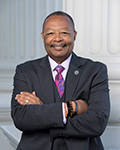
Photo of Reggie Jones-Sawyer
D California Assembly · District 57 · Former member

Asm. Reggie Jones-Sawyer

Contact Email
Compare
Total votes
26,638
all sessions
Attendance
97%
781 missed
Near the chamber average
With party
99%
of cast votes
Near the chamber average
Bipartisan score
0%
crosses aisle rarely
Near the chamber average
Sponsored
2,128
bills & resolutions
Near the chamber average
Committees
0
assignments
2,128 bills and resolutions

Sponsored bills

Total
2,128
Primary
269
Co-sponsor
1,859
This page
2,128
matching current filters
Co-sponsor SB 721
Signed into law · California Senate · Co-sponsor
California Farmworker Day.

Existing law requires the Governor to proclaim certain days each year for specified reasons. This bill would designate August 26 of each year as California Farmworker Day, and require the Governor to annually proclaim August 26 as California Farmworker Day. The bill would make legislative findings in this regard.

Signed into law Oct 4, 2021 1 co-sponsor
Co-sponsor AB 1024
Signed into law · California Assembly · Co-sponsor
Hazardous substances: cleanups: milestones and contracting.

Existing law authorizes the Department of Toxic Substances Control to undertake response or corrective actions under the hazardous waste control laws or the Carpenter-Presley-Tanner Hazardous Substance Account Act in response to a release or threatened release of hazardous substances. This bill would require the department, where feasible, to at least partially incorporate fixed-price contracting for contracts for the cleanup of hazardous substances released into the environment carried out by the department. The bill would require the department to establish performance milestones for cleanups of hazardous substances released into the environment carried out or overseen by the department to ensure that the cleanups are performed at the appropriate pace and to post on its internet website information regarding those cleanups, including specified information for each cleanup. This bill would require moneys recovered by the state from responsible parties relating to the former Exide Technologies lead-acid battery recycling facility in the City of Vernon to be used to repay the General Fund and the Lead-Acid Battery Cleanup Fund for loans made for the oversight or performance of closure activities and response and corrective actions to protect public health and the environment from hazardous substances or hazardous waste at or near the former Exide Technologies facility, and to repay other sources of state funding for costs incurred for that same purpose. The bill would also require moneys recovered by the state to be used to repay the Lead-Acid Battery Cleanup Fund for repayments to the General Fund.

Signed into law Oct 4, 2021 1 co-sponsor
Primary AB 1042
Signed into law · California Assembly · Lead sponsor
Skilled nursing facilities: unpaid penalties: related parties.

The Long-Term Care, Health, Safety, and Security Act of 1973 generally requires the State Department of Public Health to license and regulate long-term health care facilities and to establish an inspection and reporting system to ensure that long-term health care facilities are in compliance with state statutes and regulations. The term "long-term health care facility" includes, among other types of facilities, a skilled nursing facility. Existing law relating to health facility data reporting requires an organization that operates, conducts, owns, or maintains a licensed skilled nursing facility to file with the Office of Statewide Health Planning and Development information as to whether the licensee, or a general partner, director, or officer of the licensee, has an ownership or control interest of 5% or more in a related party that provides any service to the skilled nursing facility. Existing law defines "related party" for those purposes as an organization related to the licensee provider or that is under common ownership or control, as defined in a specified federal regulation. This bill would, beginning January 1, 2023, expressly authorize the department, if a licensee provider fails to pay specified penalties in full when all appeals have been exhausted and the department's position has been upheld, to give written notice to the licensee provider and related parties in which the licensee provider has an ownership or control interest of 5% or more that the department may take appropriate legal action to recover the unpaid penalty amount from the licensee provider's financial interest in the related party. The bill would also require the department, if it determines after 2 notifications that the related parties are not financially viable or recovery is unlikely, to document that determination, as specified. This bill also would require the department to give written notice to related parties when a citation has been issued against a facility licensee, and to advise the related parties of the potential action if the violation is not remedied and penalties are assessed. Existing law specifies procedures for the appointment of a temporary manager to manage a long-term health care facility when certain circumstances exist. Existing law authorizes the department to use funds from the Health Facilities Citation Penalties Account to operate the facility after all other facility revenues are exhausted. This bill would state that funds from that account that are used for the purposes of the facility's management constitute a debt due to the state that may be collected pursuant to appropriate legal action taken by the department to collect the debt from the licensee, including from the licensee's financial interest in a related party. The bill would require the department, beginning January 1, 2023, to give written notice to related parties that it may take action to collect the licensee's debt, as specified. The bill would also require the department, if it determines after 2 notifications that the related parties are not financially viable or recovery is unlikely, to document that determination, as specified. Existing law requires the State Department of Health Care Services to impose a uniform quality assurance fee on each skilled nursing facility, with certain exceptions, in accordance with a prescribed formula. Under existing law, if a skilled nursing facility fails to pay all or part of the quality assurance fee within a specified time period, among other requirements, the unpaid amount constitutes a debt to the state that may be collected pursuant to specified provisions. This bill would also authorize the department to take appropriate legal action to recover the unpaid quality assurance fee amount, including any interest and penalties owed, from the licensee's financial interest in the related party and would require the department to give written notice to the licensee and related parties before the department takes such action.

Signed into law Oct 4, 2021 0 co-sponsors
Co-sponsor AB 1177
Signed into law · California Assembly · Co-sponsor
California Public Banking Option Act.

Existing law, the CalSavers Retirement Savings Trust Act, creates in state government the CalSavers Retirement Savings Board and requires the board to, among other things, design and implement the CalSavers Retirement Savings Program. This bill, the California Public Banking Option Act, until January 1, 2032, would require the Treasurer to convene, on or before September 1, 2022, the CalAccount Blue Ribbon Commission to be composed of certain members, including the Treasurer or the Treasurer's designee. The act would require the commission to, on or before July 1, 2024, conduct, by contracting with one or more entities with appropriate expertise, and deliver, as prescribed, a market analysis to determine if it is feasible to implement a "CalAccount Program," which, if implemented, would have certain characteristics, including that it would be a program established by the state for the purpose of protecting consumers who lack access to traditional banking services from predatory, discriminatory, and costly alternatives, which offers Californians access to a voluntary, zero-fee, zero-penalty, federally insured transaction account, known as a CalAccount, and related payment services at no cost to accountholders, including robust and geographically diverse mechanisms for accessing account funds and account management tools that facilitate the automation of basic financial transactions designed to serve the needs of individuals with low or fluctuating income. The bill would require the commission to hold a public hearing to review the market analysis and, after holding that hearing, would authorize the commission to issue a report to accompany the market analysis, as prescribed. The bill would make the operation of the act contingent upon an appropriation by the Legislature in the Budget Act or another statute for its purposes.

Signed into law Oct 4, 2021 1 co-sponsor
Primary AB 1347
Signed into law · California Assembly · Lead sponsor
Bail: premiums.

Existing law provides for the procedure of approving and accepting bail, and issuing an order for the appearance and release of an arrested person. Existing law generally regulates the undertaking of bail and the licensing of bail agents and bail solicitors by the Insurance Commissioner. This bill would, on and after January 1, 2022, prohibit an insurer, bail agent, or other bail licensee from entering into a contract, agreement, or undertaking of bail that requires the payment of more than one premium for the duration of the agreement, and would require the duration of the agreement to be until bail is exonerated. The bill would additionally prohibit an insurer, bail agent, or other bail licensee from charging, collecting, or receiving a renewal premium in connection with a contract, agreement, or undertaking of bail after that date. The bill would also make these prohibitions apply to an insurer or insurance licensee with regard to immigration bonds on and after July 1, 2022. The bill would additionally make an insurer, insurance licensee, bail agent, or other bail licensee liable to the person affected by a violation of these provisions for all damages that person sustains plus $3,000 in statutory damages, and court costs and reasonable attorney's fees, as specified. The bill would state that its provisions are severable.

Signed into law Oct 1, 2021 0 co-sponsors
Co-sponsor SB 796
Signed into law · California Senate · Co-sponsor
State parks: state beaches: County of Los Angeles: Manhattan State Beach: deed restrictions: taxation.

Existing law requires the Director of Parks and Recreation, upon the adoption of a specified resolution by the Board of Supervisors of the County of Los Angeles, to grant to the County of Los Angeles, in trust for the people of California, all of the rights, title, and interest of the State of California in specified state beach property, including a portion of Manhattan State Beach. Existing law requires the grant to be made upon the express condition that the County of Los Angeles use, operate, and maintain the granted lands and improvements only for public recreation and beach purposes in perpetuity. Existing law subjects the transfer of those rights, title, and interest in the granted lands to specified restrictions, including prohibitions on new or expanded commercial development on those granted lands and on the sale, transfer, or encumbrance of those granted lands. This bill would exclude specified property located in Manhattan State Beach, commonly known as Bruce's Beach, from the requirement that the property be used only for public recreation and beach purposes in perpetuity and from those specified restrictions. The bill would authorize the property to be sold, transferred, or encumbered upon terms and conditions determined by the Board of Supervisors of the County of Los Angeles to be in the best interest of the county and the general public. The bill would require the Director of Parks and Recreation, on or before December 31, 2021, to execute an amendment to a specified deed that incorporates the exclusion of that property from that requirement and those restrictions. Under the California Constitution, all property is taxable and must be assessed at the same percentage of fair market value, unless otherwise provided in the California Constitution or federal law. The California Constitution limits the maximum amount of any ad valorem tax on real property to 1% of its full cash value and defines "full cash value" for these purposes. Existing property tax law, in accordance with these provisions, defines "full cash value" of real property to mean the fair market value of the property as of the 1975 lien date or, for property which is purchased, is newly constructed, or changes ownership after the 1975 lien date, the date on which the purchase or change in ownership occurs, or the date on which new construction is completed, and if uncompleted, on the lien date. Under existing property tax law, the purchase price, as defined, of real property is rebuttably presumed to be the "full cash value" or "fair market value" if the terms of the transaction were negotiated at arms length between a knowledgeable transferor and transferee neither of which could take advantage of the exigencies of the other. This bill, for purposes of determining the full cash value of Bruce's Beach upon its sale, transfer, or encumbrance as authorized by the bill's provisions, would require that the fair market value of that land be its full cash value as of the 1975 lien date, adjusted by an inflation factor determined as provided. The Personal Income Tax Law and the Corporation Tax Law, in modified conformity with federal law, generally define "gross income" as income from whatever source derived, except as specifically excluded, and provides various exclusions from gross income for purposes of computing tax liability. This bill, subject to certain limitations, would provide that, under both the Personal Income Tax Law and the Corporation Tax Law, a recipient's gross income does not include any sale, transfer, or encumbrance of Bruce's Beach, or income directly derived from that sale, transfer, or encumbrance, in accordance with the procedures described above for the taxable year in which the land is sold, transferred, or encumbered. Existing law, the Documentary Transfer Tax Act, authorizes the board of supervisors of any county or city and county, and the legislative body of any city within the county, to impose by ordinance a tax, at a specified rate, on each deed, instrument, or writing by which any lands, tenements, or other realty sold within the county is granted, assigned, transferred, or otherwise conveyed to, or vested in, the purchaser or any other person, if the consideration or value of the interest or property conveyed or vested exceeds $100. Existing law provides various exemptions from a tax imposed by a county, city and county, or city under these provisions. This bill would exempt any sale, transfer, or encumbrance of the portion of Bruce's Beach in accordance with the procedures described above from a documentary transfer tax imposed pursuant to the Documentary Transfer Tax Act. This bill would state that its provisions are severable. This bill would make legislative findings and declarations as to the necessity of a special statute for Bruce's Beach. This bill would declare that it is to take effect immediately as an urgency statute.


Signed into law Sep 30, 2021 1 co-sponsor
Primary AB 483
Signed into law · California Assembly · Lead sponsor
Peace officers: California Science Center and Exposition Park.

Under existing law, the chief and assistant chief of museum security at the California Science Center are peace officers whose primary duties are to provide police and security services, to keep order, and to preserve the peace and safety of persons and property at the California Science Center and at Exposition Park on a year-round basis, and whose authority extends to any place in the state for the purpose of performing their primary duty or when making an arrest as to any public offense with respect to which there is immediate danger to person or property, or of the escape of the perpetrator of that offense. Under existing law, security officers of the California Science Center are also responsible for providing police and security services, keeping order, and preserving the peace and safety of persons and property at the California Science Center and at Exposition Park on a year-round basis. Under existing law, they are not peace officers but may exercise the powers of arrest of a peace officer during the course and within the scope of their employment, as specified. This bill would grant peace officer status to security officers appointed by the Exposition Park Manager, as specified, and would clarify the training requirements for those peace officers. The bill would make other nonsubstantive conforming changes.

Signed into law Sep 30, 2021 0 co-sponsors
Primary AB 89
Signed into law · California Assembly · Lead sponsor
Peace officers: minimum qualifications.

Existing law requires the Commission on Peace Officer Standards and Training (POST) to establish a certification program for specified peace officers, including officers of the Department of the California Highway Patrol. Existing law requires the commission to establish basic, intermediate, advanced, supervisory, management, and executive certificates for the purpose of fostering the education and experience necessary to perform general police service duties. Existing law requires certificates to be awarded on the basis of a combination of training, education, experience, and other prerequisites, as determined by the commission. This bill would require the office of the Chancellor of the California Community Colleges to develop a modern policing degree program, with the commission and other stakeholders to serve as advisors, as specified, and to submit a report on recommendations to the Legislature outlining a plan to implement the program on or before June 1, 2023. The bill would require the report to include, among other things, recommendations to adopt financial assistance for students of historically underserved and disadvantaged communities with barriers to higher education access, as specified. The bill would require the commission to adopt the recommended criteria within 2 years of when the office of the Chancellor of the California Community Colleges submits its report to the Legislature. Existing law requires peace officers in this state to meet specified minimum standards, including age and education requirements. This bill would increase the minimum qualifying age from 18 to 21 years of age for specified peace officers.

Signed into law Sep 30, 2021 0 co-sponsors
Co-sponsor SB 62
Signed into law · California Senate · Co-sponsor
Employment: garment manufacturing.

Existing law makes garment manufacturers liable for guaranteeing payment of wages to employees of their contractors. This bill would expand the definition of garment manufacturing to include dyeing, altering a garment's design, and affixing a label to a garment. The bill would prohibit any employee engaged in the performance of garment manufacturing to be paid by the piece or unit, or by the piece rate, except as specified. The bill would impose compensatory damages of $200 per employee against a garment manufacturer or contractor, payable to the employee, for each pay period in which each employee is paid by the piece rate. This bill would define "brand guarantor" for purposes of these provisions as a person contracting for the performance of garment manufacturing, as specified, regardless of whether the person with whom they contract performs manufacturing operations or hires a contractor or subcontractor to perform manufacturing operations. This bill would specify that a garment manufacturer, contractor, or brand guarantor who contracts with another person for the performance of garment manufacturing operations shares joint and several liability with any manufacturer and contractor for the full amount of unpaid wages, and any other compensation, including interest, due to any and all employees who performed manufacturing operations for any violation, attorney's fees, and civil penalties, as specified. The bill would also make garment manufacturers and contractors liable for the full amount of damages and penalties for any violation, as specified. This bill would create a rebuttable presumption in a claim filed with the Labor Commissioner to recover unpaid wages and associated penalties, if an employee has provided the Labor Commissioner with labels or other information that the commissioner finds credible relating to the identity of any brand guarantor or garment manufacturer that the brand guarantor or garment manufacturer is liable with the contractor for any amounts found to be due to the employee. The bill would also give the Labor Commissioner authority to enforce these provisions by issuing a stop order or a citation. Existing law requires every employer engaged in the business of garment manufacturing to keep certain records for 3 years, including, among other things, contract worksheets indicating the price per unit agreed to between the contractor and manufacturer. This bill would also require every employer engaged in the business of garment manufacturing and brand guarantors to keep all contracts, invoices, purchase orders, work orders, style or cut sheets, and any other documentation pursuant to which garment manufacturing work was, or is being, performed for 4 years. Existing law requires the commissioner to deposit $75 of each garment manufacturer's registration fee into one separate account to be disbursed by the commissioner only to persons determined by the commissioner to have been damaged by the failure to pay wages and benefits by a garment manufacturer, contractor, or subcontractor. This bill would instead require these funds to be disbursed by the commissioner only to persons determined by the commissioner to have been damaged by the failure to pay wages and benefits by a garment manufacturer, brand guarantor, or contractor. Existing law precludes any employer, or other person or entity, who may be liable for a violation of any provision of the Labor Code from introducing as evidence, in an administrative proceeding contesting a citation or writ proceeding under specified provisions, books, documents, or records that are not provided pursuant to a duly served written request by the Labor Commissioner within the time the Labor Commissioner requests those books, documents, or records be produced, as specified. This bill would expand those provisions to also preclude the introduction of records not provided to the Labor Commissioner, as specified, in an administrative proceeding under the provisions described above relating to the payment of wages for the performance of garment manufacturing.

Signed into law Sep 27, 2021 1 co-sponsor
Co-sponsor SB 321
Signed into law · California Senate · Co-sponsor
Employment safety standards: advisory committee: household domestic services.

Existing law, the California Occupational Safety and Health Act of 1973, requires employers to comply with certain standards ensuring healthy and safe working conditions, as specified. Existing law charges the Division of Occupational Safety and Health within the Department of Industrial Relations with enforcement of the act, subject to oversight by the Chief of the Division of Occupational Safety and Health (chief) . This bill would require the chief or a representative of the chief to convene an advisory committee, comprised of no fewer than 13 and no more than 18 individuals, including representatives from specified groups, to make recommendations, in consultation with other specified divisions and entities, to the department or Legislature to protect the health and safety of household domestic service employees, and develop voluntary industry-specific occupational health and safety guidance for the purpose of educating household domestic service employees and employers, as specified. The bill would require the Division of Occupational Safety and Health to post the report to its internet website and submit a copy to the Legislature, as specified, no later than January 1, 2023.

Signed into law Sep 27, 2021 1 co-sponsor
Showing 711 to 720 of 2,128 bills
Previous 1 … 71 72 73 … 213 Next