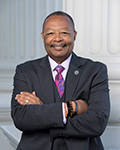
Photo of Reggie Jones-Sawyer
D California Assembly · District 57 · Former member

Asm. Reggie Jones-Sawyer

Contact Email
Compare
Total votes
26,638
all sessions
Attendance
97%
781 missed
Near the chamber average
With party
99%
of cast votes
Near the chamber average
Bipartisan score
0%
crosses aisle rarely
Near the chamber average
Sponsored
2,128
bills & resolutions
Near the chamber average
Committees
0
assignments
2,128 bills and resolutions

Sponsored bills

Total
2,128
Primary
269
Co-sponsor
1,859
This page
2,128
matching current filters
Primary AB 2854
In committee · California Assembly · Lead sponsor
Public employment: disqualification from employment.

Existing law disqualifies, for 5 years, any person employed at will for the purposes of providing services to an elected public officer from any public employment, including, but not limited to, employment with a city, county, district, or any other public agency of this state, if that person is convicted of a felony involving accepting or giving, or offering to give, any bribe, the embezzlement of public money, extortion or theft of public money, perjury, or conspiracy to commit any of those crimes arising directly out of the duties of that person as a public employee. This bill would make nonsubstantive changes to those provisions.

In committee Feb 19, 2022 0 co-sponsors
Primary AB 2831
In committee · California Assembly · Lead sponsor
Sheriffs.

Existing law sets forth the duties of a sheriff and requires a sheriff to command the aid of as many inhabitants of the sheriff's county as they think necessary in the execution of their duties. This bill would make nonsubstantive changes to that provision.

In committee Feb 19, 2022 0 co-sponsors
Co-sponsor AB 616
Vetoed · California Assembly · Co-sponsor
Agricultural labor relations: labor representative elections: representation ballot card election.

Existing law, the Alatorre-Zenovich-Dunlap-Berman Agricultural Labor Relations Act of 1975, grants agricultural employees the right to form and join labor organizations and engage in collective bargaining with respect to wages, terms of employment, and other employment conditions, and authorizes employees to elect exclusive bargaining representatives for these purposes. Existing law requires the Agricultural Labor Relations Board to certify the results of an election conducted by secret ballot of employees in a collective bargaining unit to designate a collective bargaining representative, unless the board determines there are sufficient grounds to refuse to do so. Existing law further provides that if the board refuses to certify an election because of employer misconduct that would render slight the chances of a new election reflecting the free and fair choice of employees, the labor organization shall be certified as the bargaining representative for the bargaining unit. This bill would refer to the secret ballot election as a polling place election. This bill would also permit agricultural employees, as an alternative election procedure, to select their labor representatives through a representation ballot card election by submitting a petition to the board supported by representation ballot cards signed by a majority of employees in the bargaining unit. This bill would require the board to conduct an immediate investigation regarding the validity of the petition and the supporting representation ballot cards and, within 5 days after receiving a petition, to make an administrative decision as to whether the petition meets certain requirements and as to whether the labor organization submitted the requisite number of cards. The bill would require the board to certify the labor organization as the exclusive bargaining representative if the board determines that the labor organization has submitted the required number of representation ballot cards and the cards meet specified criteria. Existing law authorizes a person aggrieved by the final order of the board granting or denying in whole or in part the relief sought for an unfair labor practice, to obtain a review of the order in a specified court of appeal by filing in the court a written petition requesting that the order of the board be modified or set aside. This bill would require an employer who appeals or petitions for a writ of review of any order of the board involving make-whole, backpay, or other monetary awards to employees, to post an appeal bond in the amount of the entire economic value of the order, as specified, and would provide for the bond to be forfeited under specified conditions. This bill would state that its provisions are severable.

Vetoed Feb 3, 2022 1 co-sponsor
Co-sponsor AB 314
died · California Assembly · Co-sponsor
Collective bargaining: Legislature.

Existing law, the Ralph C. Dills Act (Dills Act) , governs collective bargaining between the state and recognized state public employee organizations. Existing law excludes certain employees from coverage under the Dills Act, including, among others, managerial employees, supervisory employees, and confidential employees, as defined. Existing law creates the Public Employment Relations Board and authorizes it, among other things, to determine appropriate state employee bargaining units, as specified. This bill would enact the Legislature Employer-Employee Relations Act, to provide employees of the Legislature, including some supervisory and managerial employees, the right to form, join, and participate in the activities of employee organizations of their own choosing for the purpose of representation on all matters of employer-employee relations. The bill would prescribe rights, duties, and prohibitions in this context that parallel those in the Dills Act. The bill would prohibit the Public Employment Relations Board from including employees of the Legislature in a bargaining unit that includes employees other than those of the Legislature. The bill would make it a misdemeanor for any person to willfully resist, prevent, impede, or interfere with any member of the board, or any of its agents, in the performance of duties pursuant to its provisions. By expanding the definition of a crime, this bill would impose a state-mandated local program. The bill would provide that the provisions of the Legislature Employer-Employee Relations Act are severable. The California Constitution requires the state to reimburse local agencies and school districts for certain costs mandated by the state. Statutory provisions establish procedures for making that reimbursement. This bill would provide that no reimbursement is required by this act for a specified reason.


died Feb 1, 2022 1 co-sponsor
Primary AB 1366
died · California Assembly · Lead sponsor
Crimes: sex offenses.

Existing law, the Sex Offender Registration Act, requires a person convicted of one of certain crimes, as specified, to register with law enforcement as a sex offender while residing in California or while attending school or working in California, as specified. This bill would make technical, nonsubstantive changes to those provisions.

died Feb 1, 2022 0 co-sponsors
Primary AB 696
died · California Assembly · Lead sponsor
Controlled substances.

Existing law prohibits the possession, as specified, of certain controlled substances. This bill would make a technical, nonsubstantive change to those provisions.

died Feb 1, 2022 0 co-sponsors
Showing 691 to 700 of 2,128 bills
Previous 1 … 69 70 71 … 213 Next