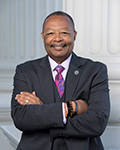
Photo of Reggie Jones-Sawyer
D California Assembly · District 57 · Former member

Asm. Reggie Jones-Sawyer

Contact Email
Compare
Total votes
26,638
all sessions
Attendance
97%
781 missed
Near the chamber average
With party
99%
of cast votes
Near the chamber average
Bipartisan score
0%
crosses aisle rarely
Near the chamber average
Sponsored
2,128
bills & resolutions
Lower than 76% of chamber peers
Committees
0
assignments
2,128 bills and resolutions

Sponsored bills

Total
2,128
Primary
269
Co-sponsor
1,859
This page
2,128
matching current filters
Primary AB 2572
In committee · California Assembly · Lead sponsor
Vehicle liens.

Existing law grants a person a lien on a vehicle, dependent upon possession, for the compensation connected with repairing, furnishing supplies, storing, or renting parking space for that vehicle. Existing law establishes how the lien arises and how it may be extinguished. This bill would make a nonsubstantive change in these provisions.

In committee Feb 22, 2016 0 co-sponsors
Primary AB 2264
In committee · California Assembly · Lead sponsor
Teachers: training and support.

Existing law establishes the California Beginning Teacher Support and Assessment System to, among other things, provide an effective transition into the teaching career for first-year and 2nd-year teachers. This bill would express the Legislature's intent to enact legislation that would support the development of a professional system of training and support for new and existing teachers focused on creating and maintaining effective environments for pupil learning and that would ensure the training is aligned with certain performance expectations.

In committee Feb 19, 2016 0 co-sponsors
Primary AB 2118
In committee · California Assembly · Lead sponsor
Meyers-Milias-Brown Act: regulations.

The Meyers-Milias-Brown Act, among other things, authorizes local public agencies to adopt reasonable rules and regulations after consultation in good faith with representatives of a recognized employee organization or organizations for the administration of employer-employee relations under the act, which may include specified provisions. This bill would make nonsubstantive changes to this provision.

In committee Feb 18, 2016 0 co-sponsors
Co-sponsor AB 21
Signed into law · California Assembly · Co-sponsor
Medical marijuana: cultivation licenses.

Existing law, the Compassionate Use Act of 1996, an initiative measure enacted by the approval of Proposition 215 at the November 5, 1996, statewide general election, authorizes the use of marijuana for medical purposes. Existing law, enacted by the Legislature, provides for the licensing and regulation by both state and local entities of medical marijuana and its cultivation. Existing law provides that if a city, county, or city and county does not have land use regulations or ordinances regulating or prohibiting the cultivation of marijuana, commencing March 1, 2016, the Department of Food and Agriculture is the sole licensing authority for medical marijuana cultivation applicants in that city, county, or city and county. This bill would delete the provision that grants the department the sole licensing authority under those circumstances. Existing law exempts certain persons cultivating medical marijuana from the requirement to obtain both a state license from the Department of Food and Agriculture and a license, permit, or other entitlement allowing cultivation from the city, county, or city and county in which the cultivation will occur. Existing law authorizes a city, county, or city and county to regulate or ban the cultivation, storage, manufacture, transport, provision, or other activity by a person otherwise exempt from state regulation, or to enforce that regulation or ban. This bill would instead provide that an exemption from these licensure requirements does not limit or prevent a city, county, or city and county from exercising its police power authority under a specified provision of the California Constitution. This bill would declare that it is to take effect immediately as an urgency statute.

Signed into law Feb 3, 2016 1 co-sponsor
Co-sponsor SB 243
In committee · California Senate · Co-sponsor
Medi-Cal: reimbursement: provider rates.

(1) Existing law establishes the Medi-Cal program, administered by the State Department of Health Care Services, under which health care services are provided to qualified, low-income persons. The Medi-Cal program is, in part, governed and funded by federal Medicaid provisions. Existing law requires the department to develop and implement a Medi-Cal inpatient hospital reimbursement payment methodology based on diagnosis-related groups, subject to federal approval, that reflects the costs and staffing levels associated with quality of care for patients in all general acute care hospitals, as specified. Existing law generally requires the diagnosis-related group-based payments to apply to all claims. This bill would require claims for payments pursuant to the inpatient hospital reimbursement methodology described above to be increased by 16% for the 2015–16 fiscal year, and would require, commencing July 1, 2016, and annually thereafter, the department to increase each diagnosis-related group payment claim amount based, at a minimum, on increases in the medical component of the California Consumer Price Index. Commencing with the 2015–16 fiscal year, and annually thereafter, the bill would require managed care rates for Medi-Cal managed care health plans to be increased by a proportionately equal amount for increased payments for hospital services. (2) Existing law requires, except as otherwise provided, Medi-Cal provider payments to be reduced by 1% or 5%, and provider payments for specified non-Medi-Cal programs to be reduced by 1%, for dates of service on and after March 1, 2009, and until June 1, 2011. Existing law requires, except as otherwise provided, Medi-Cal provider payments and payments for specified non-Medi-Cal programs to be reduced by 10% for dates of service on and after June 1, 2011. This bill would, instead, prohibit the application of those reductions for payments to providers for dates of service on or after June 1, 2011. The bill would also require payments for managed care health plans for dates of service following the effective date of the bill to be determined without application of some of those reductions. The bill would require the Director of Health Care Services to implement this provision to the maximum extent permitted by federal law and for the maximum time period for which the director obtains federal approval for federal financial participation for those payments. (3) Prior law required, beginning January 1, 2013, through and including December 31, 2014, that payments for primary care services provided by specified physicians be no less than 100% of the payment rate that applies to those services and physicians as established by the Medicare program, for both fee-for-service and managed care plans. This bill, commencing January 1, 2016, would require payments for specified medical care services to not be less than 100% of the payment rate that applies to those services as established by the Medicare program for services rendered by fee-for-service providers, and would require rates paid to Medi-Cal managed care plans to be actuarially equivalent to payment rates established by the Medicare program. The bill, commencing January 1, 2016, would require rates paid to Denti-Cal providers for dental services provided to adults and children to be increased by the equivalent percentage as the percentage increase required for other fee-for-service Medi-Cal providers. The bill would require those provisions to be implemented only to the extent permitted by federal law and that federal financial participation is available. The bill would authorize the department to implement those provisions through provider bulletins without taking regulatory action until regulations are adopted, and would require the department to adopt those regulations by July 1, 2018. The bill would require, commencing July 1, 2016, the department to provide a status report to the Legislature on a semiannual basis until regulations have been adopted. (4) This bill would declare that it is to take effect immediately as an urgency statute.


In committee Feb 1, 2016 1 co-sponsor
Primary AB 1106
Failed · California Assembly · Lead sponsor
Criminal procedure: arraignment pilot program.

Existing law requires the magistrate, on motion of counsel for the defendant or the defendant, when the defendant is in custody at the time he or she appears before the magistrate for arraignment and the public offense is a misdemeanor to which the defendant has pleaded not guilty, to determine whether there is probable cause to believe that a public offense has been committed and that the defendant is guilty of that offense. Existing law requires the determination of probable cause to be made immediately, unless the court grants a continuance not to exceed 3 court days, for good cause. This bill would require the Judicial Council to establish a 5-year pilot project in 6 counties, as specified, that would require a court to apply those same procedures in the case of an arraignment of a defendant who is not in custody for a public offense that is a misdemeanor to which the defendant has pleaded not guilty.

Failed Feb 1, 2016 0 co-sponsors
Primary AB 926
Failed · California Assembly · Lead sponsor
Parole: Safe Communities Grant Program.

Existing law governs the length and conditions of parole and establishes the Board of Parole Hearings to carry out various duties relating to parole, including conducting parole consideration hearings, parole rescission hearings, and parole progress hearings for adults and juveniles under the jurisdiction of the Department of Corrections and Rehabilitation, reviewing inmates' requests for reconsideration of the denial of good-time credit and setting of parole length or conditions, and making every order granting and revoking parole and issuing final discharges to any person under the jurisdiction of the department. This bill would require the department to establish rules and regulations for implementing an earned compliance credit program that would reduce the period of parole supervision of eligible persons, as specified, upon compliance with their parole conditions. The bill would provide that for each full calendar month of compliance with the conditions of parole supervision, earned compliance credits equal to the number of days in that month shall be deducted from the eligible parolee's parole discharge date. The bill would also specify the circumstances under which credits would not accrue, including when a parolee has been arrested for a new offense, except as specified. The bill would also require the department to provide annually to the Director of Finance and the Legislative Analyst's Office specified data regarding the program, including the number and percentage of parolees who qualified for the earned compliance credit program and the total amount of credits earned by parolees within the year. The bill would establish the Safe Communities Grant Program to be administered by the Department of Corrections and Rehabilitation in consultation with specified state entities, to allocate moneys to counties, by January 1 of each fiscal year beginning in 2018, to provide support for employment and housing for parolees, as specified. The bill would also establish the continuously appropriated Safe Communities Grant Program Fund within the State Treasury for purposes of the program. The bill would require, on or before July 31, 2017, and on or before July 31 of each fiscal year thereafter, the Director of Finance to calculate the savings accrued to the state from the implementation of the earned compliance credit program and to certify the results of the calculation to the Controller no later than August 1 of each fiscal year. The bill would require the Controller, before August 31, 2017, and before August 31 of each fiscal year thereafter, to transfer that amount from the General Fund to the Safe Communities Grant Program Fund. The bill would also require, every 2 years, beginning in 2019, the Controller to conduct an audit of the Safe Communities Grant Program Fund to ensure the funds are disbursed and expended solely according to the requirements of the bill and to report his or her findings to the Legislature and make them available to the public. The bill would also require that any costs incurred by the Director of Finance and the Controller in connection with the administration of the Safe Communities Grant Program Fund, including the costs of the required calculation and the audit, be deducted from the Safe Communities Grant Program Fund before the funds are disbursed, as specified. By establishing the continuously appropriated Safe Communities Grant Program Fund, and by directing the Controller to transfer funds from the General Fund to that fund, the bill would make an appropriation.

Failed Feb 1, 2016 0 co-sponsors
Primary AB 324
Failed · California Assembly · Lead sponsor
Trial jurors: eligibility.

Existing law excludes from jury service a person who has been convicted of malfeasance in office. Existing law also excludes from jury service a felon whose civil rights have not been restored. This bill would instead exclude a felon who has not completed probation, parole, post-release community supervision, or mandatory supervision. This bill would also categorically exclude a person who has been convicted of bribery, perjury, forgery, or other high crimes.

Failed Feb 1, 2016 0 co-sponsors
Co-sponsor AB 206
Failed · California Assembly · Co-sponsor
Student financial aid: California DREAM Work-Study Program.

Existing law establishes the Student Aid Commission as the primary state agency for the administration of state-authorized student financial aid programs available to students attending all segments of postsecondary education. This bill, commencing with the 2016–17 fiscal year, would establish the California DREAM Work-Study Program under the administration of the California State University and University of California to provide financial aid for students meeting its requirements. These requirements would include: enrollment, or acceptance for enrollment, at a campus of the California State University or the University of California; exemption from nonresident tuition pursuant to a specified provision of existing law or an equivalent provision adopted by the Regents of the University of California; making a timely application for financial aid using a designated application; qualification under applicable income and need standards applied to work-study programs at the institution at which the student is enrolled or accepted for enrollment; and meeting additional eligibility requirements as may be deemed appropriate by the institution at which the student is enrolled or accepted for enrollment. The bill would deem a student who participates in other work-study programs ineligible to receive financial aid under the California Dream Work-Study Program. To participate in the program, the bill would require, upon verification that a student is eligible for financial aid under this program, that the California State University and the University of California match 100% of the cost of the work-study grant of a student whose work under the program is accomplished on a campus of the respective university or at a campus or other facility of a school district or community college district, or 50% of the cost of the work-study grant of a student whose work under the program is accomplished at any other location.

Failed Feb 1, 2016 1 co-sponsor
Primary AB 1128
died · California Assembly · Lead sponsor
Water conservation.

Existing law declares the intent of the Legislature to, among other things, promote urban water conservation standards that are consistent with the California Urban Water Conservation Council's adopted best management practices and specified requirements for demand management. This bill would make nonsubstantive changes to these findings and declarations.

died Feb 1, 2016 0 co-sponsors
Showing 1,731 to 1,740 of 2,128 bills