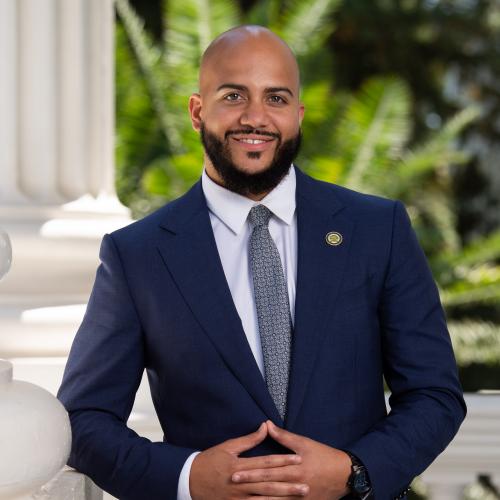
Photo of Isaac Bryan
D California Assembly · District 55 On the 2026 ballot

Asm. Isaac Bryan

Compare
Total votes
17,249
all sessions
Attendance
93%
744 missed
Near the chamber average
With party
99%
of cast votes
Near the chamber average
Bipartisan score
0%
crosses aisle rarely
Near the chamber average
Sponsored
1,230
bills & resolutions
Near the chamber average
Committees
12
assignments
1,230 bills and resolutions

Sponsored bills

Total
1,230
Primary
117
Co-sponsor
1,113
This page
1,230
matching current filters
Co-sponsor HR 71
Passed · California Assembly · Co-sponsor
Relative to National Fried Rice Day.

Maddy summaryThis symbolic resolution recognizes September 20, 2025, as National Fried Rice Day in California, highlighting the dish's cultural significance to Asian American communities and its connection to California's rice-growing economy (noting the state's status as the second-largest rice producer). It has no legal effect or policy changes - it serves solely to celebrate culinary traditions and community diversity. The resolution was adopted by the California Assembly with no opposing votes.

Passed Sep 4, 2025 1 co-sponsor
Co-sponsor HR 65
Passed · California Assembly · Co-sponsor
Relative to Filipino American History Month.

Maddy summaryThis House Resolution designates a month as Filipino American History Month in California. It recognizes the historical contributions of Filipino Americans to the state, including early settlement (dating to 1587), agricultural labor, community building (such as "Little Manila" in Stockton), and military service during World War II. As a symbolic resolution, it does not create new laws, policies, or direct effects on any specific group.

Passed Sep 2, 2025 1 co-sponsor
Co-sponsor SB 52
Passed · California Senate · Co-sponsor
Housing rental terms: algorithmic devices.

Existing law governs the hiring of residential dwelling units and requires a landlord to provide specified notice to tenants prior to an increase in rent. Existing law, the Costa-Hawkins Rental Housing Act, prescribes statewide limits on the application of local rent control with regard to certain properties. That act, among other things, authorizes an owner of residential real property to establish the initial and all subsequent rental rates for a dwelling or unit that meets specified criteria, subject to certain limitations. This bill would make it unlawful for any person to sell, license, or otherwise provide to 2 or more persons a rental pricing algorithm, as defined, with the intent or reasonable expectation that it be used by 2 or more persons, as specified, to set rental terms, as defined, for residential premises. The bill would make it unlawful for a person to set or adopt rental terms based on the recommendation of a rental pricing algorithm if the person knows or should know that the rental pricing algorithm processes nonpublic competitor data, as defined, to set rental terms and that the pricing algorithm or the recommendation of the algorithm was used by another person to set or recommend a rental term for residential premises in the same market. Existing law establishes the Attorney General as the head of the Department of Justice, with charge of all legal matters in which the state is interested, except as specified. Existing law imposes various requirements on the Attorney General related to consumer protection, including, among others, the supervision of charitable trusts and the enforcement of antitrust laws. This bill would authorize the Attorney General, and the city attorney or county counsel in the jurisdiction in which the rental unit is located, to file a civil action for a violation of the bill, as specified, and would authorize a person who is harmed by a violation of the bill to file a civil action, as specified.

Passed Aug 29, 2025 1 co-sponsor
Co-sponsor AB 785
Passed · California Assembly · Co-sponsor
Community Violence Interdiction Grant Program.

Existing law establishes the California Violence Intervention and Prevention Grant Program, administered by the Board of State and Community Corrections, to award competitive grants for the purpose of violence intervention and prevention. Existing law establishes the Youth Reinvestment Grant Program within the Board of State and Community Corrections to grant funds, upon appropriation, to local jurisdictions and Indian tribes for the purpose of implementing trauma-informed diversion programs for minors, as specified. Existing law requires the governing board of a school district to give diligent care to the health and physical development of pupils and authorizes the governing board of a school district to employ properly certified persons for the work. Existing law requires a school of a school district or county office of education and a charter school to notify pupils and parents or guardians of pupils no less than twice during the school year on how to initiate access to available pupil mental health services on campus or in the community, or both, as provided. Existing law requires the State Department of Public Health, in cooperation with the State Department of Education, to establish a Public School Health Center Support Program, upon appropriation by the Legislature, to assist school health centers, which are defined as centers or programs, located at or near local educational agencies, that provide age-appropriate health care services at the program site or through referrals, as specified. This bill would create the Community Violence Interdiction Grant Program to be administered by the California Health and Human Services Agency to provide funding to local community programs for community-driven solutions to decrease violence in neighborhoods and schools. The bill would specify the types of programs the grant funds may be used for, including, but not limited to, programs that create and enhance recreation- and health-based interventions for youth during peak times of violence and the creation and operation of school-based health centers. The bill would require the agency to develop an application process and criteria for funding and would require the agency to administer the grant program, as specified. The bill would require, beginning July 31, 2026, and annually thereafter, the Director of Finance and the Legislative Analyst's Office to calculate the savings to the state from the closure of state prisons, as specified, and would require the Director of Finance to certify the results of the calculation to the Controller no later than August 1 of each fiscal year. The bill would create the Community Violence Interdiction Grant Fund and would require moneys in the fund to be made available, only upon appropriation by the Legislature, to the agency for the purposes of the Community Violence Interdiction Grant Program. The bill would require that the Controller, before August 15, 2026, and annually thereafter, upon appropriation by the Legislature, transfer from the General Fund to the Community Violence Interdiction Grant Fund the total amount of savings from the closure of state prisons so calculated.

Passed Aug 29, 2025 1 co-sponsor
Primary AB 1456
Passed · California Assembly · Lead sponsor
California Environmental Quality Act: California Vegetation Treatment Program.

The California Environmental Quality Act (CEQA) requires a lead agency, as defined, to prepare, or cause to be prepared, and certify the completion of an environmental impact report (EIR) on a project that it proposes to carry out or approve that may have a significant effect on the environment or to adopt a negative declaration if it finds that the project will not have that effect. CEQA also requires a lead agency to prepare a mitigated negative declaration for a project that may have a significant effect on the environment if revisions in the project would avoid or mitigate that effect and there is no substantial evidence that the project, as revised, would have a significant effect on the environment. CEQA authorizes the preparation and certification of an EIR for a program, plan, policy, or ordinance, commonly known as a "program EIR," and requires a lead agency to examine later activities in the program in light of the program EIR to determine whether an additional environmental document is required to be prepared. This bill would require, on or before January 1, 2027, the State Board of Forestry and Fire Protection to update the California Vegetation Treatment Program Final Program Environmental Impact Report (FPEIR) to, among other things, expand the area that is treatable landscape under the FPEIR to portions of the state suitable for vegetation treatment consistent with the FPEIR, regardless of fire suppression responsibility designation, and recognize cultural burning conducted pursuant to a specified law as a covered treatment activity. The bill would authorize a public agency to partner with a federally recognized California Native American tribe to conduct a project under the FPEIR in the agency's jurisdiction.

Passed Aug 29, 2025 0 co-sponsors
Co-sponsor AB 380
Passed · California Assembly · Co-sponsor
Price gouging.

Under existing law, upon the proclamation of a state of emergency by the President of the United States or the Governor, or upon the declaration of a local emergency by the executive officer of any county, city, or city and county, and for 30 days or 180 days, as specified, following the proclamation or declaration of emergency, it is a misdemeanor, punishable by up to one year in county jail, a fine of $10,000, or both that imprisonment and fine, for a person, contractor, business, or other entity to sell or offer to sell certain goods or services for a price of more than 10% greater than the price charged by that person immediately prior to the proclamation or declaration of emergency. This bill would instead make that misdemeanor applicable, for those provisions for which the misdemeanor is applicable for a period of 30 days following the proclamation or declaration of emergency, for a period of 60 days. The bill would, for an entity or person other than a natural person, make that misdemeanor punishable by a fine of $25,000. By expanding the scope of a crime, this bill would impose a state-mandated local program. Under existing law, as described above, it is unlawful to increase the rental price for housing by more than 10%, or evict any residential tenant of residential housing, upon the proclamation or declaration of emergency. Existing law defines "housing" for purposes of these provisions as any rental housing with an initial lease term of no longer than one year. This bill would expand the definition of "housing" to include any rental housing without regard to the length of the initial lease term. The bill would make the prohibitions on increasing the rental price by more than 10% and eviction generally applicable to commercial real property. By expanding the scope of a crime, this bill would impose a state-mandated local program. The California Constitution requires the state to reimburse local agencies and school districts for certain costs mandated by the state. Statutory provisions establish procedures for making that reimbursement. This bill would provide that no reimbursement is required by this act for a specified reason.


Passed Aug 29, 2025 1 co-sponsor
Co-sponsor ACR 30
Signed into law · California Assembly · Co-sponsor
Relative to Black History Month.

This measure would recognize February 2025 as Black History Month, urge all citizens to join in celebrating the accomplishments of African Americans during Black History Month, and encourage the people of California to recognize the many talents of African Americans and the achievements and contributions they make to their communities to create equity and equality for education, economics, and social justice. The measure would also recognize the significance in protecting citizens' right to vote and remedying racial discrimination in voting.

Signed into law Aug 29, 2025 1 co-sponsor
Co-sponsor SB 510
Signed into law · California Senate · Co-sponsor
Pupil instruction: treatment of African Americans.

Existing law establishes the Instructional Quality Commission and requires the commission to, among other things, recommend curriculum frameworks to the State Board of Education. Existing law requires the commission, when the history-social science curriculum framework is next revised, on or after January 1, 2025, to consider providing for inclusion, in that curriculum framework, related evaluation criteria, and accompanying instructional materials, of instruction on the treatment and perspectives of Native Americans during the Spanish colonization of California and the Gold Rush Era. This bill would require the commission, when the state board next revises the history-social science curriculum framework or adopts new instructional materials, on or after January 1, 2026, to consider including content on the historical, social, economic, and political contributions of African Americans during the Spanish colonization of California, the Gold Rush Era, and Antebellum, as provided.

Signed into law Aug 28, 2025 1 co-sponsor
Co-sponsor HR 57
Passed · California Assembly · Co-sponsor
Relative to Transgender History Month.

Maddy summaryThis is a commemorative resolution, not a bill with policy changes. It recognizes key historical milestones of transgender people in California, including Indigenous gender diversity documented in 1775, 19th-century transgender figures in San Francisco's Tenderloin, early activism like the 1959 Cooper Do-nuts Riot, and legal precedents such as Sir Lady Java's 1967 employment discrimination case. The resolution has no binding effect and does not create new laws or directly affect any individuals or groups. It serves solely to honor these historical contributions.

Passed Aug 25, 2025 1 co-sponsor
Co-sponsor HR 62
Passed · California Assembly · Co-sponsor
Relative to Student Parent Month.

Maddy summaryThis House Resolution designates September as "Student Parent Month" in California. It recognizes the approximately 400,000 student parents across the state - over half a million children - and aims to raise awareness of their needs. The resolution does not create new policies or funding but encourages colleges, policymakers, and communities to honor student parents and support their educational success. It follows California’s prior legislative actions (like AB 2881 and AB 2458) that established concrete support mechanisms for student parents.

Passed Aug 25, 2025 1 co-sponsor
Showing 301 to 310 of 1,230 bills
Previous 1 … 30 31 32 … 123 Next