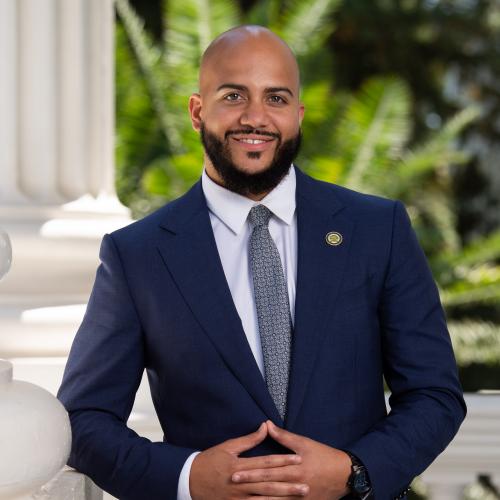
Photo of Isaac Bryan
D California Assembly · District 55 On the 2026 ballot

Asm. Isaac Bryan

Compare
Total votes
17,249
all sessions
Attendance
93%
744 missed
Near the chamber average
With party
99%
of cast votes
Near the chamber average
Bipartisan score
0%
crosses aisle rarely
Near the chamber average
Sponsored
1,230
bills & resolutions
Near the chamber average
Committees
12
assignments
1,230 bills and resolutions

Sponsored bills

Total
1,230
Primary
117
Co-sponsor
1,113
This page
1,230
matching current filters
Co-sponsor ACR 105
Signed into law · California Assembly · Co-sponsor
Relative to the music industry in California.

This measure would recognize the contributions of the music industry to the economic and cultural well-being of the state, its population, and its overall reputation as a worldwide leader in artistic and creative freedom.

Signed into law Sep 23, 2025 1 co-sponsor
Co-sponsor AB 238
Signed into law · California Assembly · Co-sponsor
Mortgage forbearance: state of emergency: wildfire.

Existing law requires a mortgage servicer to comply with applicable federal guidance regarding borrower options following a forbearance relating to the COVID-19 emergency. This bill would authorize a borrower who is experiencing financial hardship that prevents the borrower from making timely payments on a specified residential mortgage loan due directly to the wildfire disaster described in the proclamation of a state of emergency issued by Governor Gavin Newsom on January 7, 2025, or the federally declared disaster, declared on January 8, 2025, related to the Eaton Wildfire, the Palisades Fire, and the Straight-line Winds, to request forbearance on their residential mortgage loan, as prescribed. The bill would limit eligibility for that forbearance to loans that are secured by residential real property improved by 4 or fewer residential units. The bill would require the borrower to affirm that they are experiencing a financial hardship due to the wildfire disaster. Because the bill would expand the crime of perjury, the bill would impose a state-mandated local program. This bill would, except as specified, require a mortgage servicer to offer mortgage payment forbearance of a period of up to an initial 90 days, which shall be extended at the request of the borrower in 90-day increments, up to a maximum forbearance period of 12 months. The bill would also prohibit a mortgage servicer from assessing any late fees to the borrower's account or charging a default rate of interest during the forbearance period. The bill would provide that the forbearance period includes any period of forbearance related to the wildfire disaster that a mortgage servicer has provided to a borrower before the effective date of these provisions. The bill would require a mortgage servicer to report the credit obligations of borrowers under a disaster-related forbearance plan in compliance with the federal Fair Credit Reporting Act. For accounts granted disaster-related mortgage payment relief, the bill would prohibit mortgage servicers from furnishing information during the forbearance period indicating that the payments are in forbearance and would require them to report the credit obligation or account as current or delinquent, as specified. The bill would prohibit a mortgage servicer from initiating any judicial or nonjudicial foreclosure process, moving for a foreclosure judgment or order of sale, or executing a foreclosure-related eviction or foreclosure during the period of forbearance. This bill would require the Department of Financial Protection and Innovation to post specified information on its website including links to the provisions of servicing guidelines pertaining to disaster-related forbearance relief for federally backed loans and a dedicated telephone number for borrowers seeking assistance. The California Constitution requires the state to reimburse local agencies and school districts for certain costs mandated by the state. Statutory provisions establish procedures for making that reimbursement. This bill would provide that no reimbursement is required by this act for a specified reason. This bill would declare that it is to take effect immediately as an urgency statute.

Signed into law Sep 22, 2025 1 co-sponsor
Co-sponsor AB 49
Signed into law · California Assembly · Co-sponsor
Schoolsites: immigration enforcement.

(1) Existing law prohibits, except as required by state or federal law or as required to administer a state or federally supported educational program, school officials and employees of a school district, county office of education, or charter school from collecting information or documents regarding citizenship or immigration status of pupils or their family members. Existing law requires the superintendent of a school district, the superintendent of a county office of education, and the principal of a charter school, as applicable, to report to the respective governing board or body of the local educational agency in a timely manner any requests for information or access to a schoolsite by an officer or employee of a law enforcement agency for the purpose of enforcing the immigration laws in a manner that ensures the confidentiality and privacy of any potentially identifying information. This bill would prohibit school officials and employees of a local educational agency from allowing an officer or employee of an agency conducting immigration enforcement to enter a nonpublic area of a schoolsite, as defined, for any purpose without being presented with a valid judicial warrant, judicial subpoena, or a court order. The bill would require school officials and employees of a local educational agency, to the extent practicable, to request valid identification of any officer or employee of an agency conducting immigration enforcement seeking to enter a nonpublic area of a schoolsite. The bill would also prohibit a local educational agency and its personnel from disclosing or providing, in writing, verbally, or in any other manner, the education records of or any information about a pupil or a pupil's family and household without the pupil's parents' or guardians' written consent, a school employee, or a teacher to an officer or employee of an agency conducting immigration enforcement without a valid judicial warrant or judicial subpoena, or court order directing the local educational agency or its personnel to do so. By imposing additional duties on local educational agencies, the bill would impose a state-mandated local program. (2) Existing law requires the Attorney General, by April 1, 2018, in consultation with the appropriate stakeholders, to publish model policies limiting assistance with immigration enforcement at public schools, to the fullest extent possible consistent with federal and state law, and ensuring that public schools remain safe and accessible to all California residents, regardless of immigration status, as provided. Existing law requires local educational agencies, by July 1, 2018, to adopt those model policies developed by the Attorney General or equivalent policies. This bill would require the Attorney General, by December 1, 2025, to update those model policies to ensure that the policies align with the above-described prohibitions on school officials and employees of local educational agencies allowing an officer or employee of an agency conducting immigration enforcement to enter a nonpublic area of a schoolsite without a valid judicial warrant or judicial subpoena, or a court order and from disclosing or providing certain information to those officers or employees, as provided. The bill also would require a local educational agency to update its model policy by March 1, 2026, and to make the policy available to the State Department of Education upon request. By imposing additional duties on local educational agencies, the bill would impose a state-mandated local program. (3) This bill would make these provisions severable. (4) The California Constitution requires the state to reimburse local agencies and school districts for certain costs mandated by the state. Statutory provisions establish procedures for making that reimbursement. This bill would provide that, if the Commission on State Mandates determines that the bill contains costs mandated by the state, reimbursement for those costs shall be made pursuant to the statutory provisions noted above. (5) This bill would declare that it is to take effect immediately as an urgency statute.

Signed into law Sep 20, 2025 1 co-sponsor
Co-sponsor SB 627
Signed into law · California Senate · Co-sponsor
Law enforcement: masks.

Existing law makes it a misdemeanor to wear a mask, false whiskers, or any personal disguise, as specified, with the purpose of evading or escaping discovery, recognition, or identification while committing a public offense, or for concealment, flight, evasion, or escape from arrest or conviction for any public offense. This bill would make it a crime for a law enforcement officer to wear a facial covering in the performance of their duties, except as specified. The bill would define law enforcement officer as anyone designated by California law as a peace officer who is employed by a city, county, or other local agency, and any officer or agent of a federal law enforcement agency or law enforcement agency of another state, or any person acting on behalf of a federal law enforcement agency or agency of another state. The bill would make a violation of these provisions punishable as an infraction or a misdemeanor, as specified. By creating a new crime, this bill would impose a state-mandated local program. The bill would require any law enforcement agency operating in California to, by July 1, 2026, maintain and publicly post a written policy limiting the use of facial coverings, as specified. The bill would exempt personnel of any agency from the crime of wearing a facial covering if an agency maintains a policy pursuant to this section no later than July 1, 2026. The bill would deem a policy consistent with these provisions for the purposes of that exception unless a member of the public, an oversight body, or a local governing authority challenges it. The bill would also impose a specified civil penalty against certain officers for tortious conduct, including, but not limited to, false imprisonment or false arrest of an individual while wearing a facial covering. The bill would, if the agency does not address deficiencies within 90 days, authorize the complaining party to proceed to a court of competent jurisdiction for a judicial determination of the exemption, as specified. The bill would define a law enforcement agency for these purposes as any entity of a city, county, or other local agency, that employs anyone designated by California law as a peace officer, any federal law enforcement agency, or any law enforcement agency of another state. By imposing additional duties on local law enforcement agencies, this bill would create a state-mandated local program. This bill would declare its provisions to be severable. This bill would make related findings and declarations. The California Constitution requires the state to reimburse local agencies and school districts for certain costs mandated by the state. Statutory provisions establish procedures for making that reimbursement. This bill would provide that with regard to certain mandates no reimbursement is required by this act for a specified reason. With regard to any other mandates, this bill would provide that, if the Commission on State Mandates determines that the bill contains costs so mandated by the state, reimbursement for those costs shall be made pursuant to the statutory provisions noted above.


Signed into law Sep 20, 2025 1 co-sponsor
Co-sponsor SB 352
Signed into law · California Senate · Co-sponsor
Environmental justice: Department of Justice: Bureau of Environmental Justice: community air monitoring.

Existing provisions of the California Constitution make the Attorney General, subject to the powers and duties of the Governor, the chief law officer of the state. Under existing law, the Attorney General may maintain an action for equitable relief in the name of the people of the State of California against any person for the protection of the natural resources of the state from pollution, impairment, or destruction. This bill would continue in existence in the Department of Justice a Bureau of Environmental Justice. Existing law requires the State Air Resources Board to prepare, in consultation with specified entities, a monitoring plan regarding the availability and effectiveness of toxic air contaminant and criteria air pollutant advanced sensing monitoring technologies and existing community air monitoring systems, as specified, and based on the findings and recommendations of that plan, select, in consultation with the air pollution control districts and air quality management districts, the highest priority locations around the state to deploy community air monitoring systems, as provided. This bill would require monitoring in a location selected by the state board to remain active for no fewer than 5 years, with an option for the air district and the state board to agree to extend active monitoring for additional 5-year periods, as necessary. The bill would require the state board to update the above-described monitoring plan by July 1, 2026, and every 5 years thereafter. The bill would require the update to be considered and approved by the state board before it is implemented. The bill would subject these requirement to available funding. The bill would require, by March 1, 2027, and annually thereafter, the state board, in consultation with the air districts, to report to specified committees of the Legislature about the progress the state board and the air districts have made in implementing these and other provisions, as specified. The bill would require the chair of the state board and the executive directors or air pollution control officers of the relevant air districts to appear before the relevant policy committees of the Legislature to present on the progress in implementing those requirements. By imposing additional requirements on air districts, this bill would impose a state-mandated local program. The California Constitution requires the state to reimburse local agencies and school districts for certain costs mandated by the state. Statutory provisions establish procedures for making that reimbursement. This bill would provide that, if the Commission on State Mandates determines that the bill contains costs mandated by the state, reimbursement for those costs shall be made pursuant to the statutory provisions noted above.
Signed into law Sep 19, 2025 1 co-sponsor
Co-sponsor AJR 5
Signed into law · California Assembly · Co-sponsor
Relative to birthright citizenship.

This measure would declare the Legislature's opposition to the unlawful Executive Order No. 14160, entitled "Protecting the Meaning and Value of American Citizenship," ending birthright citizenship as enshrined in the United States Constitution and would affirm the Legislature's commitment to birthright citizenship, as specified.

Signed into law Sep 16, 2025 1 co-sponsor
Co-sponsor ACR 32
Passed · California Assembly · Co-sponsor
Relative to March4Water Month.

This measure would declare the month of March to be March4Water Month in California and would encourage all Californians to participate in activities and programs during March4Water Month to promote awareness, education, and actions that prioritize water as a vital resource for the state's future.

Passed Sep 13, 2025 1 co-sponsor
Co-sponsor ACR 40
Passed Sep 13, 2025 1 co-sponsor
Showing 281 to 290 of 1,230 bills
Previous 1 … 28 29 30 … 123 Next