

Existing law establishes the California State University, under the administration of the Trustees of the California State University, and the University of California, under the administration of the Regents of the University of California, as 2 segments of public postsecondary education in the state. Existing law requires the Superintendent of Public Instruction to assist all school districts to ensure that all public high school pupils have access to a core curriculum that meets the admission requirements of the University of California and the California State University. Existing law requests the University of California to assist school districts in developing, submitting, and maintaining courses certified by the University of California as meeting admission requirement criteria, as provided. This bill would request the University of California to align the admission requirement criteria used in the review and certification of high school courses with the content standards, frameworks, and model curriculum adopted by the State Board of Education for the applicable subject area, as provided. Existing law states legislative intent for the University of California and California State University governing boards, in determining the standards and criteria for undergraduate and graduate admissions, to develop processes that strive to be fair and easily understandable, consider using criteria allowing eligible students with uncontrollable course deficiencies to enroll, and consult broadly with California's diverse communities, as provided. This bill would state legislative intent for those governing boards, in determining the standards and criteria for undergraduate admissions, to develop the standards and criteria based on the content standards, frameworks, and model curriculum adopted by the state board for the applicable subject area and to consult with the state board before adopting or changing the standards and criteria for undergraduate admission. Existing law requires the California State University, and requests the University of California, to establish a model uniform set of academic standards for high school courses for admission recognition and to develop and implement, by January 1, 2006, a process for high schools to obtain approval of courses meeting California State University and University of California admissions requirements, as provided. Existing law authorizes the faculty of the postsecondary segments to consult with elementary and secondary administrators and faculty when developing the model academic standards. This bill instead would encourage faculty of the postsecondary segments to (1) consult with the state board in developing the model academic standards, and (2) strive to align the standards with the content standards, frameworks, and model curriculum adopted by the state board for the applicable subject area, as specified. The bill would require the California State University, and request the University of California, to develop and implement, on or before January 1, 2028, a revised process for local educational agencies to annually submit courses for review and certification as a course that satisfies the model academic standards, as specified.
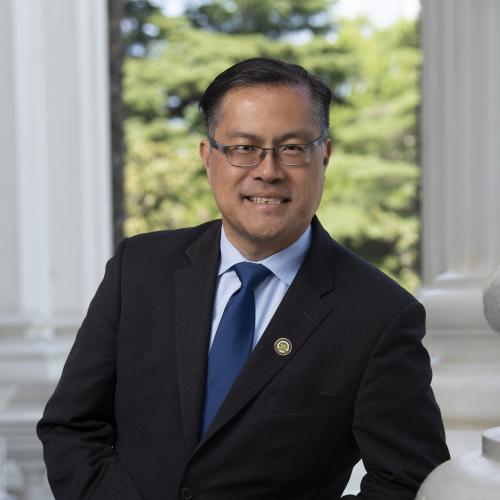
Asm. Mike Fong
Sponsored bills
Existing law appropriates $10,000,000 from the General Fund for the 2021–22 fiscal year to the Superintendent of Public Instruction to administer the Dual Language Immersion Grant Program for the purpose of expanding access to quality dual language learning and fostering languages that English learners bring to California's education system. Under that program, the State Department of Education is required to award a minimum of 25 one-time Dual Language Immersion Grants over a period of 3 fiscal years of up to $380,000 per grant to an eligible entity to expand or establish dual language immersion programs. This bill would establish the Dual Language Immersion Education Instructional Materials Grant Program, to be administered by the Superintendent, for purposes of providing one-time grants of $100,000 to school districts, county offices of education, and charter schools to increase available instructional materials in partner languages for dual language immersion programs at one or more schoolsites, as provided. The bill would require a grant recipient to report to the department, on or before June 29, 2029, on how grant funds were expended, including a list of any materials obtained or developed. The bill would require the department to submit a report to the appropriate policy and fiscal committees of the Legislature, on or before December 31, 2029, that includes the data received from the grant recipients. The bill would make implementation of these provisions contingent upon an appropriation by the Legislature for these purposes in the annual Budget Act or another statute.
Existing law establishes the Government Operations Agency, which consists of several state entities, including, but not limited to, the State Personnel Board, the Department of General Services, and the Office of Administrative Law. This bill, subject to an appropriation, would establish in the Government Operations Agency the California Education Interagency Council, composed of specified state officers for purposes of evaluating workforce and economic changes in the state, integrating and aligning education and employment systems, maximizing funding impact, supporting adult skill development, coordinating regional education and workforce needs, and serving as a forum for discussions of intersegmental and cross-sector policy issues, as specified. The bill would require the council, among other duties, to adopt strategic and work plans, report to the Governor and the Legislature on the outcomes of its work and recommendations to advance transitional kindergarten to postsecondary education, inclusive, intersegmental student pathway efforts aligned to careers, establish a faculty and employer advisory committee, and provide advice and recommend tools designed to support students across their educational careers, as specified. The bill, subject to an appropriation, would establish the Office of the California Education Interagency Council in the Government Operations Agency as a neutral administrative body tasked with supporting the California Education Interagency Council, as specified.
(1) Existing state and federal law, including the federal Voting Rights Act of 1965, require the Secretary of State and county elections officials to provide language assistance to voters in order to access voting information, register to vote, and cast their votes at the polling place. Existing law requires a county elections official to provide, as a reference for voters, a facsimile copy of the ballot with the ballot measures and ballot instructions printed in Spanish and other languages if the Secretary of State has determined that doing so is appropriate, as specified. This bill would require the Secretary of State, by December 15, 2029, and by December 15 of every subsequent year that immediately follows a year in which there is a presidential election, to determine the number of residents of voting age in each precinct who are members of a single language minority group and lack sufficient skills in English to vote without assistance and to post on the Secretary of State's website a list of languages used by single language minority groups that make up 3% or more of the voting-age residents of a particular county or precinct. For an election with a single language minority group that makes up 3% or more of the voting-age residents or if the Secretary of State otherwise finds sufficient reason to provide translated ballots, the bill would require elections officials, beginning January 1, 2030, to, among other things, provide ballots, ballot identification envelopes, and related notices and instructions in the language of an applicable language minority group. The bill would also make related, conforming changes. (2) Existing law requires an elections official, upon receiving a vote by mail ballot, to compare the signature on the identification envelope with the voter's signature appearing on specified voter registration records. Existing law requires the elections official to notify a voter whose signature does not match or who failed to sign the envelope of the opportunity to verify or provide a signature. The elections official is required to translate the notice and related instructions into all languages required for that county under the Voting Rights Act of 1965. This bill would instead require the Secretary of State to translate the notice, instructions, and voter statements to verify or provide a signature. (3) Existing law requires translations of ballots, ballot materials, and candidate statements printed in the county voter information guide to be made by a person with specified qualifications who is selected by the county elections official. This bill would authorize county elections officials to select a translator or interpreter, who has demonstrated experience in translating official or legal documents and has been referred by a nonprofit organization specializing in language access, legal aid, or community advocacy, to make those translations. (4) Existing law requires specified information to be publicly posted at each polling place, including information regarding the languages other than English in which members of the precinct board can assist voters. This bill would also require information regarding other available language assistance to be publicly posted at each polling place. (5) By increasing the duties of local elections officials, the bill would impose a state-mandated local program. The California Constitution requires the state to reimburse local agencies and school districts for certain costs mandated by the state. Statutory provisions establish procedures for making that reimbursement. This bill would provide that, if the Commission on State Mandates determines that the bill contains costs mandated by the state, reimbursement for those costs shall be made pursuant to the statutory provisions noted above.
The Personal Income Tax Law allows various credits against the taxes imposed by that law, including a young child tax credit to a qualified taxpayer in a specified amount multiplied by the earned income tax credit adjustment factor, as provided. That law also allows a payment from the continuously appropriated Tax Relief and Refund Account for an amount in excess of tax liability. Existing law defines "qualified taxpayer" for this purpose to include an eligible individual, as defined, who has a qualifying child, defined to be a child younger than 6 years of age as of the last day of the taxable year, and who meets other specified criteria. This bill, for taxable years beginning on or after January 1, 2025, would instead define a "qualifying child" to mean a child younger than a specified age as of the last day of the taxable year, as described. By increasing the payments from the Tax Relief and Refund Account, a continuously appropriated fund, the bill would make an appropriation. Existing law requires any bill authorizing a new tax expenditure to contain, among other things, specific goals that the tax expenditure will achieve, detailed performance indicators, and data collection requirements. This bill would include additional information required for any bill authorizing a new tax expenditure.
Maddy summarySCR 103 designates the week of July 20-26, 2025, as "Probation Services Week" in California. This concurrent resolution recognizes the work of probation services professionals across the state. It is a symbolic observance with no new laws, regulations, or direct impact on individuals or policies. The bill does not alter existing statutes or create obligations for any entity.
Existing law establishes the California Community Colleges, under the administration of the Board of Governors of the California Community Colleges as one of the 3 segments of public postsecondary education in the state. Existing law establishes uniform residency requirements for purposes of ascertaining the amount of tuition and fees to be paid by students of public postsecondary educational institutions. Existing law requires a student classified as a nonresident to pay nonresident tuition, in addition to other fees required by the institution, except as provided. This bill, the California Community Colleges Access and Continuity for Deported Students Act, would, until January 1, 2030, exempt a community college student from paying nonresident tuition if the student departs the United States on or after January 1, 2025, for specified reasons, was not paying nonresident tuition at the time of departure, provides an attestation of specified information related to the departure, and reenrolls in a community college online education program no later than 3 years from the date the student departed the United States. The bill, until January 1, 2030, would require a deported student, as defined, who resumes in-person education at a community college to be eligible to retain residency status for the purpose of determining tuition and fees, provided the student was previously classified as a resident and eligible for the nonresident tuition exemption at the time of departure, and would require the student to be eligible to apply for financial aid upon reenrollment. To the extent that the bill would impose new duties on community college districts, the bill would impose a state-mandated local program. The California Constitution requires the state to reimburse local agencies and school districts for certain costs mandated by the state. Statutory provisions establish procedures for making that reimbursement. This bill would provide that, if the Commission on State Mandates determines that the bill contains costs mandated by the state, reimbursement for those costs shall be made pursuant to the statutory provisions noted above. This bill would declare that it is to take effect immediately as an urgency statute.
Existing law establishes the Department of Housing and Community Development (HCD) and sets forth its powers and duties, including updating and revising the California Statewide Housing Plan, as provided. Existing law establishes the Office of Emergency Services (OES) , which is responsible for the state's emergency and disaster response services for natural, technological, or human-induced disasters and emergencies, including responsibility for activities necessary to prevent, respond to, recover from, and mitigate the effects of emergencies and disasters on people and property. This bill would require HCD to convene a state-led County of Los Angeles disaster housing task force, as specified, for the purpose of coordinating and streamlining efforts between HCD, the Federal Emergency Management Agency, OES, and local governments to rebuild housing in communities impacted by the wildfires that began on January 7, 2025, in the County of Los Angeles. The bill would require the task force to appoint a state disaster housing coordinator to accelerate the delivery of resources to communities impacted by the wildfires, and report to the Legislature on the status of rebuilding housing in communities impacted by the wildfires on April 1, 2026, and annually thereafter, as specified. The bill would repeal these provisions on June 30, 2028. This bill would make legislative findings and declarations as to the necessity of a special statute for the Counties of Los Angeles and Ventura. This bill would declare that it is to take effect immediately as an urgency statute.
Existing law establishes the Office of Small Business Advocate (OSBA) within the Governor's Office of Business and Economic Development, also known as GO-Biz, to advocate for causes of small business and to provide small businesses with the information they need to survive in the marketplace. This bill, upon appropriation by the Legislature, would require OSBA to allocate 90% of the moneys appropriated to the Small Business Recovery Fund, which would be created within the State Treasury, for purposes of a small business recovery grant program to provide competitive grants to small businesses, as defined, that are directly impacted by a state of emergency proclaimed by the Governor or other specified emergencies. The bill would require the funds to be used for, among other things, to support recovery and rebuilding efforts, and would require a grantee to match the amount of the grant awarded. The bill would require OSBA to award grants in amounts that range from $2,500 to $100,000, inclusive. This bill would require OSBA to allocate 5% of the moneys appropriated to the fund to the Small Business Technical Assistance Program administered by GO-Biz, for grants to small business technical assistance centers that provide direct service to disaster-affected areas, and 5% to the Capital Infusion Program administered by GO-Biz, to support increased demand for capital-related technical assistance in disaster areas. This bill would require the Director of the Office of Small Business Advocate to prepare and submit a report to the Legislature on the results of grant funds awarded for each state of emergency proclaimed by the Governor, as provided. This bill would repeal the Small Business Recovery Fund Act on January 1, 2032.
Maddy summaryThis bill establishes January as National Human Trafficking Awareness Month in California to raise public awareness about human trafficking. The resolution recognizes the severity of human trafficking as a felony crime and highlights statistics showing its prevalence across the country and specific challenges with identifying male victims and labor trafficking cases. It aims to educate the public and encourage reporting and support for victims during this designated month.