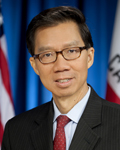
Photo of Ed Chau
D California Assembly · District 49 · Former member

Asm. Ed Chau

Compare
Total votes
22,709
all sessions
Attendance
98%
326 missed
Higher than 92% of chamber peers
With party
99%
of cast votes
Higher than 83% of chamber peers
Bipartisan score
0%
crosses aisle rarely
Lower than 88% of chamber peers
Sponsored
1,373
bills & resolutions
Lower than 90% of chamber peers
Committees
0
assignments
1,373 bills and resolutions

Sponsored bills

Total
1,373
Primary
191
Co-sponsor
1,182
This page
1,373
matching current filters
Primary ACR 148
Signed into law · California Assembly · Lead sponsor
Relative to the California Law Revision Commission.

Existing law requires the California Law Revision Commission to study, and limits the commission to studying, topics approved by resolution of the Legislature or by statute. This measure would grant approval to the commission to continue its study of designated topics that the Legislature previously authorized or directed the commission to study. The measure would also authorize and request the commission to study, report on, and prepare recommended legislation as soon as possible concerning the revision of the portions of the California Public Records Act and related provisions that would accomplish specified goals, including, among other things, reducing the length and complexity of current sections and clearly expressing legislative intent without any change in the substantive provisions. The measure would require the commission, before commencing work on any project within the calendar of topics the Legislature has authorized or directed the commission to study, to submit a detailed description of the scope of work to the chairs and vice chairs of the Assembly Committee on Judiciary and the Senate Committee on Judiciary, and any other policy committee that has jurisdiction over the subject matter of the study, and if during the course of the project there is a major change to the scope of work, to submit a description of the change. The measure would also invite a staff member of the commission to appear and testify at any committee hearing of a bill to implement a commission recommendation. The measure would also request the commission to provide a copy of a commission recommendation to each member of a policy committee that is hearing a bill that would implement the recommendation.

Signed into law Aug 30, 2016 0 co-sponsors
Co-sponsor SCR 153
Signed into law · California Senate · Co-sponsor
Maritime Museum of San Diego: San Salvador replica.

This measure would recognize and commend the Maritime Museum of San Diego for its continuing dedication to preserving, interpreting, and teaching the rich maritime history of California while upholding a worldwide reputation for excellence with regard to the restoration, maintenance, and operation of historic vessels, particularly the San Salvador replica.

Signed into law Aug 30, 2016 1 co-sponsor
Co-sponsor SB 846
Passed · California Senate · Co-sponsor
Attorneys: State Bar: board of trustees.

The State Bar Act provides for the licensure and regulation of attorneys by the State Bar of California, a public corporation governed by a board of trustees. That act requires 6 members of the 19-member board to be attorneys elected from State Bar Districts. That act requires protection of the public to be the highest priority for the State Bar and the board of trustees in exercising their licensing, regulatory, and disciplinary functions and requires protection of the public to be paramount whenever the protection of the public is inconsistent with any other interest sought to be promoted. That act prohibits the State Bar from awarding a contract for goods, services, or both, for an aggregate amount in excess of $50,000, or for information technology goods, services, or both, for an aggregate amount in excess of $100,000, except pursuant to specified public contracting provisions. That act provides that the State Bar is subject to the Bagley-Keene Open Meeting Act and the California Public Records Act, as specified. That act, until January 1, 2017, requires the board to charge an annual membership fee for active members of up to $315 for 2016. The act requires the board of trustees to elect or select the president, vice president, and treasurer of the State Bar, as specified. Existing law prohibits the Legislature, when the board of trustees places a charge upon or otherwise makes available all or any portion of the income or revenue from membership fees for the payment of security of an obligation of the State Bar and so long as any obligation remains unpaid, from reducing the maximum membership fee below the maximum in effect at the time the obligation is created or incurred and provides that this provision constitutes a covenant to the holder of such an obligation. The act requires the board of trustees to contract with the California State Auditor's Office to conduct a performance audit of the State Bar's operations, as specified. That act establishes the State Bar Court to act in the place of the board of trustees in the determination of disciplinary proceedings, as specified. That act authorizes the State Bar to raise additional revenue by any lawful means, including, but not limited to, the creation of foundations or not-for-profit corporations. That act requires the board to establish and administer a Client Security Fund to relieve or mitigate pecuniary losses caused by dishonest conduct of active members of the State Bar, as specified. This bill would provide that the board of trustees consists of no more than 19 members and no fewer than 13 members and would require the board to transition to a 13-member board, as specified. The bill would remove from the board attorney members elected from State Bar Districts and would make conforming changes. The bill would require each appointing authority, when making appointments to the board after December 31, 2016, to consider appointing members who have demonstrated education or experience, or both, in one of 6 specified areas, including public finance. The bill would require that a minimum of 7 members of the board be public members, as appointed by specified entities, and would require members of the board to serve a term of 4 years. The bill would require the California Supreme Court to review the substance of any anticompetitive decision made by the board and specifies that California Supreme Court has the power to veto, modify, or take other appropriate actions over those decisions. The bill would require the California Supreme Court to select from the members of the board a chair and vice chair of the State Bar and would require the chair's term to be 2 years. This bill would require protection of the public as the highest priority for the State Bar and set the priority of the regulatory functions of the State Bar, as specified. This bill would require the Attorney General to appoint a State Bar enforcement program monitor prior to March 31, 2017, and would require the enforcement program monitor to evaluate the disciplinary system and procedures of the State Bar, as specified. The bill would require the enforcement program monitor to submit an initial report no later than October 1, 2019, and to issue a final report before March 31, 2020. The bill would make these provisions inoperative on March 31, 2020, and would repeal the provisions as of January 1, 2021. This bill would require the board of trustees to engage the services of an independent national or regional public accounting firm with at least 5 years of experience in governmental auditing for an audit of its revenues, expenditures, reserves, and its financial statements for each fiscal year and would require the California State Auditor, for the performance audit due in January 2017, to review all of the State Bar's expenses, including, but not limited to, executive salaries, and would require that audit to also include a recommendation by the California State Auditor of the appropriate methodology for the State Bar to calculate the portion of administrative costs that are appropriately allocated to the sections of the State Bar. The bill would also require the California State Auditor to conduct a performance audit evaluating the State Bar's progress in certain areas, including correcting any issues raised in prior California State Auditor audits, and would require the California State Auditor to report its findings and recommendations, as specified. This bill would provide that access to records of the State Bar Court is subject to the rules and laws applicable to the judiciary instead of the California Public Records Act and would exempt the State Bar Court from the Bagley-Keene Open Meeting Act. This bill would allow, beginning on and after January 1, 2016, the disclosure of specified information submitted by an applicant to the State Bar for admission and license to practice. This bill, until January 1, 2018, would require the board to charge an annual membership fee in a specified amount for 2017. The bill would repeal the provision prohibiting the Legislature from reducing the maximum membership fee and would prohibit the State Bar from creating any foundation or nonprofit corporations, as specified. The bill would require the State Bar to conduct a thorough analysis of the Client Security Fund and to submit a report to the Legislature on its analysis of that fund by March 15, 2017, as specified. Existing constitutional provisions require that a statute that limits the right of access to the meetings of public bodies or the writings of public officials and agencies be adopted with findings demonstrating the interest protected by the limitation and the need for protecting that interest. This bill would make legislative findings to that effect.


Passed Aug 30, 2016 1 co-sponsor
Co-sponsor AJR 42
Signed into law · California Assembly · Co-sponsor
Relative to the transport by rail of flammable and combustible liquids.

This measure would urge the United States Department of Transportation, Department of Energy, and the Office of Management and Budget to expedite the rulemaking and implementation processes for federal safety regulations governing the transport by rail of flammable and combustible liquids, including crude oil, and would also urge the President and the Congress of the United States to pass specified federal legislation mandating public safety measures regulating the transport by rail of those liquids.

Signed into law Aug 30, 2016 1 co-sponsor
Primary AB 2609
Signed into law · California Assembly · Lead sponsor
Advertising: educational conferences.

Existing law prohibits various specified advertising practices, including, among others, the placement by an educational travel organization, as defined, or use of any misleading or untruthful advertising or statements or making of a substantial misrepresentation in conducting an educational travel program. Under existing law, the violation of any of these prohibitions is a misdemeanor. This bill would require an educational conference organization, as defined, that provides materials related to an educational conference, as defined, directly to a school or school employee for purposes of distribution to a student to include specified disclosures with the materials, to provide those disclosures to the school and specified school employees, and to provide the materials in a sealed envelope or other packaging addressed to the parent or legal guardian of the student. As a violation of these provisions would be a crime, this bill would impose a state-mandated local program. The California Constitution requires the state to reimburse local agencies and school districts for certain costs mandated by the state. Statutory provisions establish procedures for making that reimbursement. This bill would provide that no reimbursement is required by this act for a specified reason.

Signed into law Aug 25, 2016 0 co-sponsors
Co-sponsor AB 2097
Signed into law · California Assembly · Co-sponsor
Pupil records: social security numbers.

Existing law authorizes the Superintendent of Public Instruction, in order to assist the state in evaluating the effectiveness of special education programs, including transition and work experience programs, to collect and utilize social security numbers of individuals with exceptional needs as pupil identification numbers beginning in the 1993–94 fiscal year and phased in over a 2-year period. In a situation where a social security number is not available, existing law requires the Superintendent to assign another pupil identification number for purposes of evaluating special education programs and related services. This bill would repeal that authorization and would instead require the Superintendent, commencing with the 2017–18 fiscal year and phased in over a 2-year period, to assign a pupil identification number to individuals with exceptional needs for purposes of evaluating special education programs and related services. The bill would prohibit school districts, county offices of education, and charter schools from collecting or soliciting social security numbers or the last 4 digits of social security numbers from pupils or their parents or guardians unless otherwise required to do so by state or federal law, and would authorize the State Department of Education to additionally prohibit the collection and solicitation of other personally identifiable information, as recommended by the Superintendent and approved by the State Board of Education.

Signed into law Aug 25, 2016 1 co-sponsor
Co-sponsor ACR 155
Signed into law · California Assembly · Co-sponsor
Relative to Equal Pay Day.

This measure would proclaim April 12, 2016, as Equal Pay Day in recognition of the need to eliminate the gender gap in earnings by women and to promote policies to ensure equal pay for all.

Signed into law Aug 25, 2016 1 co-sponsor
Showing 841 to 850 of 1,373 bills
Previous 1 … 84 85 86 … 138 Next