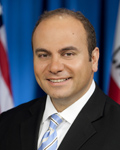
Photo of Adrin Nazarian
D California Assembly · District 46 · Former member

Asm. Adrin Nazarian

Compare
Total votes
23,010
all sessions
Attendance
96%
714 missed
Near the chamber average
With party
99%
of cast votes
Near the chamber average
Bipartisan score
0%
crosses aisle rarely
Lower than 76% of chamber peers
Sponsored
1,694
bills & resolutions
Near the chamber average
Committees
0
assignments
1,694 bills and resolutions

Sponsored bills

Total
1,694
Primary
253
Co-sponsor
1,441
This page
1,694
matching current filters
Co-sponsor ACR 28
Passed · California Assembly · Co-sponsor
Sickle Cell Disease Awareness Month.

This measure would recognize September 2020 as Sickle Cell Disease Awareness Month and encourage the Legislature to appropriate funds for research, treatment, and monitoring of sickle cell disease, and for related education and outreach.

Passed Jan 15, 2020 1 co-sponsor
Co-sponsor SB 611
Vetoed · California Senate · Co-sponsor
Housing: elderly and individuals with disabilities.

Existing law establishes the Department of Housing and Community Development in the Business, Consumer Services, and Housing Agency. The department is administered by the Director of Housing and Community Development. The department is responsible for administering various housing and home loan programs throughout the state. Existing law requires the department, on or before December 31 of each year, to submit an annual report containing specified information to the Governor and both houses of the Legislature on the operations and accomplishments during the previous fiscal year of the housing programs administered by the department. This bill would establish the Master Plan for Aging Housing Task Force, chaired by the director or their designee, and composed of specified stakeholders and representatives of government agencies to, among other things, identify policy strategies that will help increase the supply of affordable housing for older adults and reduce barriers to providing health care and social services to older adults in affordable housing, and make recommendations to the Legislature. This bill would require the task force to meet at least 6 times in the 2020 calendar year, and would require the task force to submit a report to the Legislature by April 30, 2021, that provides specified information and policy recommendations related to the supply of affordable housing for older adults. The bill would make various related legislative findings.

Vetoed Jan 13, 2020 1 co-sponsor
Co-sponsor SB 428
Vetoed · California Senate · Co-sponsor
Pupil health: school employee training: youth mental and behavioral health.

Existing law requires the governing board of any school district to give diligent care to the health and physical development of pupils and authorizes the governing board of a school district to employ properly certified persons for the work. Existing law requires a school of a school district or county office of education and a charter school to notify pupils and parents or guardians of pupils no less than twice during the school year on how to initiate access to available pupil mental health services on campus or in the community, or both, as provided. This bill, contingent on an appropriation made for these purposes, would require the State Department of Education to identify an evidence-based training program for a local educational agency to use to train classified and certificated school employees having direct contact with pupils on youth mental and behavioral health, as specified. The bill would define a local educational agency for purposes of these provisions to mean a county office of education, school district, state special school, or charter school that serves pupils in any of grades 7 to 12, inclusive. The bill would require a local educational agency, on or before January 1, 2023, to certify to the department that at least 10% of its classified employees and at least 10% of its certificated employees having direct contact with pupils at each schoolsite, or at least 2 classified employees and at least 2 certificated employees having direct contact with pupils at each schoolsite, whichever is greater, have received the youth mental and behavioral health training identified by the department. To the extent this bill, if implemented, would impose additional duties on local educational agencies, the bill would impose a state-mandated local program. The California Constitution requires the state to reimburse local agencies and school districts for certain costs mandated by the state. Statutory provisions establish procedures for making that reimbursement. This bill would provide that, if the Commission on State Mandates determines that the bill contains costs mandated by the state, reimbursement for those costs shall be made pursuant to the statutory provisions noted above.

Vetoed Jan 13, 2020 1 co-sponsor
Co-sponsor SB 163
Vetoed · California Senate · Co-sponsor
Health care coverage: pervasive developmental disorder or autism.

Existing law, the Lanterman Developmental Disabilities Services Act, requires the State Department of Developmental Services to contract with regional centers to provide services and supports to individuals with developmental disabilities and their families. Existing law defines developmental disability for these purposes to include, among other things, autism. Existing law, the Knox-Keene Health Care Service Plan Act of 1975, provides for the licensure and regulation of health care service plans by the Department of Managed Health Care and makes a willful violation of the act a crime. Existing law also provides for the regulation of health insurers by the Department of Insurance. Existing law requires a health care service plan contract or a health insurance policy to provide coverage for behavioral health treatment for pervasive developmental disorder or autism, and defines "behavioral health treatment" to mean specified services and treatment programs, including treatment provided pursuant to a treatment plan that is prescribed by a qualified autism service provider and administered either by a qualified autism service provider or by a qualified autism service professional or qualified autism service paraprofessional who is supervised as specified. Existing law defines a "qualified autism service provider" to refer to a person who is certified or licensed and a "qualified autism service professional" to refer to a person who meets specified educational, training, and other requirements and is supervised and employed by a qualified autism service provider. Existing law defines a "qualified autism service paraprofessional" to mean an unlicensed and uncertified individual who meets specified educational, training, and other criteria, is supervised by a qualified autism service provider or a qualified autism service professional, and is employed by the qualified autism service provider. Existing law also requires a qualified autism service provider to design, in connection with the treatment plan, an intervention plan that describes, among other information, the parent participation needed to achieve the plan's goals and objectives, as specified. Under existing law, these coverage requirements provide an exception for specialized health care service plans or health insurance policies that do not cover mental health or behavioral health services, accident only, specified disease, hospital indemnity, or Medicare supplement health insurance policies, and health care service plans and health insurance policies in the Medi-Cal program. Existing federal law, the federal Paul Wellstone and Pete Domenici Mental Health Parity and Addiction Equity Act of 2008 (MHPAEA) , requires group health plans and health insurance issuers that provide both medical and surgical benefits and mental health or substance use disorder benefits to ensure that financial requirements and treatment limitations applicable to mental health or substance use disorder benefits are no more restrictive than the predominant requirements or limitations applied to substantially all medical and surgical benefits. Existing state law subjects nongrandfathered individual and small group health care service plan contracts and health insurance policies that provide coverage for essential health benefits to those provisions of the MHPAEA. This bill would revise the definition of behavioral health treatment to require the services and treatment programs provided to be based on behavioral, developmental, relationship-based, or other evidence-based models. The bill would remove the exception for health care service plans and health insurance policies in the Medi-Cal program, consistent with the MHPAEA. This bill also would expand the definition of a "qualified autism service professional" to include behavioral service providers who meet specified educational and professional or work experience qualifications. The bill would revise the definition of a "qualified autism service paraprofessional" by deleting the reference to an unlicensed and uncertified individual and by requiring the individual to comply with revised educational and training, or professional, requirements. The bill would also revise the definitions of both a qualified autism service professional and a qualified autism service paraprofessional to include the requirement that these individuals complete a background check. This bill would require the intervention plan designed by the qualified autism service provider to include parent or caregiver participation, when clinically appropriate, that is individualized to the patient and takes into account the ability of the parent or caregiver to participate in therapy sessions and other recommended activities, as specified. The bill would specify that the lack of parent or caregiver participation shall not be used to deny or reduce medically necessary services and that the setting, location, or time of treatment not be used as the only reason to deny medically necessary services. Because a willful violation of the bill's provisions by a health care service plan would be a crime, it would impose a state-mandated local program. The California Constitution requires the state to reimburse local agencies and school districts for certain costs mandated by the state. Statutory provisions establish procedures for making that reimbursement. This bill would provide that no reimbursement is required by this act for a specified reason.


Vetoed Jan 13, 2020 1 co-sponsor
Co-sponsor ACR 98
Passed · California Assembly · Co-sponsor
Relative to mental health and substance use treatment.

This measure would urge specified state departments and the Attorney General to use their authority to ensure that health care service plans and health insurers subject to their authority comply with the federal Paul Wellstone and Pete Domenici Mental Health Parity and Addiction Equity Act of 2008.

Passed Jan 9, 2020 1 co-sponsor
Primary AB 715
Signed into law · California Assembly · Lead sponsor
Richard Paul Hemann Parkinson's Disease Program.

Existing law establishes the Richard Paul Hemann Parkinson's Disease Program, which, among other things, requires the State Department of Public Health to collect data on the incidence of Parkinson's disease in California, as specified. Existing law requires a hospital, facility, physician and surgeon, or other health care provider diagnosing or providing treatment to Parkinson's disease patients to report each case of Parkinson's disease to the department, as prescribed. Existing law conditions the implementation of the program on the availability of funds and repeals the program on January 1, 2020. This bill would extend the program until January 1, 2021.

Signed into law Oct 12, 2019 0 co-sponsors
Co-sponsor AB 749
Signed into law · California Assembly · Co-sponsor
Settlement agreements: restraints in trade.

Existing law provides that every contract by which anyone is restrained from engaging in a lawful profession, trade, or business of any kind is void to the extent that the contract restrains that person. This bill would prohibit an agreement to settle an employment dispute from containing a provision that prohibits, prevents, or otherwise restricts a settling party that is an aggrieved person, as defined, from working for the employer against which the aggrieved person has filed a claim or any parent company, subsidiary, division, affiliate, or contractor of the employer. The bill would also clarify that an employer and an aggrieved person are free to agree to end a current employment relationship, or to prohibit or otherwise restrict the aggrieved person from obtaining future employment with the employer, if the employer has made a good faith determination that the person engaged in sexual harassment or sexual assault, as defined. The bill would further clarify that an employer is not required to continue to employ or rehire a person if there is a legitimate nondiscriminatory or nonretaliatory reason for terminating or refusing to rehire the person. The bill would provide that a provision in an agreement entered into on or after January 1, 2020, that violates this prohibition is void as a matter of law and against public policy.

Signed into law Oct 12, 2019 1 co-sponsor
Primary AB 1287
Signed into law · California Assembly · Lead sponsor
Universal assessments: No Wrong Door system.

Existing law, including, among others, the Mello-Granlund Older Californians Act, provides various programs to assist older adults and people with disabilities. These programs include the Aging and Disability Resource Connection program established to provide information to consumers and their families on available long-term services and supports (LTSS) programs and to assist older adults, caregivers, and persons with disabilities in accessing LTSS programs at the local level. By executive order, the Governor ordered that a master plan for aging be developed and issued to serve as a blueprint to implement strategies and partnerships that promote healthy aging and prepare the state for upcoming demographic changes. This bill would require the master plan for aging developed pursuant to that executive order to consider the efficacy of utilizing a No Wrong Door System. The bill would specify the purpose of the No Wrong Door system as assisting older adults, people with disabilities, and caregivers in obtaining accurate information and timely referrals to appropriate community services and supports. The bill would also require that master plan for aging to consider the efficacy of using a universal tool and process that is capable of assessing individual need and determining initial eligibility for programs and services available in the long-term services and supports delivery network.

Signed into law Oct 12, 2019 0 co-sponsors
Co-sponsor SB 453
Signed into law · California Senate · Co-sponsor
Older adults.

Existing law establishes an Aging and Disability Resource Connection (ADRC) program, administered by the California Department of Aging, to provide information to consumers and their families on available long-term services and supports (LTSS) programs and to assist older adults, caregivers, and persons with disabilities in accessing LTSS programs at the local level. Existing law requires the ADRC program to provide services within the geographic area served and provide information to the public about the services provided by the program. Existing law requires the department to administer the ADRC Infrastructure Grants Program for the purpose of implementing a No Wrong Door System, as defined. Existing law makes the operation of these provisions contingent upon the appropriation of funds for that purpose. This bill would require the California Department of Aging to develop a core model of ADRC best practices, and would require ADRC programs operated jointly by area agencies on aging and independent living centers to implement these best practices by July 1, 2022. In developing those best practices, the bill would require the department to consider specified practices, including, among others, a person-centered counseling process. The bill would delete the contingent operation and instead make the implementation of these provisions, and the existing ADRC provisions, contingent on an appropriation of funds for that express purpose. This bill would require the California Department of Aging to take specified actions with regard to the implementation of the No Wrong Door System, including, among other things, developing a plan for, and overseeing the implementation of, the No Wrong Door System and coordinating funding sources for the No Wrong Door System. The bill would require the State Department of Health Care Services to determine if the Medicaid administrative claiming process may be used to fund the No Wrong Door System, or activities associated with the No Wrong Door System, and, if so, would authorize the department to take necessary action to receive that funding. The bill would make the implementation of these provisions contingent on an appropriation of funds for those express purposes.

Signed into law Oct 12, 2019 1 co-sponsor
Co-sponsor AB 1548
Signed into law · California Assembly · Co-sponsor
California State Nonprofit Security Grant Program.

Existing law establishes the Office of Emergency Services within the office of the Governor and under the supervision of the Director of Emergency Services and makes the Office of Emergency Services responsible for the state's emergency and disaster response services for natural, technological, or manmade disasters and emergencies. This bill would establish the California State Nonprofit Security Grant Program under the administration of the director to improve the physical security of nonprofit organizations that are at high risk of violent attacks or hate crimes due to ideology, beliefs, or mission, as specified. The bill would make the operation of the program contingent upon an appropriation in the annual Budget Act for these purposes. The bill would repeal those provisions on January 1, 2025. This bill would declare that it is to take effect immediately as an urgency statute.

Signed into law Oct 11, 2019 1 co-sponsor
Showing 581 to 590 of 1,694 bills
Previous 1 … 58 59 60 … 170 Next