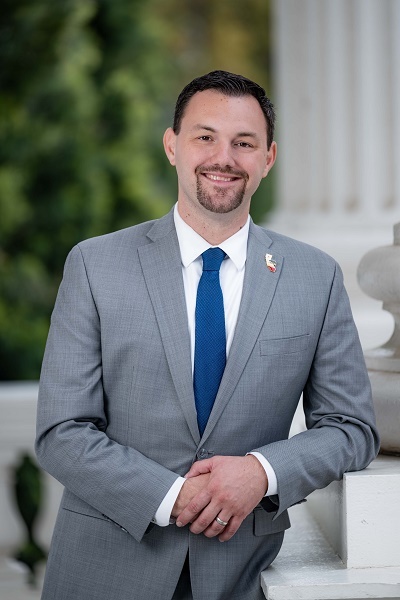
Photo of Nick Schultz
D California Assembly · District 44 On the 2026 ballot

Asm. Nick Schultz

Compare
Total votes
4,643
all sessions
Attendance
94%
219 missed
Near the chamber average
With party
99%
of cast votes
Near the chamber average
Bipartisan score
0%
crosses aisle rarely
Near the chamber average
Sponsored
410
bills & resolutions
Near the chamber average
Committees
7
assignments
410 bills and resolutions

Sponsored bills

Total
410
Primary
39
Co-sponsor
371
This page
410
matching current filters
Co-sponsor HR 79
Passed · California Assembly · Co-sponsor
Relative to Unclaimed Property Month.

Maddy summaryThis bill designates February 2026 as Unclaimed Property Month in California to raise awareness about state-held financial assets. It encourages residents to check the state Controller's website to claim unclaimed funds such as uncashed checks and insurance proceeds. The resolution does not change any laws or policies but serves as a public awareness campaign to help people locate and claim their abandoned property. It directs the Assembly Chief Clerk to distribute copies of the resolution for public distribution.

Passed Feb 5, 2026 1 co-sponsor
Co-sponsor HR 77
Passed · California Assembly · Co-sponsor
Relative to school governance.

Maddy summaryThis House Resolution declares January 2026 as School Board Recognition Month to honor the nearly 5,000 school board members across California's 1,000 school districts and county offices of education. The resolution recognizes these locally elected officials for their work in guiding public education and serving diverse communities, emphasizing their role in ensuring students' academic, social-emotional, and health needs are met. It calls on community members to join in acknowledging the dedication of school board members and collaborate to improve the education system. The bill has no operational effect beyond this symbolic recognition and does not change any laws or policies.

Passed Feb 5, 2026 1 co-sponsor
Primary HR 76
Passed · California Assembly · Lead sponsor
Relative to affordable homeownership.

Maddy summaryThis House Resolution formally recognizes the importance of affordable homeownership for California families, particularly those with lower incomes, and highlights how nonprofit-led programs help build generational wealth and reduce economic disparities. The document emphasizes that existing state programs like CalHome support the construction and preservation of affordable homes through competitive funding to cities, counties, indigenous communities, and nonprofit builders such as Habitat for Humanity. While the resolution does not create new laws or funding, it serves as an official acknowledgment of homeownership's role in improving educational outcomes, health, civic participation, and neighborhood stability. The text also notes California's significant housing deficit and racial wealth gaps as context for why expanding affordable ownership opportunities is a priority for state policy.

Passed Feb 5, 2026 0 co-sponsors
Primary AB 892
Failed · California Assembly · Lead sponsor
Captive wild animals: direct contact: prohibition.

Existing law prohibits the importation, transportation, or possession of specified wild animals into this state, except under a revocable, nontransferable permit, known as a restricted species permit, issued by the Department of Fish and Wildlife, in cooperation with the Department of Food and Agriculture, and only if certain requirements are met. Existing law exempts specified entities from this permit requirement under certain circumstances. Existing law requires the Fish and Game Commission, in cooperation with the Department of Food and Agriculture, to adopt regulations governing, among other things, the confinement of a wild animal possessed under a restricted species permit and the possession of all other wild animals. Existing law requires those regulations to be designed to, among other things, provide for the welfare of wild animals and the safety of the public. This bill would prohibit a person from allowing any member of the public to come into direct contact, as defined, with a covered animal, as defined, except as provided. The bill would provide that any person who violates this provision is subject to a specified civil penalty for each violation, and that the restricted species permit for the covered animal is subject to immediate suspension or revocation by the Department of Fish and Wildlife. The bill would authorize a person whose permit is suspended or revoked to appeal the suspension or revocation to the commission by filing a written request for an appeal within 30 days of the suspension or revocation. This bill would provide that the provisions of this bill are severable.

Failed Feb 2, 2026 0 co-sponsors
Co-sponsor AB 1243
Failed · California Assembly · Co-sponsor
Polluters Pay Climate Superfund Act of 2025.

The California Global Warming Solutions Act of 2006, until January 1, 2031, authorizes the State Air Resources Board to adopt a regulation establishing a system of market-based declining aggregate emissions limits for sources or categories of sources that emit greenhouse gases (market-based compliance mechanism) that meets certain requirements. Existing law establishes the Greenhouse Gas Reduction Fund and requires all moneys, except for fines and penalties, collected by the state board from the auction or sales of allowances as a part of a market-based compliance mechanism to be deposited into the fund and requires the Legislature to appropriate moneys in the fund for the purpose of reducing greenhouse gas emissions in the state, as provided. Existing law, the California Climate Crisis Act, declares that it is the policy of the state both to achieve net-zero greenhouse gas emissions as soon as possible, but no later than 2045, and achieve and maintain net-negative greenhouse gas emissions thereafter, and to ensure that by 2045, statewide anthropogenic greenhouse gas emissions are reduced to at least 85% below the 1990 levels. This bill would enact the Polluters Pay Climate Superfund Act of 2025 and would establish the Polluters Pay Climate Superfund Program to be administered by the California Environmental Protection Agency to require fossil fuel polluters to pay their fair share of the damage caused by greenhouse gases released into the atmosphere during the covered period, which the bill would define as the time period between the 1990 and 2024 calendar years, inclusive, resulting from the extraction, production, refining, sale, or combustion of fossil fuels or petroleum products, to relieve a portion of the burden to address cost borne by current and future California taxpayers. The bill would require the agency, within 90 days of the effective date of the act, to determine and publish a list of responsible parties, which the bill would define as an entity with a majority ownership interest in a business engaged in extracting or refining fossil fuels that, during the covered period, did business in the state or otherwise had sufficient contact with the state, and is determined by the agency to be responsible for more than 1,000,000,000 metric tons of covered fossil fuel emissions, as defined, in aggregate globally, during the covered period. This bill would require the agency, within one year of the effective date of the act, to conduct and complete a climate cost study to, among other things, quantify the total damage amount, which the bill would define as all past and future climate harms and damages to the state from January 1, 1990, through December 31, 2045, inclusive. The bill would require the agency to update the climate cost study, not less frequently than every 5 years, through January 1, 2045, as provided. The bill would require the agency, within 60 days of the completion of the climate cost study, to determine and assess, as provided, a cost recovery demand for each responsible party listed, which represents the responsible party's proportionate share of the total damage amount. The bill would require responsible parties to pay their cost recovery demand, as provided. The bill would require the collected cost recovery demands to be deposited in the Polluters Pay Climate Superfund, which the bill would create in the State Treasury. The bill would, upon appropriation by the Legislature, require moneys in the fund be expended for, among other things, qualifying expenditures, which the bill would define to include expenditures for projects and programs to mitigate, adapt, or respond to the damages and costs caused to the state from climate change. The bill would require all interest earned on moneys that have been deposited into the fund to be retained in the fund for use in implementing the program. The bill would require the agency to determine the initial implementation costs for the act, as provided, and would require the agency to assess an amount allocated equitably among responsible parties to cover those costs. This bill would require the Director of Finance, within 45 days of the effective date of the act, to perform an initial assessment of the reasonable and appropriate initial implementation costs that will be incurred by the agency. This bill would declare that it is to take effect immediately as an urgency statute.

Failed Feb 2, 2026 1 co-sponsor
Co-sponsor SB 605
Failed · California Senate · Co-sponsor
State attorneys and administrative law judges: compensation.

Existing law requires the Department of Human Resources to establish and adjust salary ranges for each class of position in the state civil service. This bill would require that the salaries of state attorneys and administrative law judges in State Bargaining Unit 2 be no less than the average salaries of public sector attorneys, as specified. The bill would require the Department of Human Resources to annually conduct a survey of salary structures by March 1 of each year, as specified, and determine the average salary of public sector attorneys for each attorney classification, including the minimum salaries for entry-level attorneys, intermediate classifications, and the most senior nonmanagerial attorneys, noninclusive of negotiated differentials. The bill would require that state administrative law judges have salaries not less than the maximum salary of state attorneys classified at a specified level. The bill would require the department to make a good faith offer of parity in salary with respect to public sector agency attorneys' and administrative law judges' salaries in any negotiations with the exclusive bargaining representative. The bill would provide that no state attorney or administrative law judge classification shall be reduced in salary as a result of these provisions. This bill would state that its provisions supersede any memorandum of understanding and shall become effective with respect to salary increases on March 1 of each year. It would provide that its implementation, except for the annual survey, is contingent upon the appropriation of funds in the annual Budget Act and that implementation shall be phased in over 3 fiscal years commencing on July 1, 2026. The bill would also provide that the superior court has exclusive jurisdiction over disputes arising under these provisions.

Failed Feb 2, 2026 1 co-sponsor
Primary AB 1304
Failed · California Assembly · Lead sponsor
Paint product recovery program: paint recovery: education and outreach.

Existing law establishes a paint product recovery program for the purpose of requiring paint manufacturers to develop and implement a stewardship plan to collect, transport, and process postconsumer paint to reduce the costs and environmental impacts of the disposal of postconsumer paint in this state. Existing law defines various terms for the purpose of the program. Existing law requires a stewardship plan to include consumer, contractor, and retailer education and outreach efforts to promote source reduction and recycling products, and authorizes the development and updating of education and outreach materials. This bill would state that the purpose of the program is also to require paint manufacturers to develop and implement a program to recover, reuse, and recycle postconsumer paint. The bill would define "paint recovery" to mean the process of collecting and transporting leftover paint for the purpose of reuse, processing, or recycling to reduce its environmental impact and disposal costs. The bill would require, rather than authorize, the development and updating of education and outreach materials, would require a stewardship plan's education and outreach efforts to also promote the proper use and handling of paint products, and would require those efforts to include investment in the training of California's future workforce by working with California apprenticeship programs for training apprentices and journey-level painters.

Failed Feb 2, 2026 0 co-sponsors
Co-sponsor AB 51
Failed · California Assembly · Co-sponsor
Education finance: General Fund cashflow loans: Inglewood Unified School District: interest waivers.

Existing law authorizes the governing board of a school district that determines during a fiscal year that its revenues are less than the amount necessary to meet its current year expenditure obligations to request an emergency apportionment through the Superintendent of Public Instruction, subject to specified requirements. Existing law authorizes emergency apportionments to be provided through an interim loan from the General Fund and lease financing made available by the California Infrastructure and Economic Development Bank, which is authorized to issue bonds for purposes of the emergency apportionments and related costs, or as an alternative to lease financing, as an emergency apportionment from the General Fund. Existing law prescribes the financing conditions on emergency apportionments, including the calculation of the interest rate. Existing law, notwithstanding any other law, authorizes the Inglewood Unified School District, through the State Department of Education, to request cashflow loans from the General Fund for a total of up to $55,000,000 for emergency operational purposes, as provided. Existing law requires the interest on these loans to be charged at the annual rate of return of the Pooled Money Investment Account, plus an additional 2%. This bill, notwithstanding any other law, and once the Inglewood Unified School District has successfully repaid at least 10 years of a General Fund cashflow loan made pursuant to those provisions, would authorize the school district to seek, and would require the Department of Finance to grant, a waiver of interest on that loan for the next succeeding fiscal year if specified conditions are met, including, among other conditions, that the Los Angeles County Superintendent of Schools, in consultation with the County Office Fiscal Crisis and Management Assistance Team, determines that the school district is making substantial progress towards fiscal solvency and that a waiver of interest would help the school district to exit receivership, as provided. In each subsequent fiscal year, the bill would authorize the school district to seek, and would require the Department of Finance to grant, a subsequent waiver of interest for the applicable fiscal year if the school district again meets those same requirements. To the extent the bill would impose additional duties on the Los Angeles County Superintendent of Schools, the bill would impose a state-mandated local program. This bill would make legislative findings and declarations as to the necessity of a special statute for the Inglewood Unified School District. The California Constitution requires the state to reimburse local agencies and school districts for certain costs mandated by the state. Statutory provisions establish procedures for making that reimbursement. This bill would provide that, if the Commission on State Mandates determines that the bill contains costs mandated by the state, reimbursement for those costs shall be made pursuant to the statutory provisions noted above.

Failed Feb 2, 2026 1 co-sponsor
Co-sponsor AB 661
Failed · California Assembly · Co-sponsor
The California Guaranteed Income Statewide Feasibility Study Act.

Existing law requires the State Department of Social Services, subject to an appropriation for this purpose in the annual Budget Act, to administer the California Guaranteed Income Pilot Program to provide grants to eligible entities for the purpose of administering pilot programs and projects that provide a guaranteed income to participants. Existing law requires the department to prioritize funding for pilot programs and projects that serve California residents who age out of the extended foster care program and pregnant individuals. Existing law requires the department, in consultation with relevant stakeholders, to determine the methodology for, and manner of, distributing those grants, subject to certain requirements. Existing law requires the department to review and evaluate the pilot programs and projects funded pursuant to these provisions, provide a report to the Legislature regarding that review and evaluation, and post a copy of the report on its internet website. This bill, the California Guaranteed Income Research and Expansion Act, would require the State Department of Social Services to contract with one or more entities, subject to specified requirements, to develop and provide comprehensive recommendations on how to design, fund, and implement a permanent, statewide Guaranteed Income Program. The bill would require the contractor, among other things, to examine the benefits and challenges of scaling up permanent guaranteed income programs to reach a larger proportion of California's socially and economically vulnerable populations, focusing on regions with a high cost of living and insights from best practices and lessons learned from the California Guaranteed Income Pilot Program. The bill would require specified state departments to disclose necessary data to the State Department of Social Services and require the contractor to convene a steering committee composed of various stakeholders, as provided. The bill would require the department to, on or before January 1, 2028, publish on its internet website and provide a report to the Governor and the Legislature on the feasibility and benefits of expanding the California Guaranteed Income Pilot Program statewide based on the outcomes of the act. This bill would authorize the State Department of Social Services to implement, interpret, or make specific the act without taking any regulatory action, as specified, and accept and, subject to an appropriation, expend funds to administer and implement the act.

Failed Feb 2, 2026 1 co-sponsor
Co-sponsor AB 1083
Failed · California Assembly · Co-sponsor
California Environmental Quality Act: exemptions: housing development projects: natural and protected lands: record of proceedings.

The California Environmental Quality Act (CEQA) requires a lead agency, as defined, to prepare, or cause to be prepared, and certify the completion of an environmental impact report (EIR) on a project that it proposes to carry out or approve that may have a significant effect on the environment or to adopt a negative declaration if it finds that the project will not have that effect. CEQA also requires a lead agency to prepare a mitigated negative declaration for a project that may have a significant effect on the environment if revisions in the project would avoid or mitigate that effect and there is no substantial evidence that the project, as revised, would have a significant effect on the environment. Existing law exempts from CEQA a rezoning that implements the schedule of actions contained in an approved housing element, as specified, except, among other things, a rezoning that would allow for the construction of a distribution center or for oil and gas infrastructure. This bill would instead exempt a rezoning to the extent that it is necessary to implement a schedule of actions contained in an approved housing element, except, among other things, a rezoning that would allow for the construction of a distribution center, for a tourism facility, as defined, or for oil and gas infrastructure. Existing law, for a proposed housing development project, as defined, that would otherwise be exempt from CEQA pursuant to a statutory exemption or specified categorical exemptions, but for a single condition, limits the application of CEQA to the effects upon the environment that are caused by that single condition, except as provided. This bill, for purposes of those provisions, would modify the definition of housing development project to exclude a project that has any portion of the project designated for use as a tourism facility, as defined. To the extent that this would create new duties for a lead agency, this bill would impose a state-mandated local program. Existing law exempts specified projects from CEQA, including a project that consists exclusively of a facility for advanced manufacturing, as defined, if the project is located on a site zoned exclusively for industrial uses. Existing law excludes projects located on natural and protected lands, as defined, from these exemptions, as provided. Existing law includes in the definition of natural and protected lands, lands protected as preserve areas or reserve lands pursuant to an adopted natural community conservation plan or habitat conservation plan, as specified. This bill would instead include, for that portion of the definition of natural and protected lands, lands identified for conservation in an adopted natural community conservation plan, habitat conservation plan, or other adopted natural resource protection plan, as specified. The bill would also expand the definition of natural and protected lands to include habitat for protected species, as specified, fully protected species, or species protected by the federal Endangered Species Act of 1973, the California Endangered Species Act, or the Native Plant Protection Act. The bill would eliminate the exemption from CEQA for advanced manufacturing projects. The bill would instead exempt from CEQA, until January 1, 2030, a project that consists exclusively of a facility for semiconductor manufacturing if the project is located on a site that was zoned exclusively for heavy industrial use on or before August 1, 2025, and meets specified criteria, including, among other things, that the project does not involve the storage, use, or discharge of extremely hazardous gases or chemicals above California's accidental release program reporting thresholds, the project applicant demonstrates high road employment standards and certifies to the lead agency that it will maintain those standards in the development, construction, and operation of the facility, and the project applicant has provided a legally binding commitment to comply with specified labor-related requirements with respect to the initial construction of the facility and subsequent maintenance that is contracted out to a contractor in the construction industry, as specified. Because a lead agency would be required to determine the applicability of this exemption, the bill would impose a state-mandated local program. The bill would require the State Energy Resources Conservation and Development Commission to develop and make available to lead agencies guidelines for evaluating whether a project applicant demonstrates high road employment standards. The bill would require the Office of Land Use and Climate Innovation, on or before January 1, 2029, to report to the Legislature on projects that were exempted from CEQA pursuant to the above exemption, as provided, and require the report to include a list of the projects for semiconductor manufacturing facilities that have been approved for development in the state, as specified. CEQA requires in an action or proceeding to attack, review, set aside, void, or annul certain acts or decisions of a public agency to be commenced according to a specified process and requires the record of proceedings to contain specified information, including all internal agency communications, except as specified. Existing law provides that for those projects that do not include a distribution center or oil and gas infrastructure, internal agency communication does not include staff notes and electronic internal agency communications, including emails, that were not presented to the final decisionmaking body, other than those communications and documents consulted, or reviewed by the lead agency executive or a local agency executive, as provided, thereby limiting what the record of proceeding is required to contain for these projects. This bill would eliminate the above-described limitation on internal agency communication required to be included in the record of proceedings for those projects that do not include a distribution center or oil and gas infrastructure, thereby requiring additional information to be included in the record of proceeding. By imposing new duties on a lead agency in order to comply with this provision, the bill would create a state-mandated local program. The California Constitution requires the state to reimburse local agencies and school districts for certain costs mandated by the state. Statutory provisions establish procedures for making that reimbursement. This bill would provide that no reimbursement is required by this act for a specified reason.


Failed Feb 2, 2026 1 co-sponsor
Showing 221 to 230 of 410 bills
Previous 1 22 23 24 41 Next