

Existing law requires the adopted course of study for grades 7 to 12, inclusive, to offer courses in specified areas of study, including, among others, science and mathematics. This bill would require the governing board of each school district, and the governing body of each charter school, maintaining any of grades 9 to 12, inclusive, by January 1, 2025, to adopt a plan at a regularly scheduled public meeting to offer at least one course in computer science education pursuant to a specified timeline, to post the plan to its internet website, and, on or before May 31, 2025, and annually thereafter, to review the plan at a regularly scheduled public meeting and report to the public on the plan's implementation, as provided. The bill would, among other things, specify that a computer science education course means a computer science course that is aligned to the computer science academic content standards adopted by the State Board of Education and in which pupils do not merely use technology as passive consumers, but understand why and how computing technologies work, and then build upon that conceptual knowledge by creating computational artifacts. The bill would require school districts and charter schools to describe in the plan their planned efforts to increase the computer science course enrollment of female pupils, pupils with disabilities, pupils who belong to ethnic and racial groups, and pupils eligible for free or reduced-priced meals that are underrepresented in the field of computer science. The bill would require school districts and charter schools, on or before June 30, 2026, and by each June 30 thereafter, to report specified computer science education course-related data to the department, as specified. By imposing additional duties on school districts and charter schools, the bill would impose a state-mandated local program. The California Constitution requires the state to reimburse local agencies and school districts for certain costs mandated by the state. Statutory provisions establish procedures for making that reimbursement. This bill would provide that, if the Commission on State Mandates determines that the bill contains costs mandated by the state, reimbursement for those costs shall be made pursuant to the statutory provisions noted above.
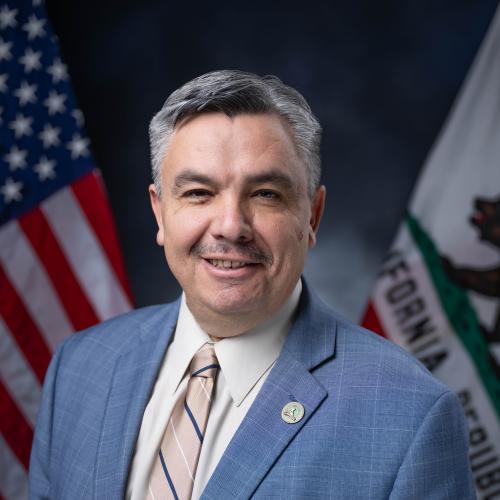
Asm. Juan Carrillo
Sponsored bills
Existing law establishes within state government the Office of Planning and Research as the comprehensive state planning agency for long-range planning and research. Existing law, until January 1, 2026, establishes within state government a Governor's Military Council that serves under the direction of the Military Department to advise the Governor on efforts to retain military installations and operations within this state that are necessary for the defense of the nation and to coordinate and focus those efforts. This bill, upon appropriation by the Legislature, would establish the California Defense Community Infrastructure Program, which would require the Office of Planning and Research to grant funds and provide technical assistance to local agencies to assist with matching fund requirements in applications for funds from the federal Defense Community Infrastructure Program. The bill would require the office, in consultation with the Governor's Military Council, to develop guidelines for the program that, where possible, align with the guidelines of the federal program. This bill would require the office to use specified project criteria, define an eligible project, as specified, rank eligible projects, as specified, and award grants based on the available funds. The bill would require the office to give priority to projects located in, or that would provide services to people who live in, a disadvantaged community, as defined.
Existing law, the Early Education Act, among other things, requires the Superintendent of Public Instruction to administer all California state preschool programs, including, but not limited to, part-day and full-day age and developmentally appropriate programs for 3- and 4-year-old children. Existing law requires each state preschool program applicant or contracting agency to give priority for part-day and full-day programs according to a specified priority ranking. Existing law requires the 3rd priority for services to be given to eligible 4-year-old children who are not enrolled in a state-funded transitional kindergarten program and requires the 4th priority to be given to eligible 3-year-old children. This bill would instead require the 3rd priority for services to be given to eligible 3- and 4-year old children who are not enrolled in a state-funded transitional kindergarten program, and would revise the remaining priorities accordingly. Existing law requires the State Department of Education, in collaboration with the State Department of Social Services, to implement a reimbursement system plan that establishes reasonable standards and assigned reimbursement rates, which vary with the length of the program year and the hours of service, for purposes of the act. Existing law requires those contractors who, as of December 31, 2021, received the established standard reimbursement rate to be reimbursed at the greater of the 75th percentile of the 2018 regional market rate survey or the contract per-child reimbursement amount as of December 31, 2021, as increased by a specified cost-of-living adjustment. This bill would instead require, for a contract whose period of performance begins on and after July 1, 2023, the contract reimbursement to be based on the lesser of the maximum reimbursable amount stated in the contract, the net reimbursable program costs, or the product of the adjusted child days of enrollment for certified children times the contract rate set forth in the above-described provisions. Existing law establishes adjustment factors to reflect the additional expense of serving full-day and part-day preschool children who have exceptional needs, are being provided with early childhood mental health consultation services, or are 47 months or younger, as provided. Existing law additionally establishes adjustment factors to reflect the additional expense of serving full-day preschool children who are at risk of neglect, abuse, or exploitation or who are dual language learners. Existing law prohibits days of enrollment for children who meet more than one of the criteria eligible for adjustment from being reported under more than one of those categories. This bill would, on and after July 1, 2024, additionally apply those adjustment factors for children who are at risk of neglect, abuse, or exploitation or who are dual language learners to part-day preschool children. The bill would also eliminate the prohibition on reporting children under more than one of the above-specified categories eligible for adjustment and make conforming changes.
(1) Existing law establishes the California Career Technical Education Incentive Grant Program, administered by the State Department of Education, with the purpose of encouraging, maintaining, and strengthening the delivery of high-quality career technical education programs. Existing law provides, for the 2021–22 fiscal year and each fiscal year thereafter, that $300,000,000 shall be available to the department, upon appropriation by the Legislature, for the program. Existing law prohibits an applicant from being awarded an amount higher than the amount that the allocation formula determines them to be eligible to receive under the program. This bill instead would provide, for the 2024–25 fiscal year, and each fiscal year thereafter, that $450,000,000 shall be made available to the department upon appropriation by the Legislature, for the program. The bill would delete the prohibition against an applicant being awarded more than the amount determined by the allocation formula. (2) Existing law requires grant applicants to meet minimum requirements, including, among other things, reporting to the Superintendent of Public Instruction data on the number of pupils completing career technical education coursework. This bill would require applicants to additionally report data on the number of pupils completing a career technical education pathway consisting of a sequence of 2 or more career technical education courses in the same career technical education subject matter discipline. (3) Existing law requires the Superintendent to take specified actions for purposes of administering the California Career Technical Education Incentive Grant Program. This bill would require the Superintendent to establish, in collaboration with the executive director of the State Board of Education, a stakeholder workgroup, as specified, on or before June 30, 2024, to consider and provide recommendations on maximizing career technical education opportunities for pupils, as provided, and to report those recommendations to the policy and fiscal committees of the Legislature, the Department of Finance, and the Governor by January 31, 2025. The bill would require the Superintendent to ensure a level of professional staffing within the department that is dedicated to career technical education, sufficient to effectively administer the program and other federal and state career technical education programs, as specified. (4) Existing law requires the K–12 Workforce Pathway Coordinators and the K–14 Technical Assistance Providers to provide technical assistance and support to grant recipients, as provided. This bill would, commencing with the 2024–25 fiscal year, and each fiscal year thereafter, instead require $12,000,000 to be made available to the department, subject to an appropriation in the annual Budget Act or another statute, to provide regional career technical education coordinators for the provision of technical assistance and support to local educational agencies in implementing all of their career technical education courses, programs, and pathways, as provided. (5) Existing law establishes the California Community Colleges, under the administration of the Board of Governors of the California Community Colleges, as one of the segments of public postsecondary education in this state. Existing law establishes the Strong Workforce Program to provide funding to career technical education regional consortia made up of community college districts, as specified. Existing law also establishes a K–12 component of the Strong Workforce Program. Existing law provides that, commencing with the 2018–19 fiscal year, the amount appropriated in the annual Budget Act for the K–12 component of the program is used to create, support, or expand high-quality career technical education programs at the K–12 level that are aligned with the workforce development efforts occurring through the program. This bill would, as of July 1, 2024, repeal the K–12 component of the Strong Workforce Program and would require the administration of any outstanding allocations for the K–12 component of the Strong Workforce Program to be administered by the department pursuant to the California Career Technical Education Incentive Grant Program.
This measure would declare that the Legislature should pass laws that halt the importation of cobalt or any product using cobalt mined in Africa using child slave labor and encourage the production of cobalt and other critical minerals ethically sourced from within the United States.
This measure would recognize July 17, 2023, to July 23, 2023, as Outdoor Worker Appreciation Week.
This measure would declare the month of October 2023 as Sudden Infant Death Syndrome (SIDS) Awareness Month.
This measure would designate the month of November 2023 to be California's Sikh American Awareness and Appreciation Month. The measure would recognize and acknowledge the significant contributions made by Californians of Sikh heritage to our state and would seek to afford all Californians the opportunity to better understand, recognize, and appreciate the rich history and shared principles of Sikh Americans. The measure would condemn all hate crimes and bias incidents against Sikh Americans and would encourage all Sikhs to practice their faith freely and fearlessly.
This measure would designate the month of October 2023 as California Hindu American Awareness and Appreciation Month. The measure would also recognize and acknowledge the significant contributions made by Californians of Hindu heritage to the state and seek to increase awareness and understanding of the Hindu American community.