

Existing law classifies certain criminal offenses as a "violent felony" for the purposes of various provisions of the Penal Code, including sentencing enhancements for prior convictions, as well as numerous other provisions. Existing law includes among the list of violent felonies rape accomplished against a person's will by means of force, violence, duress, menace, or fear, or rape accomplished against the victim's will by threat of violent retaliation, but does not include rape of a person unable to give consent due to disability, intoxication, or unconsciousness, rape under false pretenses, or rape accomplished by threat of incarceration, arrest, or deportation. This bill would also include the rape of an intoxicated person wherein the defendant drugged the victim, as specified, in the list of violent felonies. By expanding the scope of an enhancement, this bill would impose a state-mandated local program. The California Constitution requires the state to reimburse local agencies and school districts for certain costs mandated by the state. Statutory provisions establish procedures for making that reimbursement. This bill would provide that no reimbursement is required by this act for a specified reason.
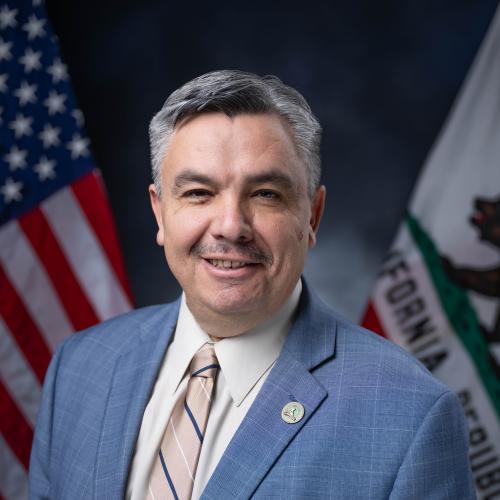
Asm. Juan Carrillo
Sponsored bills
Existing law provides for various memorials and monuments on the grounds of the State Capitol. Existing law requires the Department of General Services to maintain state buildings and grounds. Existing law, the Apology Act for the 1930s Mexican Repatriation Program, makes findings and declarations regarding the unconstitutional removal and coerced emigration of United States citizens and legal residents of Mexican descent, between the years 1929 and 1944, to Mexico from the United States during the 1930s "Mexican Repatriation" Program. Existing law expresses the apology of the State of California to those individuals who were illegally deported and coerced into emigrating to Mexico and requires that a plaque to commemorate those individuals be installed and maintained by the Department of Parks and Recreation in an appropriate public place in the City or County of Los Angeles. This bill would authorize a nonprofit organization representing Mexican Americans or Mexican immigrants to enter into negotiations to plan, construct, and maintain a memorial to Mexican Americans and Mexican immigrants who were forcibly deported from the United States during the Great Depression, as provided. The bill would require the memorial to be located at an appropriate public place in the City or County of Los Angeles. The bill would require the nonprofit organization to enter into negotiations with the Department of General Services and the state agency with jurisdiction over the state property where the memorial is proposed, where applicable, if the nonprofit organization proposes to locate the memorial on state property. The bill would require the nonprofit organization to submit a plan for the memorial to the department and the applicable state agency for review and approval. The bill would require these provisions to be funded exclusively through private sources. This bill would, if the nonprofit organization proposes a site owned by the City of Los Angeles or the County of Los Angeles for location of the memorial, require the nonprofit organization to follow any procedures that the City of Los Angeles or the County of Los Angeles require to consider approving the proposed memorial. This bill would make legislative findings and declarations as to the necessity of a special statute for the City of Los Angeles and the County of Los Angeles.
Existing law establishes various educational benefits for dependents of veterans who were killed during military service or are totally disabled, as specified. Existing law defines "dependent of a veteran" to include the spouse of a totally disabled veteran. Existing law prohibits a dependent of a veteran from receiving these educational benefits during the time the dependent is entitled to receive specified federal educational benefits or duplicate assistance from any other government source. This bill would repeal that prohibition.
(1) Existing law provides that a child may be adjudged to be a dependent of the juvenile court because of abuse or neglect and generally provides for the placement of dependent children in various foster care placement settings. Existing law requires the court to review the status of every dependent child in foster care no less frequently than once every 6 months and requires the county social worker to file a supplemental report as part of that review. This bill would additionally require the court, in conducting the periodic status review for a child or nonminor dependent who is not residing with their relatives, nonrelative extended family members, or in the case of an Indian child, their extended family members, or an Indian custodian, to determine whether the social worker has continued efforts, and in the case of an Indian child, the active efforts, to locate any relatives, extended family members, or nonrelative extended family members who could provide family support or possible placement of the child and the names of those relatives, extended family members, or nonrelative extended family members. The bill would also require the supplemental report for a child or nonminor dependent who does not reside with their relatives, nonrelative extended family members, or in the case of an Indian child, their extended family members, or an Indian custodian to additionally include the efforts, and in the case of an Indian child, the active efforts, and findings that the social worker has made to locate any relative, extended family members, or nonrelative extended family members who could provide family support or possible placement of the child or nonminor dependent and the name of those relatives, extended family members, or nonrelative extended family members. By imposing additional duties on county officials, the bill would impose a state-mandated local program. (2) Existing law requires the court to place a foster child in the home of a relative, if possible, unless the placement would not be in the best interest of the child. Existing law requires the court to take into consideration other specified factors in making a determination of the placement of a foster child. This bill would make a nonsubstantive change to correct an erroneous cross reference in that provision. (3) The California Constitution requires the state to reimburse local agencies and school districts for certain costs mandated by the state. Statutory provisions establish procedures for making that reimbursement. This bill would provide that no reimbursement is required by this act for a specified reason.
Existing law prohibits persons desiring to use an electric vehicle charging station that requires payment of a fee from being required to pay a subscription fee to use the station and from being required to obtain membership in any club, association, or organization as a condition of using the station. Existing law requires the total actual charges for the use of an electric vehicle charging station, including any additional network roaming charges for nonmembers, to be disclosed to the public at the point of sale. Existing law authorizes the State Energy Resources Conservation and Development Commission to adopt interoperability billing standards for network roaming payment methods for electric vehicle charging stations if no interoperability billing standards have been adopted by a national standards organization by January 1, 2015. This bill would require the commission to apply any network roaming standards it adopts only to major electric vehicle charging network providers, as defined. The bill would require that those network roaming standards require major electric vehicle charging network providers to accept payment for charging made by users from multiple other major electric vehicle charging network providers and automakers.
(1) Existing federal law, the Victims of Crime Act of 1984, creates the Crime Victims Fund and authorizes federal financial assistance to states for the purpose of supporting eligible crime victim assistance programs. Existing law creates various programs under the Office of Emergency Services related to crime prevention and education, including, among other things, programs concerning family violence prevention and domestic violence prevention. This bill, the California Victims of Crime Act, would establish the California Crime Victims Fund in the State Treasury and would require that moneys deposited in the fund be continuously appropriated to the Office of Emergency Services to support crime victims services. The bill would require the Office of Emergency Services to seek advisement from the Victims of Crime Act Steering Committee on priorities for utilizing the funds and would require the Treasurer to provide an annual report to the Legislature on the amounts deposited into the fund. By continuously appropriating moneys to the Office of Emergency Services for the support of crime victim services, the bill would make an appropriation. (2) Existing law establishes the aggravated white-collar crime enhancement which imposes enhanced penalties against a person who commits 2 or more related felonies, a material element of which is fraud or embezzlement, that involve a pattern of related felony conduct, and the pattern of related felony conduct involves the taking or loss of more than $100,000, as specified. This bill would authorize a court to impose an additional fine, known as the corporate white collar criminal enhancement, against a corporation that is convicted of a misdemeanor or felony. The bill would authorize the court to determine the amount of the fine, but would set specified limits. The bill would require the court to consider certain factors when determining the amount of the fine, including, among other things, the nature and seriousness of the offense and the corporation's assets, liabilities, and net worth, as specified. The bill would require that any moneys collected under this provision be deposited into the California Crime Victims Fund. (3) The California Constitution entitles the victim of a crime to restitution. Existing law requires the court in each criminal case to order a convicted defendant to pay full restitution to the victim and a separate restitution fine, as specified. This bill would, if a corporation is convicted of a misdemeanor or felony offense, require the court to impose a separate and additional restitution fine, as specified. The bill would authorize the court to determine the amount of the restitution fine, but would impose specified maximums. The bill would require any moneys collected under this provision to be distributed to the California Crime Victims Fund and the prosecuting agency that brought the criminal prosecution, as specified.
Existing law vests the Public Utilities Commission with regulatory authority over public utilities, including electrical corporations. Existing law, except as provided, requires certain uneconomic costs to be applied to each customer based on the amount of electricity purchased by that customer from an electrical corporation or alternate supplier of electricity, subject to changes in usage occurring in the normal course of business. Under existing law, changes in usage occurring in the normal course of business are those resulting from, among other things, the enhancement or increased efficiency of equipment. This bill would specify that the enhancement or increased efficiency of equipment occurring in the normal course of business includes industrial process heat recovery technology that meets prescribed requirements. The bill would prohibit nonbypassable or departing load surcharges from applying to a reduction in kilowatthours of electricity that an electrical corporation customer consumes from the electrical grid in a metered interval due to industrial process heat recovery technology, up to a cap established by the commission, that meets those prescribed requirements. The bill would also require the commission, in implementing that exemption from the surcharges, to minimize the cost impacts to all nonparticipating customers that are directly attributable to the nonbypassable or departing load charges of customers using industrial process heat recovery technology, as provided. Under existing law, a violation of the Public Utilities Act, or of an order, decision, rule, direction, demand, or requirement of the commission is a crime. Because the provisions of this bill would be part of the act, and a violation of a commission action implementing its requirements would be a crime, the bill would impose a state-mandated local program. The California Constitution requires the state to reimburse local agencies and school districts for certain costs mandated by the state. Statutory provisions establish procedures for making that reimbursement. This bill would provide that no reimbursement is required by this act for a specified reason.
Existing law vests the Department of Transportation with full possession and control of all state highways. Existing law describes the authorized routes in the state highway system and establishes a process for adoption of a highway on an authorized route by the California Transportation Commission. Existing law authorizes the commission to relinquish to local agencies state highway segments that have been deleted from the state highway system by legislative enactment or have been superseded by relocation, and in certain other cases. Existing law designates State Route 138 from Route 14 near the City of Palmdale to Route 18 near Crestline in the County of San Bernardino. This bill would authorize the commission to relinquish to the City of Palmdale all or a portion of State Route 138 within the city's jurisdiction and prescribe conditions that apply upon relinquishment.
Existing law authorizes the operation of an autonomous vehicle on public roads for testing purposes by a driver who possesses the proper class of license for the type of vehicle operated if specified requirements are satisfied. Existing law prohibits the operation of an autonomous vehicle on public roads until the manufacturer submits an application to the Department of Motor Vehicles, as specified, and that application is approved. This bill would require a manufacturer of an autonomous vehicle to report to the department a collision on a public road that involved one of its autonomous vehicles with a gross vehicle weight of 10,001 pounds or more that is operating under a testing or deployment permit that resulted in damage of property, bodily injury, or death within 10 days of the collision. The bill would require a manufacturer of an autonomous vehicle to annually submit to the department specified information regarding the deactivation of the autonomous mode for its autonomous vehicles with a gross vehicle weight of 10,001 pounds or more that were operating under a testing or deployment permit that authorized the vehicle to operate on public roads. The bill would prohibit the operation of an autonomous vehicle with a gross vehicle weight of 10,001 pounds or more on public roads for testing purposes, transporting goods, or transporting passengers without a human safety operator physically present in the autonomous vehicle at the time of operation. The bill would require the Department of Motor Vehicles, by January 1, 2030, or 5 years after commencement of testing, whichever occurs later, and upon appropriation by the Legislature, to submit a report to the appropriate policy and fiscal committees of the Legislature evaluating the performance of autonomous vehicle technology and its impact on public safety and employment in the transportation sector for autonomous vehicles with a gross vehicle weight of 10,001 pounds or more. The bill would require the Department of the California Highway Patrol, the Labor and Workforce Development Agency, the Department of Transportation, the State Air Resources Board, and other relevant state agencies to provide additional information needed to research the report.
Existing law establishes the California Interagency Council on Homelessness to identify mainstream resources, benefits, and services that can be accessed to prevent and end homelessness in California by creating partnerships between federal, state, local, and nonprofit entities. Existing law requires a state agency or department that administers one or more state homelessness programs, upon request of the council, to participate in council activities, as specified, and to provide to the council any relevant information regarding those state homelessness programs. This bill would require, commencing September 1, 2025, a state agency or department that administers one or more state homelessness programs to report annually to the council cost and outcome data for each program the agency or department administers, and would require the council, in coordination with each agency or department required to report to the council, as specified, to develop data collection and reporting procedures for this purpose. The bill would require the council to compile the data reported by agencies and departments and, commencing April 1, 2026, annually make that data available to the public.