

Passed Feb 6, 2023
1 co-sponsor
Total votes
27,298
all sessions
Attendance
92%
1,511 missed
Near the chamber average
With party
99%
of cast votes
Higher than 90% of chamber peers
Bipartisan score
0%
crosses aisle rarely
Lower than 93% of chamber peers
Sponsored
2,006
bills & resolutions
Near the chamber average
Committees
0
assignments
2,006 bills and resolutions
Sponsored bills
Total
2,006
Primary
262
Co-sponsor
1,744
This page
2,006
matching current filters
Passed Feb 2, 2023
1 co-sponsor
Passed Feb 2, 2023
1 co-sponsor
Passed Jan 30, 2023
1 co-sponsor
Passed Jan 23, 2023
1 co-sponsor
California State University: doctoral programs in public health.
Existing law establishes the California State University, under the administration of the Trustees of the California State University, and the University of California, under the administration of the Regents of the University of California, as 2 of the segments of public postsecondary education in this state. Existing law provides for the missions and functions of these segments, and states that the University of California has the sole authority in public higher education to award doctoral degrees in all fields of learning, except that it may agree with the California State University to award joint doctoral degrees in selected fields. However, existing law authorizes the California State University to offer doctoral programs in education, audiology, physical therapy, and occupational therapy without that agreement. This bill would authorize the California State University to award the Doctor of Public Health degree. The bill would require the Doctor of Public Health degree programs to be focused on health and scientific knowledge translation and transformative community leadership, and to be designed to address the community public health workforce needs of California and prepare qualified professionals to be leaders and experienced practitioners who apply their advanced knowledge in service to California's diverse communities. The bill would require each student in these degree programs to be charged fees comparable to, but no higher than, those fees charged for the Doctor of Public Health degree at the University of California.
Signed into law Sep 30, 2022
1 co-sponsor
School accountability: English language acquisition status: data.
Existing law establishes the State Department of Education under the administration of the Superintendent of Public Instruction, and assigns to the department numerous responsibilities relating to the governance of the public elementary and secondary schools in the state. Existing law establishes the California Assessment of Student Performance and Progress (CAASPP) and requires the department to ensure that local educational agencies comply with certain requirements related to CAASPP. This bill would require the department, on an annual basis, to include a report on its internet website that allows the public to view, among other assessment data, certain CAASPP test results by English language acquisition status, as provided. The bill would require the department to publicly report on an annual basis enrollment data by English language acquisition status and disability, as specified.
Signed into law Sep 30, 2022
1 co-sponsor
Communications: California Advanced Services Fund.
Existing law vests the Public Utilities Commission with regulatory authority over public utilities, including telephone corporations. Existing law requires the commission to develop, implement, and administer the California Advanced Services Fund (CASF) to encourage deployment of high-quality advanced communications services to all Californians that will promote economic growth, job creation, and the substantial social benefits of advanced information and communications technologies. Existing law authorizes the commission to impose a surcharge, until December 31, 2032, to collect up to $150,000,000 per year for deposit into the CASF. Existing law requires the commission to establish specified accounts within the CASF, including the Broadband Infrastructure Grant Account to fund the deployment of broadband infrastructure and the Federal Funding Account to fund last-mile broadband projects, as specified. This bill would expressly authorize otherwise eligible wireless broadband service providers to receive funding from the Broadband Infrastructure Grant Account and the Federal Funding Account. The bill would, for purposes of the Federal Funding Account, require the commission to review completed applications within a review period, to document the basis for denial of an application, to authorize the amendment and resubmission of denied applications for consideration in a future review period, and to periodically establish an application deadline. The bill would, for purposes of the Federal Funding Account, authorize the commission to adopt affordability requirements for a recipient of a grant. This bill would incorporate additional changes to Section 281 of the Public Utilities Code proposed by AB 1426 to be operative only if this bill and AB 1426 are enacted and this bill is enacted last. Under existing law, a violation of the Public Utilities Act or any order, decision, rule, direction, demand, or requirement of the commission is a crime. Because the above provisions would be part of the act and a violation of a commission action implementing this bill's requirements would be a crime, the bill would impose a state-mandated local program. The California Constitution requires the state to reimburse local agencies and school districts for certain costs mandated by the state. Statutory provisions establish procedures for making that reimbursement. This bill would provide that no reimbursement is required by this act for a specified reason. This bill would declare that it is to take effect immediately as an urgency statute.
Vetoed Sep 29, 2022
1 co-sponsor
Occupational safety and health standards: heat illness: wildfire smoke.
Existing law grants the Division of Occupational Safety and Health, which is within the Department of Industrial Relations, jurisdiction over all employment and places of employment, with the power necessary to enforce and administer all occupational health and safety laws and standards. The Occupational Safety and Health Standards Board, an independent entity within the department, has the exclusive authority to adopt occupational safety and health standards within the state. Existing law, the California Occupational Safety and Health Act of 1973 (OSHA) , requires employers to comply with certain safety and health standards, as specified, and charges the division with enforcement of the act. Under OSHA, certain knowing, negligent, or willful violations of safety and health standards are punishable as a misdemeanor. The existing Maria Isabel Vasquez Jimenez heat illness standard provides for the prevention of heat-related illness of employees in outdoor places of employment, as prescribed. There is also an existing standard for workplace protection from wildfire smoke. This bill would require the division, before December 1, 2025, to submit to the standards board a rulemaking proposal to consider revising the heat illness standard and wildfire smoke standard. The bill would require the division, in preparing the proposed regulations, to consider revising the heat illness standard to require employers to distribute copies of the Heat Illness Prevention Plan, as provided. The bill would similarly require a rulemaking proposal to consider revising the wildfire smoke standard, with regard to farmworkers, to reduce the existing air quality index threshold for PM2.5 particulate matter at which control by respiratory protective equipment becomes mandatory for farmworkers. The bill would require the standards board to review the proposed changes and consider adopting revised standards on or before December 31, 2025. The bill would further require the division to consider regulations, or revising existing regulations, relating to protections related to acclimatization to higher temperatures, as provided.
Signed into law Sep 29, 2022
0 co-sponsors
Broadband infrastructure and video service: mapping: subscriber information.
(1) Existing law vests the Public Utilities Commission with regulatory authority over public utilities, including telephone corporations. Existing law requires the commission to develop, implement, and administer the California Advanced Services Fund program to encourage deployment of high-quality advanced communications services to all Californians that will promote economic growth, job creation, and the substantial social benefits of advanced information and communications technologies. Existing law requires the commission, in collaboration with relevant state agencies and stakeholders, to maintain and update a statewide, publicly accessible, and interactive map showing the accessibility of broadband service in the state, as provided. This bill would authorize the commission to collect information from providers of broadband services at the address level. The bill would prohibit the commission from disclosing residential subscriber information, as provided. (2) The Digital Infrastructure and Video Competition Act of 2006 establishes a procedure for the issuance of state franchises for the provision of video service, defined to include video programming services, cable service, and open-video system service, administered by the commission. The act requires, among other things, the commission to collect granular data on the actual locations served by franchise holders. This bill would specify that actual locations include addresses.
Signed into law Sep 29, 2022
1 co-sponsor
Ask Maddy
·
AI policy assistant
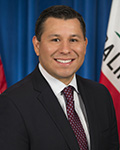
Ask Maddy about Eduardo Garcia
Scope: CA
Hi! I can help you understand Eduardo Garcia's legislative record. What would you like to know?
Try one of these
i
Maddy answers using official bill text and legislative records. Always verify before sharing.
Sources cited inline