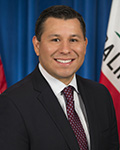
Photo of Eduardo Garcia
D California Assembly · District 36

Asm. Eduardo Garcia

Contact Email
Compare
Total votes
27,298
all sessions
Attendance
92%
1,511 missed
Near the chamber average
With party
99%
of cast votes
Near the chamber average
Bipartisan score
0%
crosses aisle rarely
Near the chamber average
Sponsored
2,006
bills & resolutions
Near the chamber average
Committees
0
assignments
2,006 bills and resolutions

Sponsored bills

Total
2,006
Primary
262
Co-sponsor
1,744
This page
2,006
matching current filters
Primary AB 827
Failed · California Assembly · Lead sponsor
Public health: pulmonary health: Salton Sea region.

Existing law establishes the State Department of Public Health and prescribes its duties related to public health, including the prevention of disease and the promotion of health. Among other duties, contingent on appropriation in the annual Budget Act, the department is required to analyze asthma morbidity and mortality data, periodically assess the burden of asthma on the state's medical and economic resources, and identify those populations most seriously affected by the disease. This bill would require the department to conduct a study of the pulmonary health of communities in the Salton Sea region. The bill would also make related findings and declarations.

Failed Feb 1, 2024 0 co-sponsors
Primary AB 1401
Failed · California Assembly · Lead sponsor
Low Carbon Fuel Standard regulations: alternative diesel fuel regulations.

The California Global Warming Solutions Act of 2006 establishes the State Air Resources Board as the state agency responsible for monitoring and regulating sources emitting greenhouse gases. The act requires the state board to adopt rules and regulations to achieve the maximum technologically feasible and cost-effective greenhouse gas emissions reductions to ensure that the statewide greenhouse gas emissions are reduced to at least 40% below the statewide greenhouse gas emissions limit, as defined, no later than December 31, 2030. Pursuant to the act, the state board has adopted the Low Carbon Fuel Standard regulations. This bill would require the state board, in administering the Low Carbon Fuel Standard, to deem a Tier 2 pathway application certified under specified circumstances. Existing law requires the State Air Resources Board to adopt and implement motor vehicle emission standards, in-use performance standards, and motor vehicle fuel specifications for the control of air contaminants and sources of air pollution the state board has found to be necessary, cost effective, and technologically feasible, to carry out specified purposes, unless preempted by federal law. Pursuant to this and other authority, the state board adopted regulations governing the commercialization of alternative diesel fuels. This bill would require the state board to revise those regulations to authorize the sale, offer for sale, or supply of alternative diesel fuel for use in the state that contains up to 20% biodiesel by volume.

Failed Feb 1, 2024 0 co-sponsors
Primary AB 1609
Failed · California Assembly · Lead sponsor
Air pollution: motor vehicle registration: pollution reduction.

(1) Existing law requires a registration fee to be paid to the Department of Motor Vehicles for the registration of each vehicle or trailer coach of a type subject to registration under the Vehicle Code, except those vehicles that are expressly exempted from the payment of registration fees. Existing law, until January 1, 2024, increases vehicle registration fees by $3 and requires revenues from those fees to be used, upon appropriation by the Legislature, for programs to reduce air pollution from motor vehicles. This bill would impose an additional annual $4 charge on each motor vehicle registered in the state except those vehicles that are expressly exempted from the payment of registration fees, thereby imposing a tax. The bill would require the department to collect the charge and deposit revenues from the charge in the Air Quality Improvement Fee Fund, which the bill would create. The bill would continuously appropriate the revenues in the fund to the department for distribution to air pollution control districts and air quality management districts based upon the amount of the charges collected from motor vehicles registered within each air district, thereby creating an appropriation. The bill would require these revenues to be used for the reduction of air pollution from motor vehicles and for related planning, monitoring, enforcement, and technical studies, as specified, or for the attainment or maintenance of state or federal ambient air quality standards or the reduction of toxic air contaminant emissions from motor vehicles. The bill would also authorize the department to withhold up to 1% of the annual revenues collected from the charge to cover its administrative costs, and the bill would authorize an air district to use not more than 6.25% of the revenues distributed to the air district for its administrative costs. The bill would require the charge to be increased annually based on the California Consumer Price Index, as specified. (2) Existing law authorizes an air pollution control or air quality management district, except the Sacramento district, to levy a surcharge of up to $6 on the registration fees for motor vehicles registered in the air district, as specified by the governing body of the air district. Existing law requires the Department of Motor Vehicles to collect that surcharge if requested by an air district, and requires the department, after deducting its administrative costs, to distribute the revenues to the air districts. Existing law, until January 1, 2034, authorizes a $2 increment of that surcharge to be used for the reduction of air pollution from motor vehicles and for related planning, monitoring, enforcement, and technical studies, as specified, or for the attainment or maintenance of state or federal ambient air quality standards or the reduction of toxic air contaminant emissions from motor vehicles. This bill would authorize that increment to be used for both of those purposes indefinitely. (3) This bill would include a change in state statute that would result in a taxpayer paying a higher tax within the meaning of Section 3 of Article XIIIA of the California Constitution, and thus would require for passage the approval of 23 of the membership of each house of the Legislature.

Failed Feb 1, 2024 0 co-sponsors
Primary AB 1131
Failed · California Assembly · Lead sponsor
Health care: Hospitals First Revolving Fund.

Existing law establishes the Department of Health Care Access and Information, which administers, among other programs, the Rural Hospital Grant Program, which provides grants to alternative rural hospitals and rural hospitals that are sole community providers to encourage the development and transition to an alternative rural hospital model, and to provide essential access to services not available at the alternative rural hospital level, and the Small and Rural Hospital Relief Program for the purpose of funding seismic safety compliance with respect to small hospitals, rural hospitals, and critical access hospitals in the state. This bill would establish the Hospitals First Revolving Fund, administered by the department, to offer grants and low-cost loans to hospitals in rural and medically underserved communities to prevent the closure of a hospital or facilitate the reopening of a closed hospital.

Failed Feb 1, 2024 0 co-sponsors
Primary AB 1562
Failed · California Assembly · Lead sponsor
Governor's Office of Business and Economic Development: Southeast California Desert Valleys Economic Zone.

Existing law authorizes the Governor's Office of Business and Economic Development (office) to develop content on its internet website or through other mediums to be used for public dissemination, through outreach activities, in order to provide information and resources to inform the general public about place-based and other geographically targeted economic development programs, including California Promise Zones and California Opportunity Zones. Existing law requires the office to convene, at least annually, representatives from various programs and agencies across the state and from various federal programs and agencies for the purpose of discussing how California can leverage Promise Zones and Opportunity Zones to meet state and local community and economic development needs. This bill would require the office, subject to available funding, to provide technical assistance to local and regional entities and collaboration on how to establish and maintain regional economic hubs through the designation of place-based economic development zones. The bill would require the director of the office, by January 15, 2024, to designate an economic development liaison to assist entities in the Eastern Coachella Valley and the Imperial Valley to establish a Southeast California Desert Valleys Economic Zone. The bill would also make clarifying changes.

Failed Feb 1, 2024 0 co-sponsors
Primary AB 1579
Failed · California Assembly · Lead sponsor
Vehicles: batteries.

Existing law establishes several programs pertaining to vehicles and reducing pollution, such as the Clean Transportation Program, and various zero-emission vehicle programs administered by the State Air Resources Board, including the Medium- and Heavy-Duty Zero-Emission Vehicle Fleet Purchasing Assistance Program. With regard to zero-emission vehicles or plug-in hybrid electric vehicles, existing law requires the Department of General Services to develop prescribed criteria to evaluate bidders when awarding contracts for commercial rental car services. By January 1, 2025, this bill would require the Department of General Services to report to the Legislature on a specified study regarding the supply chain for lithium batteries in electric vehicles, and recommendations for any legislation or policy related to this supply chain to advance state environmental and economic development goals.

Failed Feb 1, 2024 0 co-sponsors
Primary AB 865
Failed · California Assembly · Lead sponsor
Sale of agricultural products: requirements for sale.

(1) Existing law requires all California state-owned or state-run institutions, except segments of public postsecondary education or local educational agencies, as defined, that purchases agricultural food products to implement necessary practices to achieve a goal of ensuring that at least 60% of the agricultural food products that it purchases in a calendar year are grown or produced in the state by December 31, 2025. Existing law establishes within the Department of Food and Agriculture a public and private collaboration known as the "Buy California Program" to encourage consumer nutritional and food awareness and to foster purchases of high-quality California agricultural products. This bill would require a grower or producer that sells bell peppers, blueberries, dates, honeydew melons, lemons, olives, or table grapes to a distributor, as defined, to attest to the distributor under penalty of perjury, using a self-attestation form developed by the department, whether the agricultural product was produced in compliance with specified California health and environmental protection laws and specified California labor laws, as defined. By expanding the crime of perjury, this bill would create a state-mandated local program. The bill would require a distributor that sells one of those agricultural products to a retailer with more than one retail location to provide to the retailer the self-attestation form received from a grower or producer. The bill would prohibit a distributor from selling the agricultural products to these retailers if the self-attestation form provided to the distributor is incomplete or indicates that the agricultural products were not produced in compliance with the above-described laws. The bill would provide that a violation of these provisions is subject to a $500 civil penalty for each violation. The bill would require the department to adopt regulations to administer and enforce these requirements, as specified. The bill would prohibit the department from imposing additional fees on growers or producers to meet the requirements of this bill. (2) The California Constitution requires the state to reimburse local agencies and school districts for certain costs mandated by the state. Statutory provisions establish procedures for making that reimbursement. This bill would provide that no reimbursement is required by this act for a specified reason.

Failed Feb 1, 2024 0 co-sponsors
Co-sponsor AB 1664
Failed · California Assembly · Co-sponsor
Energy: self-generation incentive program: block grant.

Existing law requires the Public Utilities Commission to require the administration, until January 1, 2026, of a self-generation incentive program to increase the deployment of distributed generation resources and energy storage systems. Existing law requires the commission, in administering the program, to use funds that are appropriated by the Legislature, as provided, for the purposes of providing incentives to eligible residential customers who install behind-the-meter energy storage systems or solar photovoltaic systems paired with energy storage systems. This bill would require, as part of administering the funds used to provide incentives to eligible residential customers, the commission to establish a block grant structure for eligible entities, as defined, to apply for grants on behalf of residential households to increase the resiliency of residential households, as specified. The bill would require the commission, in determining the block grant funding criteria, to consider and prioritize one or more specified requirements. Under existing law, a violation of the Public Utilities Act or any order, decision, rule, direction, demand, or requirement of the commission is a crime. Because the above provision would be a part of the act and a violation of a commission action implementing this bill's requirements would be a crime, the bill would impose a state-mandated local program. The California Constitution requires the state to reimburse local agencies and school districts for certain costs mandated by the state. Statutory provisions establish procedures for making that reimbursement. This bill would provide that no reimbursement is required by this act for a specified reason.

Failed Feb 1, 2024 1 co-sponsor
Co-sponsor AB 1536
Vetoed · California Assembly · Co-sponsor
Cash Assistance Program for Aged, Blind, and Disabled Immigrants.

Existing law requires the State Department of Social Services to establish and supervise a county- or county consortia-administered program to provide cash assistance for aged, blind, or disabled legal immigrants who are not citizens who, due to their immigration status, are not eligible for the Supplemental Security Income/State Supplementary Program for the Aged, Blind, and Disabled, also known as SSI/SSP benefits. Under existing law, an individual is eligible for this program if their immigration status meets SSI/SSP eligibility criteria but they are not eligible for those benefits solely due to their immigration status, as specified. Existing law also requires any person who is found to be eligible by the department for federally funded SSI to apply for SSI benefits. This bill would expand eligibility for that program to aged, blind, and disabled individuals regardless of immigration status if the individual meets the eligibility criteria for the program and is not eligible solely due to their immigration status. This bill would exempt individuals who are not qualified immigrants, as specified, from having to apply for SSI in order to receive benefits. The bill would also delete several inoperative provisions. The bill would make the implementation of these substantive changes contingent upon an appropriation for its express purposes. By expanding county duties under the program, this bill would impose a state-mandated local program. The California Constitution requires the state to reimburse local agencies and school districts for certain costs mandated by the state. Statutory provisions establish procedures for making that reimbursement. This bill would provide that, if the Commission on State Mandates determines that the bill contains costs mandated by the state, reimbursement for those costs shall be made pursuant to the statutory provisions noted above.

Vetoed Jan 30, 2024 1 co-sponsor
Primary AB 371
Vetoed · California Assembly · Lead sponsor
Housing programs: tribal housing program.

Existing law sets forth the general responsibilities and roles of the Business, Consumer Services, and Housing Agency, the Department of Housing and Community Development (department) , and the California Housing Finance Agency in carrying out state housing policies and programs. Existing law, the G. David Singleton California Indian Assistance Program, requires the department to provide comprehensive technical assistance to tribal housing authorities, housing sponsors, and governmental agencies on reservations, rancherias, and on public domain to facilitate the planning and orderly development of suitable, decent, safe, and sanitary housing for American Indians residing in these areas. Upon request of the governing body of a reservation or rancheria, existing law authorizes the department to act on behalf of the tribal housing authority and perform the functions thereof. This bill would remove the authority for the department to act on behalf of the tribal housing authority. The bill would also require the department to provide comprehensive technical assistance to tribes, designated tribal housing entities, and tribal housing departments on reservations, rancherias, and on public domain, and tribes that want to participate in tribal housing grant programs on fee simple land. The bill would additionally require the department to provide comprehensive technical assistance to facilitate the planning and orderly development of suitable, decent, safe, and sanity housing for American Indians residing within a tribe's designated service area, as defined by the tribe. The bill would require the department to provide outreach, education, and comprehensive technical assistance to tribes, tribal housing authorities, tribally designated housing entity, housing departments of a tribe, housing sponsors, and governmental agencies on reservations, rancherias, and on public domain in the development of tribal housing grant programs, and before, during, and after the grant application process. The bill would require data collected pursuant to these provisions to be kept confidential and not subject to public disclosure. Existing law authorizes the department to modify or waive various requirements of any state financing being provided to a housing development by the department in specified situations, if tribal law, tribal governance, tribal charter, or difference in tribal entity or agency legal structure would cause a violation or not satisfy the requirements for the financing. Existing law authorizes the department to waive, among other things, target population percentage requirements, not to exceed a change of more than 5% of any amount expressly set forth in statute and affordability levels and unit mix requirements, not to exceed a change of more than 5% of any amount expressly set forth in statute. This bill would instead authorize the department to waive the target population percentage requirements and affordability levels and unit mix requirements, without limitation. The bill would additionally authorize the department to waive, among other things, timeline requirements, service area requirements, fund matching requirements, shovel ready project requirements, and requirements related to housing elements and housing plans, and income limits. To provide assistance with these waivers, the bill would require the department to, among other things, assign each waiver submitted a waiver reference number and post on its internet website a waiver submitted to the department, including the nature of the waiver and the waiver reference number. This bill would require the department to include its designated tribal liaison or their designee in all discussions with tribes that are eligible recipients, unless those eligible recipients give permission for the tribal liaison or their designee to be absent. If the department requires a tribe that is an eligible recipient of state funding to waive tribal sovereignty in order to access funds, the bill would require the department to draft the waiver narrowly to serve both the individual needs of the tribe and make the funding agreement enforceable. Existing constitutional provisions require that a statute that limits the right of access to the meetings of public bodies or the writings of public officials and agencies be adopted with findings demonstrating the interest protected by the limitation and the need for protecting that interest. This bill would make legislative findings to that effect.


Vetoed Jan 25, 2024 0 co-sponsors
Showing 231 to 240 of 2,006 bills
Previous 1 … 23 24 25 … 201 Next