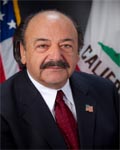
Photo of Katcho Achadjian
R California Assembly · District 35

Asm. Katcho Achadjian

Compare
Total votes
12,699
all sessions
Attendance
97%
310 missed
Near the chamber average
With party
92%
of cast votes
Lower than 90% of chamber peers
Bipartisan score
4%
crosses aisle rarely
Higher than 86% of chamber peers
Sponsored
807
bills & resolutions
Lower than 91% of chamber peers
Committees
0
assignments
807 bills and resolutions

Sponsored bills

Total
807
Primary
92
Co-sponsor
715
This page
807
matching current filters
Primary AB 2451
In committee · California Assembly · Lead sponsor
Vehicles: ridesharing.

Existing law defines ridesharing to mean 2 or more persons traveling by any mode, including, but not limited to, carpooling, vanpooling, buspooling, taxipooling, jitney, and public transit. This bill would make a technical, nonsubstantive change to that provision.

In committee Feb 22, 2016 0 co-sponsors
Primary AB 2378
In committee · California Assembly · Lead sponsor
Theft.

Under existing law, grand theft is generally the theft of anything valued at $950 or more and is punished as either a misdemeanor or a felony. All other theft is petty theft and is punished as a misdemeanor. This bill would state the intent of the Legislature to enact legislation relating to theft.

In committee Feb 19, 2016 0 co-sponsors
Co-sponsor ACR 9
Signed into law · California Assembly · Co-sponsor
Relative to Pet Care Education Month.

This measure would declare the month of January 2016 as Pet Care Education Month and would request Californians to observe the month by ensuring that their companion animals receive the proper preventative care by establishing a financial plan for pet health emergencies and by contributing to charitable organizations that provide low-cost spay and neuter services and vaccinations or funds to help low-income individuals pay for veterinary care.

Signed into law Feb 10, 2016 1 co-sponsor
Co-sponsor SB 243
In committee · California Senate · Co-sponsor
Medi-Cal: reimbursement: provider rates.

(1) Existing law establishes the Medi-Cal program, administered by the State Department of Health Care Services, under which health care services are provided to qualified, low-income persons. The Medi-Cal program is, in part, governed and funded by federal Medicaid provisions. Existing law requires the department to develop and implement a Medi-Cal inpatient hospital reimbursement payment methodology based on diagnosis-related groups, subject to federal approval, that reflects the costs and staffing levels associated with quality of care for patients in all general acute care hospitals, as specified. Existing law generally requires the diagnosis-related group-based payments to apply to all claims. This bill would require claims for payments pursuant to the inpatient hospital reimbursement methodology described above to be increased by 16% for the 2015–16 fiscal year, and would require, commencing July 1, 2016, and annually thereafter, the department to increase each diagnosis-related group payment claim amount based, at a minimum, on increases in the medical component of the California Consumer Price Index. Commencing with the 2015–16 fiscal year, and annually thereafter, the bill would require managed care rates for Medi-Cal managed care health plans to be increased by a proportionately equal amount for increased payments for hospital services. (2) Existing law requires, except as otherwise provided, Medi-Cal provider payments to be reduced by 1% or 5%, and provider payments for specified non-Medi-Cal programs to be reduced by 1%, for dates of service on and after March 1, 2009, and until June 1, 2011. Existing law requires, except as otherwise provided, Medi-Cal provider payments and payments for specified non-Medi-Cal programs to be reduced by 10% for dates of service on and after June 1, 2011. This bill would, instead, prohibit the application of those reductions for payments to providers for dates of service on or after June 1, 2011. The bill would also require payments for managed care health plans for dates of service following the effective date of the bill to be determined without application of some of those reductions. The bill would require the Director of Health Care Services to implement this provision to the maximum extent permitted by federal law and for the maximum time period for which the director obtains federal approval for federal financial participation for those payments. (3) Prior law required, beginning January 1, 2013, through and including December 31, 2014, that payments for primary care services provided by specified physicians be no less than 100% of the payment rate that applies to those services and physicians as established by the Medicare program, for both fee-for-service and managed care plans. This bill, commencing January 1, 2016, would require payments for specified medical care services to not be less than 100% of the payment rate that applies to those services as established by the Medicare program for services rendered by fee-for-service providers, and would require rates paid to Medi-Cal managed care plans to be actuarially equivalent to payment rates established by the Medicare program. The bill, commencing January 1, 2016, would require rates paid to Denti-Cal providers for dental services provided to adults and children to be increased by the equivalent percentage as the percentage increase required for other fee-for-service Medi-Cal providers. The bill would require those provisions to be implemented only to the extent permitted by federal law and that federal financial participation is available. The bill would authorize the department to implement those provisions through provider bulletins without taking regulatory action until regulations are adopted, and would require the department to adopt those regulations by July 1, 2018. The bill would require, commencing July 1, 2016, the department to provide a status report to the Legislature on a semiannual basis until regulations have been adopted. (4) This bill would declare that it is to take effect immediately as an urgency statute.


In committee Feb 1, 2016 1 co-sponsor
Primary AB 212
died · California Assembly · Lead sponsor
State highways.

Existing law establishes the Department of Transportation and the California Transportation Commission and provides that the department has full possession and control of all state highways and all property and rights in property acquired for state highway purposes and authorizes and directs the department to lay out and construct all state highways between the termini designated by law and on the locations as determined by the commission. This bill would make technical, nonsubstantive changes to these provisions.

died Feb 1, 2016 0 co-sponsors
Primary AB 286
Failed · California Assembly · Lead sponsor
Developmental services: supported living services.

Existing law, the Lanterman Developmental Disabilities Services Act, requires the State Department of Developmental Services to contract with regional centers to provide services and supports, including supported living services, to individuals with developmental disabilities and their families. Existing law lists the range of supported living services and supports to include, among other things, recruiting, training, and hiring individuals to provide personal care and other assistance, and requires supported living service providers to conduct comprehensive assessments for the purpose of getting to know the consumer they will be supporting. This bill would require direct care workers providing supported living services to satisfactorily complete 15 hours of training in behavioral intervention within 3 months from the date the provider was hired.

Failed Feb 1, 2016 0 co-sponsors
Co-sponsor AB 1410
Failed · California Assembly · Co-sponsor
Public employees' retirement: investments: Turkish investment vehicles.

The California Constitution provides that the Legislature may by statute prohibit retirement board investments if it is in the public interest to do so, and providing that the prohibition satisfies specified fiduciary standards. Existing law prohibits the Public Employees' Retirement System and the State Teachers' Retirement System from investing public employee retirement funds in a company with active business operations in Sudan and in Iran, as specified. This bill would additionally prohibit the Public Employees' Retirement System and the State Teachers' Retirement System from investing public employee retirement funds in a Turkish investment vehicle, as specified. The bill would require the Board of Administration of the Public Employees' Retirement System and the Teachers' Retirement Board of the State Teachers' Retirement System to sell or transfer any investments in a Turkish investment vehicle. This bill would require these boards, on or before January 1, 2017, and annually thereafter, to report to the Legislature any investments in a Turkish investment vehicle and the sale or transfer of those investments, subject to the fiduciary duty of these boards. This bill would indemnify from the General Fund and hold harmless the present, former, and future board members, officers, and employees of and investment managers under contract with those retirement systems.

Failed Feb 1, 2016 1 co-sponsor
Showing 151 to 160 of 807 bills
Previous 1 … 15 16 17 … 81 Next