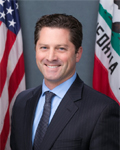
Photo of Jordan Cunningham
R California Assembly · District 35

Asm. Jordan Cunningham

Compare
Total votes
13,035
all sessions
Attendance
91%
921 missed
Lower than 86% of chamber peers
With party
95%
of cast votes
Among the lowest in the chamber
Bipartisan score
3%
crosses aisle rarely
Higher than 98% of chamber peers
Sponsored
995
bills & resolutions
Near the chamber average
Committees
0
assignments
995 bills and resolutions

Sponsored bills

Total
995
Primary
116
Co-sponsor
879
This page
995
matching current filters
Primary AB 2914
In committee · California Assembly · Lead sponsor
Crimes: forgery.

Existing law provides that every person who, with the intent to defraud, designs, makes, alters, or embosses, a counterfeit access card or utters or otherwise attempts to use a counterfeit access card is guilty of forgery. This bill would make technical, nonsubstantive changes to these provisions.

In committee Feb 19, 2022 0 co-sponsors
Primary AB 2474
In committee · California Assembly · Lead sponsor
Articles of incorporation: filing fee: cancellation.

Existing law authorizes one or more natural persons, partnerships, associations, or corporations, domestic or foreign, to form a corporation by executing and filing articles of incorporation. Existing law imposes a fee in connection with the filing of articles of a domestic corporation or the filing of a statement and designation by a foreign corporation and a franchise tax on corporations doing business within the state, as provided. Existing law authorizes the Secretary of State to cancel those filings if a check or other remittance accepted as payment is not paid upon presentation. Existing law requires the secretary to give written notice of the effective date of the cancellation, as specified, and requires the cancellation date to be not less than 20 days from the date of mailing the written notice as certified by the secretary. This bill would instead require the cancellation date to be not less than 30 days from the date of mailing the written notice as certified by the secretary.

In committee Feb 18, 2022 0 co-sponsors
Co-sponsor AB 123
Vetoed · California Assembly · Co-sponsor
Paid family leave: weekly benefit amount.

Existing unemployment compensation disability law requires workers to pay contribution rates based on, among other things, wages received in employment and benefit disbursement, for payment into the Unemployment Compensation Disability Fund, a special fund in the State Treasury. That fund is continuously appropriated for the purpose of providing disability benefits and making payment of expenses in administering those provisions. Existing unemployment compensation disability law provides a formula for determining benefits available to qualifying disabled individuals. Under existing law, for periods of disability commencing on and after January 1, 2023, if the amount of wages paid an individual during the quarter of their disability base period in which those wages were highest exceeds $1,749.20, the weekly benefit amount is 55% of those wages divided by 13. Under existing law, a benefit that is not a multiple of $1 shall be computed to the next higher multiple of $1, and the amount of the benefit is prohibited from exceeding the maximum workers' compensation temporary disability indemnity weekly benefit amount. Under existing law, the maximum amount of benefits payable to an individual during any one disability benefit period is 52 times their weekly benefit amount, as specified. Existing law establishes, within the above state disability insurance program, a family temporary disability insurance program, also known as the paid family leave program, for the provision of wage replacement benefits for up to 8 weeks to workers who take time off work to care for a seriously ill family member or to bond with a minor child within one year of birth or placement, as specified. Existing law defines "weekly benefit amount" for purposes of both employee contributions and benefits under this program to mean the amount of weekly benefits available to qualifying disabled individuals pursuant to unemployment compensation disability law, calculated pursuant to specified formulas partly based on the applicable percentage of the wages paid to an individual for employment by employers during the quarter of the individual's disability base period in which these wages were highest, but not to exceed the maximum workers' compensation temporary disability indemnity weekly benefit amount established by the Department of Industrial Relations. This bill would revise the formulas described above for periods of disability commencing after January 1, 2023, but before January 1, 2025, by redefining the weekly benefit amount to be equal to 65% or 75% of the wages paid to an individual for employment by employers during the quarter of the individual's disability base period in which these wages were highest, divided by 13, but not exceeding the maximum workers' compensation temporary disability indemnity weekly benefit amount established by the Department of Industrial Relations, depending on the amount of wages paid to the individual for employment by employers during the quarter of the individual's disability base period in which these wages were highest. The bill would, for periods of disability commencing after January 1, 2025, increase the wage replacement percentages to be equal to 70% or 90% depending on the amount of wages paid to the individual for employment by employers during the quarter of the individual's disability base period in which these wages were highest. The bill, however, would only make these revisions to the formula applicable to only the first 12 weeks of benefits for disability benefits that are not the paid family leave program. By providing for the deposit of additional contributions in, and by authorizing an increase in disbursements from, the Unemployment Compensation Disability Fund, this bill would make an appropriation.


Vetoed Feb 3, 2022 1 co-sponsor
Primary AB 1414
died · California Assembly · Lead sponsor
Crimes: intent.

Under existing law, the intent to commit a crime is manifested by the circumstances connected with the offense. In the guilt phase of a criminal action or a juvenile adjudication hearing, existing law makes evidence that the accused lacked the capacity or ability to control their conduct inadmissible on the issue of whether they had any mental state with respect to the commission of any crime. This bill would make technical, nonsubstantive changes to these provisions.

died Feb 1, 2022 0 co-sponsors
Primary AB 1412
died · California Assembly · Lead sponsor
Director of Finance: gifts.

Existing law authorizes the Director of Finance to accept any gift of real or personal property on behalf of the state whenever the director deems such gift and the terms and conditions thereof to be in the best interest of the state. This bill would make nonsubstantive changes to that provision.

died Feb 1, 2022 0 co-sponsors
Co-sponsor SB 285
died · California Senate · Co-sponsor
California Tourism Recovery Act.

Existing law, the California Tourism and Marketing Act, establishes a nonprofit mutual benefit corporation named the California Travel and Tourism Commission under the direction of a board of commissioners composed of 37 members, including the Director of the Governor's Office of Business and Economic Development. This bill, the California Tourism Recovery Act, would require the commission to, upon a determination by the State Department of Public Health that it is safe to resume travel in California, implement a strategic media and jobs recovery campaign known as the "Calling All Californians" program for the purpose of reversing the impact of the COVID-19 pandemic on the travel and tourism industry in California, as specified. The bill would require the commission to report to the Legislature, on or before January 1, 2024, regarding the cost of the program and the impact of the program on the tourism industry in California. The bill would require, only upon appropriation by the Legislature, the Controller to transfer $45,000,000 to the commission for the purpose of implementing the "Calling All Californians" program.

died Feb 1, 2022 1 co-sponsor
Co-sponsor SB 229
In committee · California Senate · Co-sponsor
Pupil health: mental health services: grants.

Existing law requires the governing board of any school district to give diligent care to the health and physical development of pupils and authorizes the governing board of a school district to employ properly certified persons for the work, including school psychologists and counselors. This bill would require the State Department of Education, upon appropriation by the Legislature, to provide up to $500,000,000 in grants each year for the purpose of providing mental health services for all pupils, including those affected by school closures and distance learning requirements resulting from the COVID-19 pandemic. The bill would require the department to allocate those grants to local educational agencies, as specified. The bill would be implemented only to the extent that funds for its purposes are appropriated by the Legislature in the annual Budget Act, and would authorize that appropriation to come from any available state and federal funds.

In committee Feb 1, 2022 1 co-sponsor
Co-sponsor SB 220
In committee · California Senate · Co-sponsor
Craft distillers: direct shipping.

Existing law, the Alcoholic Beverage Control Act, which is administered by the Department of Alcoholic Beverage Control, regulates the application, issuance, and suspension of alcoholic beverage licenses. Existing law establishes specified types of alcoholic beverage licenses and prescribes the rights and duties of the respective licensees. Existing law prohibits a person without the appropriate license from exercising a privilege or performing any act for which the license is required, and a violation of this prohibition is a misdemeanor or a felony, as specified. Existing law authorizes a licensed craft distiller to manufacture and produce distilled spirits, subject to specified conditions, including that the licensee manufacture no more than 150,000 gallons of distilled spirits per fiscal year and sell no more than 2.25 liters of prepackaged containers of the licensee's spirits per day per consumer. This bill would additionally authorize a licensed craft distiller to sell and ship distilled spirits directly to a California resident, who is at least 21 years of age, for the resident's personal use and not for resale, under specific conditions. This bill would also authorize a person currently licensed in another state as a craft distiller, or licensed in a similar manner, that obtains a distilled spirits direct shipper permit to sell and ship distilled spirits directly to a California resident, who is at least 21 years of age, for the resident's personal use and not for resale, under similar conditions. The bill would make a knowing violation of these provisions a misdemeanor. The bill would establish a new license type for a distilled spirits direct shipper permit (Type 89) and would set an application fee of $100 and an annual renewal fee of $25. By expanding the scope of an existing crime and creating a new crime, this bill would impose a state-mandated local program. The California Constitution requires the state to reimburse local agencies and school districts for certain costs mandated by the state. Statutory provisions establish procedures for making that reimbursement. This bill would provide that no reimbursement is required by this act for a specified reason.

In committee Feb 1, 2022 1 co-sponsor
Showing 211 to 220 of 995 bills
Previous 1 … 21 22 23 … 100 Next