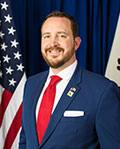
Photo of Devon Mathis
R California Assembly · District 33

Asm. Devon Mathis

Contact Email
Compare
Total votes
23,116
all sessions
Attendance
85%
2,834 missed
Near the chamber average
With party
97%
of cast votes
Near the chamber average
Bipartisan score
2%
crosses aisle rarely
Near the chamber average
Sponsored
2,082
bills & resolutions
Higher than 76% of chamber peers
Committees
0
assignments
2,082 bills and resolutions

Sponsored bills

Total
2,082
Primary
225
Co-sponsor
1,857
This page
2,082
matching current filters
Co-sponsor ACR 241
Signed into law · California Assembly · Co-sponsor
Relative to cardiopulmonary resuscitation.

This measure would declare the week of June 1, 2018, to June 7, 2018, inclusive, as Cardiopulmonary Resuscitation and Automated External Defibrillator Awareness Week in California, as specified.

Signed into law Aug 17, 2018 1 co-sponsor
Co-sponsor ACR 242
Signed into law · California Assembly · Co-sponsor
Relative to California Manufacturing Day.

This measure would declare Friday, October 5, 2018, as California Manufacturing Day and would recognize the importance of California's manufacturing sector. The measure would also commemorate California's manufacturers as they continue to push the bounds of clean technologies that reduce emissions and increase energy efficiency in products and processes.

Signed into law Aug 17, 2018 1 co-sponsor
Co-sponsor AB 1952
Passed · California Assembly · Co-sponsor
Social services: access to food.

Existing law provides for the federal Supplemental Nutrition Assistance Program (SNAP) , administered in California as CalFresh, under which each county distributes nutrition assistance benefits provided by the federal government to eligible households. Existing state law authorizes a county to deliver CalFresh benefits through the use of an electronic benefits transfer (EBT) acceptance system. Existing law, until January 1, 2022, encourages the Regents of the University of California, requires the Trustees of the California State University, and authorizes the Board of Governors of the California Community Colleges, to designate as a "hunger-free campus" each of the institutions' respective campuses that meet specified criteria, including having a campus employee designated to help ensure that students have the information they need to enroll in CalFresh. This bill would require the State Department of Social Services, the State Department of Public Health, the State Department of Education, and the Department of Food and Agriculture, to develop a plan to end hunger. The bill would require the State Department of Social Services to serve as the lead agency for the development of the plan. The bill would require the plan to be distributed to the Legislature no later than January 1, 2020, and would establish criteria for the plan, including that the plan establish a budget of $11,500,000, contingent upon an appropriation in the annual Budget Act or other measure, for the Department of Food and Agriculture to support local food hub efforts. The bill would also require the plan to request the Regents of the University of California, and direct the Trustees of the California State University and the Board of Governors of the California Community Colleges, to develop systems that allow EBT cards to be used on their respective campuses, and present a report to the Assembly Select Committee on Campus Climate on the progress that has been made, by July 1, 2019.

Passed Aug 16, 2018 1 co-sponsor
Co-sponsor AB 2018
Passed · California Assembly · Co-sponsor
Mental health workforce planning: loan forgiveness, loan repayment, and scholarship programs.

Existing law establishes the Steven M. Thompson Physician Corps Loan Repayment Program (program) in the California Physician Corps Program within the Health Professions Education Foundation, which provides financial incentives, including repayment of educational loans, to a physician and surgeon who practices in a medically underserved area, as defined. Existing law establishes the Medically Underserved Account for Physicians, a continuously appropriated account, within the Health Professions Education Fund, to primarily provide funding for the ongoing operations of the program. Existing law defines "practice setting," for these purposes, to include a community clinic, as defined, a clinic owned or operated by a public hospital and health system, or a clinic owned and operated by a hospital that maintains the primary contract with a county government to fulfill the county's role to serve its indigent population, that is located in a medically underserved area and at least 50% of whose patients are from a medically underserved population. Existing law also defines "practice setting," for these purposes, to include a physician owned and operated medical practice setting that provides primary care located in a medically underserved area and has a minimum of 50% of patients who are uninsured, Medi-Cal beneficiaries, or beneficiaries of another publicly funded program that serves patients who earn less than 250% of the federal poverty level. This bill also would define "practice setting" to include a program or facility operated by, or contracted to, a county mental health plan. By expanding the group of persons eligible for financial incentives payable from a continuously appropriated fund, this bill would make an appropriation. Existing law, the Mental Health Services Act, an initiative measure enacted by the voters as Proposition 63 at the November 2, 2004, statewide general election, requires the Office of Statewide Health Planning and Development (OSHPD) , in coordination with the California Behavioral Health Planning Council, to identify the total statewide needs for each professional and other occupational category utilizing county needs assessment information and develop a 5-year education and training development plan. Existing law requires OSHPD to include specified components in the 5-year plan, including expansion plans for the forgiveness and scholarship programs offered in return for a commitment to employment in California's public mental health system and making loan forgiveness programs available to current employees of the mental health system who want to obtain Associate of Arts, Bachelor of Arts, master's degrees, or doctoral degrees. This bill would clarify that OSHPD needs to include in the 5-year plan both expansion plans for loan forgiveness and scholarship programs offered in return for a commitment to employment in California's public mental health system and expansion plans for making loan forgiveness programs available to current employees of the mental health system who want to obtain Associate of Arts, Bachelor of Arts, master's degrees, or doctoral degrees. The bill would also make specified findings and declarations.

Passed Aug 16, 2018 1 co-sponsor
Co-sponsor AB 986
Passed · California Assembly · Co-sponsor
Hunting and sport fishing licenses: sport fishing license duration: reduction in license fees for veterans.

Existing law requires every person 16 years of age or older who takes any fish, reptile, or amphibian for any purpose other than profit to first obtain a sport fishing license for that purpose, with specified exceptions, and to have that license on his or her person or in his or her immediate possession when engaged in carrying out any activity authorized by the license. Existing law requires a resident or a nonresident, 16 years of age or older, upon payment of a specified fee, to be issued a sport fishing license for the period of a calendar year, or, if issued after the beginning of the year, for the remainder thereof. Existing law also requires the issuance of shorter term licenses upon payment of a specified lesser fee. Existing law requires the Fish and Game Commission to adjust the amount of the fees, as prescribed, to fully recover, but not exceed, all reasonable administrative and implementation costs of the Department of Fish and Wildlife and the commission relating to those licenses. This bill, in addition to sport fishing licenses for the periods specified above, would require a sport fishing license to be issued to a resident or nonresident for the period of 12 consecutive months, upon payment of a fee that is equal to 130% of the fees for issuance of resident or nonresident calendar-year licenses, as applicable. The bill would require the commission to adjust the amount of the fees as necessary to fully recover, but not exceed, all reasonableimplementation and administrative costs of the department and the commission relating to these licenses, including all costs related to their establishment and enforcement. The bill would require the department to submit to the Legislature a written report on the implementation of these provisions, as provided. The bill would make these provisions operative beginning January 1, 2020, until January 1, 2023. Under existing law, a hunting license grants the privilege to take birds and mammals. Existing law requires the department to issue a hunting license for specified periods of time, including for a term of one year, as provided, upon payment of a fee, to eligible residents and nonresidents. Existing law requires the department to issue a sport fishing license for specified periods of time, including for the period of a calendar year, as provided, upon payment of a fee, to eligible residents and nonresidents. Existing law requires the department to issue lifetime hunting licenses and lifetime sport fishing licenses, and grants certain lifetime privileges to holders of those licenses, upon the one-time payment of specified fees. This bill would require the department to reduce the fee required to obtain the above-described licenses and the 12 consecutive month licenses created by this bill by 25% for a person who is a veteran of the Armed Forces of the United States, was honorably discharged, and is a resident of California. Under existing law, the department issues, upon payment of specified fees, various types of sport fishing report cards and validations that are required, in addition to a sport fishing license, to engage in various activities relating to the taking and possession of amphibians, reptiles, and fish for purposes other than profit. This bill would require the department to reduce the fee required to obtain a sport fishing report card, validation, or other entitlement by 25% for a person who is a veteran of the Armed Forces of the United States, was honorably discharged, and is a resident of California and by 50% for a person who meets those requirements and who also has a 50% or greater service-connected disability.


Passed Aug 16, 2018 1 co-sponsor
Primary AB 2539
Passed · California Assembly · Lead sponsor
California Physician Corps Program: practice setting.

Existing law establishes the Steven M. Thompson Physician Corps Loan Repayment Program (program) in the California Physician Corps Program within the Health Professions Education Foundation, which provides financial incentives, including repayment of educational loans, to a physician and surgeon who practices in a medically underserved area, as defined. Existing law establishes the Medically Underserved Account for Physicians, a continuously appropriated account, within the Health Professions Education Fund, to primarily provide funding for the ongoing operations of the program. Existing law requires the foundation and the Office of Statewide Health Planning and Development to develop guidelines using specified criteria for selection and placement of applicants. Existing law defines "practice setting," for these purposes, to include a community clinic, as defined, a clinic owned or operated by a public hospital and health system, or a clinic owned and operated by a hospital that maintains the primary contract with a county government to fulfill the county's role to serve its indigent population, that is located in a medically underserved area and at least 50% of whose patients are from a medically underserved population. Existing law also defines "practice setting," for these purposes, to include a physician owned and operated medical practice setting that provides primary care located in a medically underserved area and has a minimum of 50% of patients who are uninsured, Medi-Cal beneficiaries, or beneficiaries of another publicly funded program that serves patients who earn less than 250% of the federal poverty level. This bill would instead require, for purposes of this definition, only until January 1, 2021, and only for program participants who enroll in the program on or after January 1, 2019, and before January 1, 2021, that the clinic or the physician owned and operated medical practice setting have at least 30% of patients, if the area is a rural area, as defined, or at least 50% of patients, if the area is not a rural area, who are from the above-described populations. By expanding the authorization for the use of moneys in the continuously appropriated Medically Underserved Account for Physicians, this bill would make an appropriation. The bill would require the foundation to prepare a study to determine the effect that the revised definition has on funding for loan repayment granted under the program during the calendar years 2019 and 2020. The bill would require the foundation to submit 2 reports of the study by March 1, 2020, and March 1, 2021, respectively, including program data for certain years and identifying specified information. The bill would appropriate $120,000 from the General Fund to the office to amend regulations, as applicable, to provide technical assistance to the increased number of program applicants, and to prepare the above-described study and reports, for the purpose of implementing this bill. The bill would also make conforming changes to related provisions.

Passed Aug 16, 2018 0 co-sponsors
Co-sponsor AB 2124
Passed · California Assembly · Co-sponsor
Human trafficking: vertical prosecution program.

Existing law establishes the Office of Emergency Services, which is required to, among other things, allocate and award funds to communities developing and providing ongoing citizen involvement and crime resistance programs. This bill would require the office, to the extent funds are available for this purpose and until January 1, 2023, to allocate and award funds to up to 11 district attorney offices that employ a vertical prosecution methodology for the prosecution of human trafficking crimes and that meet other specified criteria, including minimum staffing levels for the program. The bill would require the office, on or before January 1, 2021, to submit to the Legislature and the Governor's office a report that describes the counties that received funding pursuant to this program, the number of prosecutions for human trafficking cases filed by the counties receiving funding, the number of human trafficking convictions obtained by those counties, and the sentences imposed for human trafficking crimes in those counties. The bill would be operative only to the extent that funding is provided in the annual Budget Act or another statute for the purposes of the bill.

Passed Aug 16, 2018 1 co-sponsor
Co-sponsor AB 2087
Passed · California Assembly · Co-sponsor
State government operations: technology modernization.

Existing law establishes the Department of Technology within the Government Operations Agency, under the supervision of the Director of Technology. Existing law requires state agencies, as defined, as required by the director, to cooperate with the department in the development of an annual information technology strategic plan that guides the acquisition, management, and use of information technology. Existing law gives state agencies and entities various other responsibilities relating to their use of technology, including submission of a report on actual and projected costs of information technology, telecommunications, and information security, and development of a plan to leverage cost-effective strategies to reduce the total amount of energy utilized by information technology and telecommunications equipment, as provided. This bill would require each state agency, not later than January 1, 2020, to, in consultation with the Department of Technology, establish modernization goals that will achieve specified objectives. The bill would require those goals to include, but not be limited to, goals for modernization of the agency's information technology system and for usage of technologies that will improve the efficiency of the agency. The bill would require an agency, upon establishing those goals, to create an implementation and cost assessment plan for achieving them. The bill would define "state agency" for these purposes to include the Legislature.

Passed Aug 16, 2018 1 co-sponsor
Co-sponsor AB 3021
Passed · California Assembly · Co-sponsor
Farm animals: egg-laying hens: confinement.

(1) Existing law, enacted by Proposition 2, an initiative measure approved by the voters at the November 4, 2008, statewide general election, prohibits a person from tethering or confining a calf raised for veal, a pregnant pig, or an egg-laying hen on a farm in a manner that prevents the animal from lying down, standing up, fully extending its limbs, or turning around freely, except under specified circumstances. Existing statutory law prohibits a shelled egg from being sold or contracted for sale for human consumption in California if the seller knows or should have known that the egg is the product of an egg-laying hen that was confined on a farm or place that is not in compliance with the above-specified animal care standards. This bill would also prohibit a farm owner or operator in California from confining an egg-laying hen in an enclosure that is not in compliance with specified standards, except as provided. The bill would prohibit a person from selling or contracting to sell shell eggs or liquid eggs in California from an egg-laying hen that was in an enclosure not in compliance with the specified standards. The bill would make a violation of the bill's provisions a misdemeanor, thereby imposing a state-mandated local program. The bill would require the Department of Food and Agriculture to promulgate regulations for the implementation of those provisions on or before September 1, 2019. (2) Existing law requires California and out-of-state egg handlers and producers to pay to the Secretary of Food and Agriculture a maximum fee of $0.15 for each 30 dozen eggs sold in this state, as provided. Existing law requires the fees paid to the secretary under these provisions to be deposited in the Department of Food and Agriculture Fund, a continuously appropriated fund for these purposes. Existing law requires the secretary to establish a lower rate for these fees if the funds derived from the assessment are more than reasonably necessary to cover the cost of administration and enforcement of the preparation for market and marketing of eggs, as specified. This bill would additionally authorize these fees to be used for the administration and enforcement of the provisions described in paragraph (1) and would make a conforming change. By expanding the purposes of a continuously appropriated fund, this bill would make an appropriation. (3) The California Constitution requires the state to reimburse local agencies and school districts for certain costs mandated by the state. Statutory provisions establish procedures for making that reimbursement. This bill would provide that no reimbursement is required by this act for a specified reason.

Passed Aug 16, 2018 1 co-sponsor
Co-sponsor AB 862
Passed · California Assembly · Co-sponsor
Social innovation financing.

Existing law, until January 1, 2022, establishes the Social Innovation Financing Program to award grant funding to 3 counties to reduce recidivism through contracts between the government, private investors, and service providers pursuant to which private investors agree to provide financing to service providers to achieve social outcomes agreed upon in advance, and the government agency agrees to pay a return on the investment to the investors if successful programmatic outcomes are achieved by the service provider. Existing law, upon appropriation by the Legislature, requires the Board of State and Community Corrections to issue grants in an amount of not less than $500,000 and not more than $2,000,000 to each county selected, up to a maximum of $5,000,000. This bill would establish the Social Innovation Financing Program of 2018. The bill would require the board to select 3 counties to receive funding and would require the board to issue grants in an amount of not less than $300,000 and not more than $2,000,000, up to a maximum of $5,000,000. The bill would repeal the program as of January 1, 2025.

Passed Aug 16, 2018 1 co-sponsor
Showing 1,331 to 1,340 of 2,082 bills