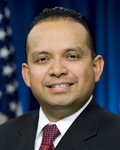
Photo of Luis Alejo
D California Assembly · District 30

Asm. Luis Alejo

Compare
Total votes
13,365
all sessions
Attendance
95%
552 missed
Near the chamber average
With party
99%
of cast votes
Near the chamber average
Bipartisan score
0%
crosses aisle rarely
Near the chamber average
Sponsored
940
bills & resolutions
Near the chamber average
Committees
0
assignments
940 bills and resolutions

Sponsored bills

Total
940
Primary
142
Co-sponsor
798
This page
940
matching current filters
Co-sponsor SB 14
Vetoed · California Senate · Co-sponsor
State Budget.

(1) The California Constitution requires the Governor to submit annually to the Legislature a budget itemizing state expenditures and estimating state revenues and requires the Legislature to pass the Budget Bill by midnight on June 15. This bill would require that the budget submitted by the Governor to the Legislature for the 2013–14 fiscal year and each fiscal year thereafter, as specified in a plan developed by the Department of Finance and distributed to the appropriate committees of the Legislature by August 1, 2012, be developed pursuant to performance-based budgeting, as defined, for each state agency. (2) Under existing law, a state agency for which an appropriation is made is generally required to submit to the Department of Finance for approval a complete and detailed budget setting forth all proposed expenditures and estimated revenues for the ensuing fiscal year. The bill would require the budget of a state agency, as defined, submitted to the department as specified in the plan developed by the department, to utilize performance-based budgeting for all programs, as defined to include those performed not only by state agencies, but by local agencies, contractors, or others that have a material relationship with the state, or its authorities and activities. For those programs not administered by the state, but which confer a benefit that would not otherwise be conferred but for the action of state government, state departments would be required to develop a process for consulting with responsible local agencies, contractors or other responsible entities, and stakeholders to develop information related to performance standards and program performance. The bill would require the department to include specified performance-based budgeting information in the Governor's Budget proposal and to post that information on the department's Internet Web site. Implementation of the requirement to use performance-based budgeting for departments and programs would be contingent on an appropriation of funding for that requirement in the annual Budget Act.


Vetoed Mar 1, 2012 1 co-sponsor
Primary AB 496
Failed · California Assembly · Lead sponsor
School safety: comprehensive school safety plans.

(1) Existing law requires a schoolsite council to write and develop a comprehensive school safety plan, except in the case of a small school district, as defined, that develops a districtwide comprehensive school safety plan that is applicable to each schoolsite in the school district. The comprehensive school safety plan is required to include routine and emergency disaster procedures. This bill would require disaster procedures of the comprehensive school safety plan also to include a protocol for ensuring that all school personnel have access to classrooms and other school facilities during a disaster or other emergency if a school restricts that access during regular hours of school operation. The inclusion of this protocol would increase the duties of local officials and thus impose a state-mandated local program (2) The California Constitution requires the state to reimburse local agencies and school districts for certain costs mandated by the state. Statutory provisions establish procedures for making that reimbursement. This bill would provide that, if the Commission on State Mandates determines that the bill contains costs mandated by the state, reimbursement for those costs shall be made pursuant to these statutory provisions.

Failed Feb 1, 2012 0 co-sponsors
Primary AB 1363
Failed · California Assembly · Lead sponsor
Workers' compensation insurance: rating organizations: statistical agent.

Existing law requires the Insurance Commissioner to designate a licensed rating organization, as defined, as his or her statistical agent to gather and compile workers' compensation insurers' loss and expense experience statistics, and all licensed rating organizations are required to report loss and expense experiences of their member workers' compensation insurers to the statistical agent. Subject to reasonable rules approved by the commissioner, the statistical agent is required to make those compiled experience statistics available to all licensed rating organizations. The statistical agent is authorized to make a reasonable charge to other ratings organizations for the expense incurred by it in combining, tabulating, and compiling the experience of all workers' compensation insurers. This bill would prohibit the commissioner from designating a rating organization as his or her statistical agent unless the rating organization agrees to comply with the Bagley-Keene Open Meeting Act and the California Public Records Act with regard to those activities that are associated with its role as the commissioner's statistical agent. The bill would require any dispute arising between the commissioner's designated rating organization and any party seeking to enforce the Bagley-Keene Open Meeting Act or the California Public Records Act be resolved in a court of competent jurisdiction, and would provide that the commissioner shall not be obligated to defend or represent the rating organization in those proceedings. The bill would prohibit the designated rating organization from releasing any information or communications, pursuant to the Bagley-Keene Open Meeting Act or the California Public Records Act, determined to be confidential, as provided.

Failed Feb 1, 2012 0 co-sponsors
Primary AB 1089
Failed · California Assembly · Lead sponsor
Translation of court proceedings.

Existing law requires an interpreter to be sworn to interpret for a witness who is incapable of understanding the English language or is incapable of expressing himself or herself in the English language so as to be understood directly by counsel, court, and jury. Existing law also requires an interpreter to be present at specified family court proceedings in which a party does not proficiently speak or understand the English language to interpret and assist communications between the party and his or her attorney. Existing law requires judicial proceedings to be conducted, preserved, and published in English, but nothing in this provision prohibits a court from providing an unofficial translation of specified court orders in a language other than English. This bill would authorize a bilingual judge, notwithstanding any other law, to provide an unofficial translation of preliminary court procedures that do not bear on any substantive right of a party when a court interpreter is not immediately available.

Failed Feb 1, 2012 0 co-sponsors
Primary AB 10
Failed · California Assembly · Lead sponsor
Minimum wage: annual adjustment.

Existing law requires that, on and after January 1, 2008, the minimum wage for all industries be not less than $8.00 per hour. This bill would increase the minimum wage, as of January 1, 2012, to not less than $8.50 per hour. This bill would provide for an adjustment to the hourly minimum wage on January 1, 2013, and annually thereafter, to maintain employee purchasing power. The automatically adjusted minimum wage would be calculated using the California Consumer Price Index, as specified. The bill would prohibit the Industrial Welfare Commission from adjusting the minimum wage downward and from adjusting the minimum wage upward if the average percentage of inflation for the previous year was negative. The bill would require the Industrial Welfare Commission to publicize the automatically adjusted minimum wage. This bill would provide that its provisions not be construed to preclude an increase in the minimum wage greater than the formula would provide.

Failed Feb 1, 2012 0 co-sponsors
Primary AB 909
Failed · California Assembly · Lead sponsor
Pupil nutrition: Farm to School Program.

Existing law requires the State Department of Education to ensure that the nutrition levels of meals served to schoolage children pursuant to the federal National School Lunch Act be of the highest quality and greatest nutritional value possible. This bill would authorize a school district to submit an application to the State Department of Education for funding under the Farm to School Program if 80% of the school district's expenditure for fresh produce for use in its food service program is derived from California produce, as defined. The bill would require the State Department of Education to reimburse a school district that purchases California produce in the prescribed quantity of $0.05 for every meal the district serves as part of the federal National School Lunch or School Breakfast Programs, or both. The bill would require the Department of Food and Agriculture to consult with the State Department of Education for the purpose of assisting school districts with meeting the California produce requirement and, at a minimum, identify the seasons, sources, and suppliers of California produce and help small farmers collaborate with one another to supply the large quantities of produce demanded by school districts. The bill would require the State Department of Education to develop strategies for school districts that would result in more California produce use in school meal programs. The bill would authorize the State Board of Education to adopt any rules and regulations necessary for the implementation of this program.

Failed Feb 1, 2012 0 co-sponsors
Primary AB 196
Failed · California Assembly · Lead sponsor
Minimum wage: annual adjustment.

Existing law requires that, on and after January 1, 2008, the minimum wage for all industries be not less than $8.00 per hour. This bill would increase the minimum wage, as of January 1, 2013, to not less than $8.50 per hour. This bill would provide for an adjustment to the hourly minimum wage on January 1, 2014, and annually thereafter, to maintain employee purchasing power. The automatically adjusted minimum wage would be calculated using the California Consumer Price Index, as specified. The bill would prohibit the Industrial Welfare Commission from adjusting the minimum wage downward and from adjusting the minimum wage upward if the average percentage of inflation for the previous year was negative. The bill would require the Industrial Welfare Commission to publicize the automatically adjusted minimum wage. This bill would provide that the commission may increase the minimum wage in an amount greater than the formula would provide.

Failed Feb 1, 2012 0 co-sponsors
Showing 831 to 840 of 940 bills
Previous 1 83 84 85 94 Next