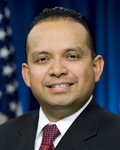
Photo of Luis Alejo
D California Assembly · District 30

Asm. Luis Alejo

Compare
Total votes
13,365
all sessions
Attendance
95%
552 missed
Near the chamber average
With party
99%
of cast votes
Near the chamber average
Bipartisan score
0%
crosses aisle rarely
Near the chamber average
Sponsored
940
bills & resolutions
Near the chamber average
Committees
0
assignments
940 bills and resolutions

Sponsored bills

Total
940
Primary
142
Co-sponsor
798
This page
940
matching current filters
Co-sponsor SB 955
Signed into law · California Senate · Co-sponsor
Public employees' retirement: pension fund management.

Existing law establishes the Public Employees' Retirement System and the State Teachers' Retirement System. These systems provide defined pension benefits to public employees based on age, service credit, and final compensation. The California Constitution confers upon the retirement boards of public retirement systems plenary authority and fiduciary responsibility for the investment of moneys of those systems. This bill would authorize these public retirement system boards, consistent with their fiduciary duties and the standard for prudent investment, to prioritize investment in an in-state infrastructure project over a comparable out-of-state infrastructure project.

Signed into law Sep 29, 2012 1 co-sponsor
Co-sponsor SB 1327
Signed into law · California Senate · Co-sponsor
State government: business information: Internet Web site.

Existing law requires a business to obtain various licenses from regulatory agencies. Existing law requires state agencies to take specified actions, including, but not limited to, designating a small business liaison, to assist small businesses to achieve compliance with statutory and regulatory requirements. This bill would require the Director of the Governor's Office of Business and Economic Development to ensure that the office's Internet Web site contains information to assist an individual with the licensing, permitting, and registration requirements necessary to start a business. The bill would require a state agency that the Governor determines has licensing authority to provide accurate updated information about its licensing requirements, and would prohibit a state agency from using this Internet Web site as the exclusive source of licensing information for the public. The bill would also authorize the Governor to impose a reasonable fee, not to exceed the actual cost to provide the service, upon users of the Internet Web site.

Signed into law Sep 29, 2012 1 co-sponsor
Co-sponsor SB 214
Vetoed · California Senate · Co-sponsor
Infrastructure financing districts: voter approval: repeal.

(1) Existing law authorizes a legislative body, as defined, to create an infrastructure financing district, adopt an infrastructure financing plan, and issue bonds, for which only the district is liable, to finance specified public facilities, upon voter approval. Existing law authorizes an infrastructure financing district to fund infrastructure projects through tax increment financing, pursuant to the infrastructure financing plan and agreement of affected taxing entities, as defined. This bill would revise and recast the provisions governing infrastructure financing districts. The bill would eliminate the requirement of voter approval for creation of the district and for bond issuance and authorize the legislative body to create the district, subject to specified procedures. The bill would instead authorize a newly created public financing authority, consisting of 5 members, 3 of whom are members of the city council or board of supervisors that established the district, and 2 of whom are members of the public, to adopt the infrastructure financing plan, subject to approval by the legislative body, and issue bonds by majority vote of the authority by resolution. The bill would authorize a public financing authority to enter into joint powers agreements with affected taxing entities with regard to nontaxing authority or powers only. The bill would authorize a district to finance specified actions and projects and prohibit the district from providing financial assistance to a vehicle dealer or big box retailer, as defined. The bill would create a public accountability committee, as specified, to review the actions of the public financing authority. (2) Existing law requires that an infrastructure financing plan created by a legislative body include a date on which the district will cease to exist, which shall not be more than 30 years from the date on which the ordinance forming the district is adopted. This bill instead would specify that the date on which the district would cease to exist would not be more than 40 years from the date on which the public financing authority adopted the resolution adopting the infrastructure financing plan. The bill would also impose additional reporting requirements after the adoption of an infrastructure financing plan.

Vetoed Sep 29, 2012 1 co-sponsor
Co-sponsor AB 1842
Signed into law · California Assembly · Co-sponsor
California Central Coast State Veterans Cemetery: Endowment Fund.

Existing law requires the Department of Veterans Affairs, in voluntary cooperation with specified local entities, to design, develop, and construct a state-owned and state-operated veterans cemetery located on the site of the former Fort Ord. Existing law creates the California Central Coast State Veterans Cemetery at Fort Ord Endowment Fund (Endowment Fund) in the State Treasury, and requires moneys in the fund to be allocated, upon appropriation by the Legislature, to the department for the annual administrative and oversight costs of the veterans cemetery, as specified, and to generate funding through interest for the veterans cemetery. Existing law provides that the Endowment Fund may consist of, among other things, donations from public and private entities and fees. This bill would authorize the department to enter into any financial agreement to receive cash advances in the Endowment Fund, provided that no obligations of repayment are made to the state and the agreement is reviewed and performed in consultation with the Department of Finance. Existing law requires the department, upon the determination of specified parties that the Endowment Fund has adequate principal to annually yield sufficient investment earnings, from the date of the determination, to cover the annual administrative and oversight costs over the next 10 years and to fund the estimated costs of developing and submitting the federal State Veterans Cemetery Grant Program application, to develop and submit a State Veterans Cemetery Grant Program application to the United States Department of Veterans Affairs for the establishment of a veterans cemetery. Under existing law, if awarded, the moneys received from the federal grant program are required to be used to reimburse the Endowment Fund for specified costs, as well as the state's share of any other costs for the design, construction, and equipping of the veterans cemetery. This bill would authorize the department to use any moneys received from the State Veterans Cemetery Grant Program that are transferred to the Endowment Fund for the reimbursement of those specified costs to reimburse any cash advances made to the Endowment Fund used for those costs to the extent allowed by grant requirements, once it is determined by the California Department of Veterans Affairs and certified by the Controller's office that sufficient funds remain in the Endowment Fund to cover ongoing maintenance and operating costs.

Signed into law Sep 29, 2012 1 co-sponsor
Co-sponsor SB 1003
Signed into law · California Senate · Co-sponsor
Local government: open meetings: cease and desist letters.

Existing law, the Ralph M. Brown Act (Brown Act) , requires each legislative body of a local agency to provide the time and place for holding regular meetings and requires that all meetings of a legislative body be open and public and all persons be permitted to attend unless a closed session is authorized. Existing law authorizes the district attorney or any interested person to file an action by mandamus, injunction, or declaratory relief to, among other things, determine the applicability of the act to actions or threatened future actions of the legislative body. This bill would prohibit a district attorney or an interested person from filing an action for an alleged violation of the Brown Act for past actions of a legislative body, unless certain conditions are met, including, but not limited to, a requirement that the district attorney or interested person submit a cease and desist letter to the legislative body being accused of the violation setting forth the alleged violation, and the legislative body has failed to issue an unconditional commitment to cease and desist from the alleged past action within 30 days of receiving the letter. The bill would require the unconditional commitment to cease and desist from the alleged past action to meet certain requirements. The bill would require that an action filed to challenge an alleged violation of the Brown Act pursuant to these provisions be dismissed with prejudice if the legislative body enters into an unconditional commitment to cease and desist from the alleged past action. The bill would authorize the legislative body to enter into an unconditional commitment to cease and desist from the alleged action at any time, unless the plaintiff succeeds in a civil action against the legislative body and is awarded attorney's fees. The bill would provide that if an action filed to challenge an alleged violation of the Brown Act pursuant to these provisions is dismissed with prejudice because the legislative body has entered into an unconditional commitment to cease and desist from the alleged action after the 30-day period described above, and if the filing of that action caused the legislative body to enter into the unconditional commitment, then a court shall award costs and reasonable attorney fees to the plaintiff. The bill would require a legislative body that wishes to rescind a commitment to do so by a majority vote of the membership of the legislative body.

Signed into law Sep 28, 2012 1 co-sponsor
Primary AB 276
Signed into law · California Assembly · Lead sponsor
Central Coast Hospital Authority.

Existing law authorizes the board of supervisors of certain counties to establish a hospital authority for the management, administration, and control of certain medical facilities. Existing law authorizes the Board of Supervisors of the County of Monterey to establish a special health care authority with prescribed powers and duties. This bill would authorize the Board of Supervisors of the County of Monterey to establish, by ordinance, the Central Coast Hospital Authority to manage, administer, and control the Natividad Medical Center and other health care facilities, as defined, in the county, as specified. This bill would prohibit establishing the hospital authority until the medical center affiliates or consolidates with at least one other health care facility, as specified. This bill would grant to the authority the duties, privileges, immunities, rights, liabilities, and limitations of a local unit of government within the state. This bill would also grant to the authority, among other things, the power to incur debt, borrow money, and issue bonds, as specified, and the power to request that the board of supervisors levy a tax on behalf of the authority, as prescribed. The bill would specify that the transfer to the authority of the management, administration, and control of the medical center and another health facility shall not affect the eligibility of the county or the governing board of another health care facility for, and shall authorize the authority to participate in and receive, various sources of funding, as specified. This bill would provide various protections for the benefits of the permanent employees of the medical center. The bill would require the authority to contract with the Public Employees' Retirement System, as specified, and with exceptions, and would require the authority to maintain retirement benefits, as specified.

Signed into law Sep 28, 2012 0 co-sponsors
Co-sponsor AB 1277
Signed into law · California Assembly · Co-sponsor
Sherman Food, Drug, and Cosmetic Law.

The Sherman Food, Drug, and Cosmetic Law regulates the packaging, labeling, and advertising of drugs and devices, and is administered by the State Department of Public Health. The law prohibits the sale, delivery, or giving away of any new drug or new device unless either the department has approved a new drug or device application for that new drug or new device and that approval has not been withdrawn, terminated, or suspended or a new drug application has been approved for it and that approval has not been withdrawn, terminated, or suspended under specified provisions of the Federal Food, Drug, and Cosmetic Act, or it is a new device for which a premarket approval application has been approved, and that approval has not been withdrawn, terminated, or suspended under the federal act. The Sherman Food, Drug, and Cosmetic Law requires the department to adopt regulations to establish the application form and set the fee for licensure and renewal of a drug or device license. This bill would revise the above-described prohibition to exempt a new biologic product for which a license has been issued under federal law. Existing law also requires the department to inspect the place of business of each licensed manufacturer of a drug or device in the state prior to issuance of the license and, thereafter, once every 2 years, unless the United States Food and Drug Administration inspected the place of business within the previous 2 years. This bill would, instead, require each place of business to submit to the department documentation that evidences ownership and that the place of business is operating pursuant to a valid biologics license, establishment registration, or approved investigational new drug or investigational device exemption issued by the United States Food and Drug Administration, as prescribed, or is in compliance with audits conducted pursuant to specified standards, prior to the department issuing the place of business a license. If the business does not provide this documentation, the bill would require the department to inspect the place of business prior to licensure. This bill would authorize the business to request an official copy of the valid license. Existing law authorizes any authorized agent of the department to enter and inspect specified locations, as prescribed, for purposes of enforcement of the Sherman Food, Drug, and Cosmetic Law. This bill would require, for any place of business where a drug or device is manufactured and its manufacturer has received a license, the department to make investigations or inspections only under specified circumstances, including when the department makes a determination that the health and safety of the public is at risk, notification has been sent by the United States Food and Drug Administration to the department requesting assistance regarding a specified recall action, or when the United States Food and Drug Administration has requested assistance for enforcement activities.


Signed into law Sep 28, 2012 1 co-sponsor
Primary AB 1915
Signed into law · California Assembly · Lead sponsor
Safe routes to school.

Existing law requires the Department of Transportation, in consultation with the Department of the California Highway Patrol, to establish and administer a "Safe Routes to School" program for construction of bicycle and pedestrian safety and traffic calming projects, and to award grants to local agencies in that regard from available federal and state funds, based on the results of a statewide competition. Existing law sets forth various factors to be used to rate proposals submitted by applicants for these funds. This bill would provide that up to 10% of program funds may be used to assist eligible recipients in making infrastructure improvements, other than schoolbus shelters, that create safe routes to schoolbus stops located outside of the vicinity of schools.

Signed into law Sep 27, 2012 0 co-sponsors
Co-sponsor AB 1844
Signed into law · California Assembly · Co-sponsor
Employer use of social media.

Existing law generally regulates the conduct of employers in the state. This bill would prohibit an employer from requiring or requesting an employee or applicant for employment to disclose a username or password for the purpose of accessing personal social media, to access personal social media in the presence of the employer, or to divulge any personal social media. This bill would also prohibit an employer from discharging, disciplining, threatening to discharge or discipline, or otherwise retaliating against an employee or applicant for not complying with a request or demand by the employer that violates these provisions. Under existing law, the Labor Commissioner, who is the Chief of the Division of Labor Standards Enforcement in the Department of Industrial Relations, is required to establish and maintain a field enforcement unit to investigate specified violations of the Labor Code and other labor laws and to enforce minimum labor standards. Existing law authorizes, and under specified circumstances requires, the Labor Commissioner to investigate employee complaints of violations of the Labor Code, provide for a hearing, and determine all matters arising under his or her jurisdiction. This bill would provide that the Labor Commissioner is not required to investigate or determine any violation of a provision of this bill.

Signed into law Sep 27, 2012 1 co-sponsor
Co-sponsor AB 1525
Signed into law · California Assembly · Co-sponsor
Elder or dependent adult financial abuse: money transmission agents: training materials.

Existing law, the Money Transmission Act, provides for the regulation of money transmission businesses in California by the Department of Financial Institutions. Existing law provides that corporations or limited liability companies may become licensed for money transmission, and that a licensee may appoint agents, as specified, to conduct money transmission on behalf of the licensee. This bill would require specified money transmission licensees to provide, on or before April 1, 2013, and annually thereafter, each of their agents with training materials on recognizing elder or dependent adult financial abuse, and on the appropriate response to suspected elder or dependent adult financial abuse in a transaction.

Signed into law Sep 27, 2012 1 co-sponsor
Showing 681 to 690 of 940 bills
Previous 1 … 68 69 70 … 94 Next