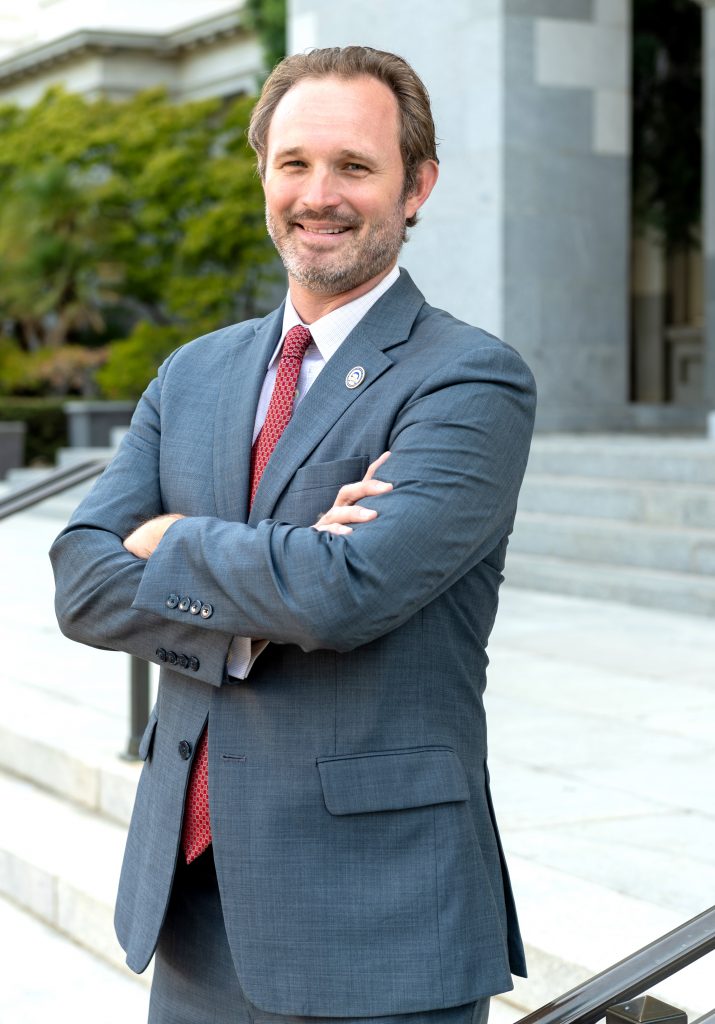
Photo of James Gallagher
R California House · District 3

Rep. James Gallagher

Compare
Total votes
27,305
all sessions
Attendance
85%
3,290 missed
Lower than 84% of chamber peers
With party
97%
of cast votes
Near the chamber average
Bipartisan score
2%
crosses aisle rarely
Near the chamber average
Sponsored
2,099
bills & resolutions
Higher than 88% of chamber peers
Committees
5
assignments
2,099 bills and resolutions

Sponsored bills

Total
2,099
Primary
217
Co-sponsor
1,882
This page
2,099
matching current filters
Co-sponsor SCR 156
Signed into law · California Senate · Co-sponsor
Relative to National Stroke Awareness Month.

Maddy summaryThis bill designates the month of May 2026 as National Stroke Awareness Month. The primary effect is to officially recognize this time period for public education and awareness campaigns regarding stroke prevention and treatment. It does not alter laws, allocate funding, or impose new requirements on individuals or organizations. The measure serves as a symbolic gesture to highlight the importance of stroke awareness during the specified month.

Signed into law Jun 5, 2026 1 co-sponsor
Co-sponsor AB 2048
Passed · California House · Co-sponsor
California-Ireland Trade Commission.

Existing law establishes the Governor as the primary state officer representing California's interest in international affairs, to the extent that representation is not in conflict with federal law or the California Constitution. Existing law establishes the Lieutenant Governor as the Chair of the Commission for Economic Development to improve trade opportunities for California, and develop international partnerships for foreign companies to do business in the state and for California. Existing law requires the Office of Planning and Research to maintain and update a list of all state agreements made with foreign governments. Existing law additionally requires the Director of the Governor's Office of Business and Economic Development to provide the Legislature with an updated strategy for international trade and investment, that includes, at a minimum, specified components, once every 5 years. This bill would require the Governor to establish the California-Ireland Trade Commission within the Governor's Office of Business and Economic Development as an advisory body to the Governor and the Legislature, consisting of specified appointed members, upon availability of sufficient funding resources for this purpose, as provided. The bill would establish the various purposes of the commission, which would include advancing bilateral trade and investment between California and Ireland. This bill would require the commission to report its findings, results, and recommendations to the Governor and the Legislature within one year of its initial organizational meeting and by February 1 of each succeeding year, as specified. The bill would require the Governor's Office of Business and Economic Development to consider the commission's recommendations when updating its strategy for international trade and investment. The bill would include related legislative findings.

Passed Jun 3, 2026 1 co-sponsor
Co-sponsor SCR 168
Signed into law · California Senate · Co-sponsor
Relative to Motorcycle Safety Awareness Month in California.

Maddy summaryThis bill designates May 2026 as Motorcycle Safety Awareness Month in California. It affects state agencies and organizations that typically host public awareness campaigns or educational events. The measure requires no changes to existing laws or regulations; it simply establishes a specific timeframe for promoting motorcycle safety. By creating this designated month, the state provides a formal opportunity to focus public attention on rider safety without altering current legal requirements.

Signed into law May 29, 2026 1 co-sponsor
Co-sponsor SCR 123
Signed into law · California Senate · Co-sponsor
California Peace Officers' Memorial Day.

Maddy summaryThis bill designates Monday, May 4, 2026, as California Peace Officers' Memorial Day to honor law enforcement officers. It does not create new laws or change existing policies but serves as a formal proclamation to recognize the date. The measure affects the state by establishing an official day of remembrance for peace officers.

Signed into law May 21, 2026 1 co-sponsor
Co-sponsor ACR 141
Signed into law · California House · Co-sponsor
Relative to Vesak Day.

This measure would recognize the significance of Vesak Day to people of Buddhist faith and extend sincere best wishes to the state's Buddhist community in celebrating Vesak Day.

Signed into law May 18, 2026 1 co-sponsor
Primary AB 1893
In committee · California House · Lead sponsor
Wildfire prevention: local assistance grant program: eligible activities.

Existing law requires the Department of Forestry and Fire Protection to establish a local assistance grant program for fire prevention and home hardening education activities in California and extends eligibility for grants to specified entities, including local agencies. Existing law provides that eligible activities under the local assistance grant program include, among other things, technical assistance to local agencies to improve fire prevention and reduce fire hazards and projects to improve public safety, including, but not limited to, access to emergency equipment and improvements to public evacuation routes. Existing law makes funding for this program subject to an appropriation by the Legislature. This bill would expand eligible activities under the local assistance grant program to include projects undertaken by a local governmental entity involving the acquisition or installation of mobile rigid dip tanks or similar mobile and permanent infrastructure that is capable of providing helicopter-accessible water supplies for firefighting response or suppression purposes in very high fire and high fire hazard severity zones, as provided.

In committee May 14, 2026 0 co-sponsors
Co-sponsor SB 1162
In committee · California Senate · Co-sponsor
Wildfire and Forest Resilience Task Force: FAIR Plan policies: wildland-urban interface.

The California FAIR Plan Association is a joint reinsurance association in which all insurers licensed to write basic property insurance participate in administering a program for the equitable apportionment of basic property insurance for persons who are unable to obtain that coverage through normal channels. Existing law requires the Wildfire and Forest Resilience Task Force to develop a comprehensive implementation strategy to track and ensure the achievement of the goals and key actions identified in the state's Wildfire and Forest Resilience Action Plan, as provided. Existing law requires, on or before March 1, 2026, and every 5 years thereafter, the task force to update the action plan. This bill would require the Department of Forestry and Fire Protection, on or before June 30, 2027, and in consultation with the Department of Insurance and the California FAIR Plan Association, to make recommendations to the task force regarding specific wildfire risk reduction measures that would reduce the regional risk profile for high-hazard landscapes and communities, particularly those ZIP Codes that have seen the largest increases in FAIR Plan policies sold since 2019.

In committee May 14, 2026 1 co-sponsor
Co-sponsor SB 1020
In committee · California Senate · Co-sponsor
State of emergency: Governor's powers and annual report.

Existing law, the California Emergency Services Act (CESA) , among other things, authorizes the Governor to proclaim a state of emergency in an area affected by, or likely to be affected by, conditions of disaster or extreme peril to the safety of persons and property within the state if specified local officials request the proclamation or the Governor determines that local authority is inadequate to cope with the emergency. During a state of emergency, existing law confers on the Governor, to the extent the Governor deems necessary, complete authority over all agencies of the state government and the right to exercise within the area designated all police power vested in the state by the Constitution and laws of the state to effectuate the purposes of the CESA. Existing law requires the Governor, in the exercise of that authority, to promulgate, issue, and enforce orders and regulations as the Governor deems necessary. This bill would state the intent of the Legislature, in enacting the CESA, to provide flexibility for the administration to respond to emergencies, but not an alternative legislative, budget, or regulatory process. The bill would further state that, to the greatest extent possible, additional spending should be undertaken through the Legislature's budget and policy process, as defined, and changes to law or regulation should be undertaken through state legislation. This bill would further require the Governor, in cases where the Governor orders the suspension or modification of existing statutes or regulations, including the state Budget Act, or promulgates new statutes or regulations, to demonstrate in each order the need for those suspensions, modifications, or promulgations and specify the general reasons why the Legislature's budget and policy processes are insufficient to address these needs. The bill would require the Office of Emergency Services, on or before July 1, 2027, and on or before July 1 of each year thereafter, to prepare and submit a prescribed annual report to the Legislature and the Legislative Analyst's Office consisting of a review of all open state of emergency proclamations. Existing law establishes the Disaster Response-Emergency Operations Account in the Special Fund for Economic Uncertainties. Moneys in the account are continuously appropriated, subject to specified limitations, for allocation by the Director of Finance to state agencies for disaster response operation costs incurred by state agencies as a result of a state of emergency proclamation by the Governor. Existing law requires funds to be allocated from the account subject to certain conditions and upon notification by the Director of Finance to the Chairperson of the Joint Legislative Budget Committee and the chairpersons of the fiscal committees in each house. This bill would state the intent of the Legislature in enacting existing law to provide flexibility for the administration in response to unanticipated emergency expenses. The bill would further state that existing law does not provide an alternative budget process, and proposals for additional spending ordinarily should be considered in the annual state budget or other state legislation to the greatest extent possible, as specified. The bill would require notification by the Director of Finance to include certain information, including a description of the entities that will receive funding allocations from the account.

In committee May 14, 2026 1 co-sponsor
Co-sponsor AB 1774
In committee · California House · Co-sponsor
Electrical corporations: wildfire mitigation plans: expenditures.

Existing law requires an electrical corporation to submit to the Office of Energy Infrastructure Safety a wildfire mitigation plan at least once every 4 years for review. Existing law requires the office to approve or deny each wildfire mitigation plan within 9 months of its submission. Existing law requires the Public Utilities Commission to assess a penalty on an electrical corporation that fails to substantially comply with its wildfire mitigation plan. Existing law prohibits a large electrical corporation from including in its equity rate base its share for the first $5,000,000,000 expended in aggregate by large electrical corporations on fire risk mitigation capital expenditure, as provided, and authorizes those expenditures to be financed through a financing order, as described. Existing law requires the commission, in addition to the $5,000,000,000, to prohibit a large electrical corporation from including in its equity rate base its share of the first $6,000,000,000 expended in aggregate by large electrical corporations on fire risk mitigation capital expenditures approved by the commission on or after January 1, 2026, and authorizes the electrical corporation's share of the fire risk mitigation capital expenditures and the debt financing cost of these fire risk mitigation capital expenditures to be financed through a financing order, as provided. This bill would require the commission, on or before June 30, 2027, to complete a one-time independent audit of all wildfire mitigation expenditures incurred by each electrical corporation between January 1, 2021, and January 1, 2027, as provided. The bill would require that the audit be conducted by an independent third-party auditor. The bill would require the commission, in the next appropriate proceeding following the audit, to consider the findings of the audit in determining the terms and conditions under which an electrical corporation's requested cost recovery may be authorized, as provided. The bill would require the commission to establish a schedule for conducting future independent audits of each electrical corporation's wildfire mitigation expenditures incurred during the preceding 4 calendar years. The bill would require the commission, pursuant to that schedule, to conduct an independent audit of an electrical corporation's prior wildfire mitigation expenditures before any proceeding in which the electrical corporation seeks to recover, collect, or expend ratepayer funds for wildfire mitigation programs, including, but not limited to, expenditures authorized pursuant to an approved wildfire mitigation plan. Under existing law, a violation of an order, decision, rule, direction, demand, or requirement of the commission is a crime. Because a violation of a commission action implementing the bill's requirements would be a crime, this bill would impose a state-mandated local program. The California Constitution requires the state to reimburse local agencies and school districts for certain costs mandated by the state. Statutory provisions establish procedures for making that reimbursement. This bill would provide that no reimbursement is required by this act for a specified reason.

In committee May 14, 2026 1 co-sponsor
Co-sponsor AB 2365
In committee · California House · Co-sponsor
Education-related positions: egregious misconduct: previous employment disclosures.

(1) Existing law prohibits a permanent school employee from being dismissed, except for one or more of certain enumerated causes, including egregious misconduct, and prescribes specific procedures for dismissals and suspensions based solely on acts of egregious misconduct. Existing law authorizes a first- or 2nd-year probationary employee of a school district to be dismissed during the school year for unsatisfactory performance or for cause, pursuant to specified procedures. Existing law specifies that those provisions do not apply to a probationary employee in a school district having an average daily attendance of less than 250 pupils and instead authorizes their suspension or dismissal for cause, including for egregious misconduct, pursuant to separate procedures that are applicable to permanent employees of a school district. Existing law also prescribes various reporting requirements relating to egregious misconduct for both certificated and noncertificated employees. Existing law, for these purposes, defines "egregious misconduct" as specified sex offenses, controlled substance offenses, and acts subject to the Child Abuse and Neglect Reporting Act. This bill would expand the definition of egregious misconduct for those purposes to include additional offenses, including, among other offenses, those relating to human trafficking, child abandonment and neglect, and impermissible contact or communication with a minor, as specified. (2) Existing law requires the Commission on Teacher Credentialing, on or before July 1, 2027, and contingent upon an appropriation for these purposes in the annual Budget Act or another statute, to develop a statewide data system that includes information relating to investigations of allegations of egregious misconduct of individuals serving in a noncertificated position for a local educational agency, as defined, or in any position for a private school. Existing law requires local educational agency employers and private school employers, following both the start of, and completion of, an investigation of egregious misconduct, to submit notice to the statewide data system, as provided. This bill would require the commission to include a section in the above-described statewide data system that identifies whether the commission received any reports of a certificated employee's possible misconduct submitted to the commission by a school district, county office of education, charter school, state special school or diagnostic center operated by the department, or private school. The bill would require the section of the data system to include the full name, date of birth, and last four digits of the social security number of the credentialholder or applicant, and the name of each school district, county office of education, charter school, state special school or diagnostic center operated by the department, or private school that has submitted a complaint, information, or indictment against the credentialholder or applicant, including specified reports. The bill would require the commission, within 5 business days of receiving a request for access to the statewide data system from a school district, county office of education, charter school, state special school or diagnostic center operated by the department, or private school, to provide the requesting entity access to the data system for the purposes of these provisions. (3) Existing law requires a person applying for a certificated position at a school district, county office of education, charter school, state special school or diagnostic center operated by the State Department of Education, or private school to provide that prospective employer with a complete list of every school district, county office of education, charter school, state special school or diagnostic center operated by the department, and private school that previously employed the applicant. Existing law requires those entities, when considering an applicant for a certificated position, to inquire with each disclosed entity as to whether the applicant, while previously employed by the disclosed entity, was the subject of any credible complaints of, substantiated investigations into, or discipline for, egregious misconduct. Existing law requires the responding entities that have made a report of an employee's egregious misconduct to the commission to disclose this fact to the inquiring entity, and to provide the inquiring entity with a copy of all relevant information within its possession that was reported to the commission. This bill, commencing July 1, 2027, would require a school district, county office of education, charter school, state special school or diagnostic center operated by the department, or private school considering an applicant for a certificated position to instead (A) check the section of the statewide data system maintained by the commission as to whether the commission received a copy of a complaint, information, or indictment, or specified report, relating to the applicant being the subject of a credible complaint of, substantiated investigation into, or discipline for, egregious misconduct, (B) identify any reporting entities, and (C) request from each reporting entity a copy of all relevant information within its possession that was reported to the commission. The bill would require a school district, county office of education, charter school, state special school or diagnostic center operated by the department, or private school identified in the data system as having submitted a report for a certificated employee to provide a copy of all relevant information within its possession to the inquiring entity. The bill would authorize, instead of require, a school district, county office of education, charter school, state special school or diagnostic center operated by the department, or private school that is considering an applicant for a certificated position to directly inquire with a disclosed entity, as described above. To the extent the bill would impose additional duties on local agencies or officials, the bill would impose a state-mandated local program. The California Constitution requires the state to reimburse local agencies and school districts for certain costs mandated by the state. Statutory provisions establish procedures for making that reimbursement. This bill would provide that, if the Commission on State Mandates determines that the bill contains costs mandated by the state, reimbursement for those costs shall be made pursuant to the statutory provisions noted above.


In committee May 14, 2026 1 co-sponsor
Showing 41 to 50 of 2,099 bills
Previous 1 4 5 6 210 Next