

(1) Existing law, as amended by Proposition 83, the Sexual Predator Punishment and Control Act (Jessica's Law) , approved by the voters at the November 7, 2006, statewide general election, makes a defendant subject to imprisonment in the state prison for 25 years to life if convicted of certain crimes, including rape, sexual penetration, sodomy, oral copulation, continuous sexual abuse of a child, or rape, spousal rape, or sexual penetration in concert, if certain circumstances were present, including, among other things, in the commission of that offense, any person kidnapped the victim, tortured the victim, or committed the offense during the commission of a burglary, as specified. Existing law also makes a defendant subject to imprisonment in the state prison for 15 years to life if convicted of certain crimes, including rape, sexual penetration, sodomy, oral copulation, continuous sexual abuse of a child, or rape, spousal rape, or sexual penetration in concert, if certain circumstances were present, including, among other things, in the commission of that offense any person, except as specified in the provisions above, kidnapped the victim, committed the offense during the commission of a burglary, or used a dangerous or deadly weapon in the commission of the offense. Proposition 83 provides that the Legislature may amend the provisions of the act to expand the scope of their application or increase the punishment or penalties by a statute passed by a majority vote of each house of the Legislature. This bill would add the crimes of rape, sexual penetration, sodomy, and oral copulation, perpetrated against a person who is incapable, because of a mental disorder or developmental or physical disability, of giving legal consent, to the above provisions, if the victim is developmentally disabled, as defined. By applying the above enhancements to these crimes, this bill would impose a state-mandated local program. (2) Existing law makes a defendant subject to imprisonment in the state prison for 25 years to life if convicted of certain crimes, including rape, spousal rape or sexual penetration in concert, sexual penetration, sodomy, or oral copulation if certain circumstances were present, including, among other things, in the commission of that offense, any person kidnapped the victim, committed the offense during the commission of a burglary, or used a dangerous or deadly weapon in the commission of the offense, or under other specified circumstances, and the crime was committed against a minor 14 years of age or older. This bill would add the crimes of rape, sexual penetration, sodomy, and oral copulation, perpetrated against a person who is incapable, because of a mental disorder or developmental or physical disability, of giving legal consent, to the above provisions, if the victim is developmentally disabled, as defined. By applying the above enhancements to these crimes, this bill would impose a state-mandated local program. (3) Existing law requires that a person who commits certain enumerated crimes, including rape, sodomy, oral copulation, and sexual penetration, against a person who is 65 years of age or older, or against a person who is blind, deaf, developmentally disabled, a paraplegic, or a quadriplegic, or against a person who is under 14 years of age, receive a one-year sentence enhancement and requires that any person having a prior conviction for any of the enumerated offenses receive a 2-year sentence enhancement. This bill would add to the enumerated list of crimes rape, sodomy, oral copulation, and sexual penetration, perpetrated against a person who is incapable, because of a mental disorder or developmental or physical disability, of giving legal consent. By applying the above enhancements to these crimes, this bill would impose a state-mandated local program. (4) The California Constitution requires the state to reimburse local agencies and school districts for certain costs mandated by the state. Statutory provisions establish procedures for making that reimbursement. This bill would provide that no reimbursement is required by this act for a specified reason.
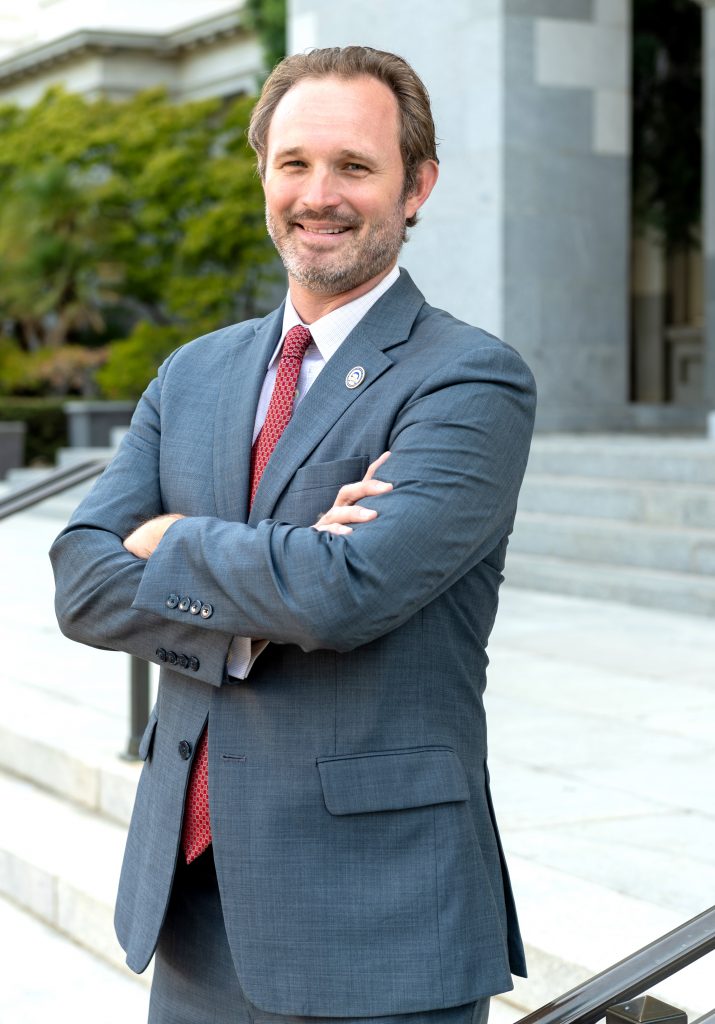
Sponsored bills
Under the Natural Disaster Assistance Act, the state share for eligible project costs is generally no more than 75% of total state eligible costs, and for specific incidents, the state share is up to 100% of total state eligible costs. This bill would require the state share to be 100% of the total state eligible costs connected with the mandatory evacuation that occurred in the Counties of Butte, Sutter, and Yuba due to the potential failure of the auxiliary emergency spillway at Lake Oroville on February 12, 2017. This bill would make legislative findings and declarations as to the necessity of a special statute for the Counties of Butte, Sutter, and Yuba.
Existing law establishes the Assumption Program of Loans for Education, administered by the Student Aid Commission, under which any person enrolled in an eligible institution of postsecondary education, as defined, or any person who agrees to participate in a teacher trainee or teacher internship program, is eligible to enter into an agreement for loan assumption, to be redeemed pursuant to a prescribed procedure upon becoming employed as a teacher in an eligible school, as defined, if he or she satisfies certain conditions. This bill would express the intent of the Legislature to restore the funding for the Assumption Program of Loans for Education to its 2011–12 fiscal year level. The bill would require the commission to award 7,200 new warrants for the assumption of loans under the program in the 2017–18 fiscal year. The bill would appropriate $5,000,000 from the General Fund to the commission for the funding of warrants for the assumption of loans under the program for the 2017–18 fiscal year. This bill would declare that it is to take effect immediately as an urgency statute.
Existing law prohibits an entity from substantially diverting or obstructing the natural flow of, or substantially changing or using any material from the bed, channel, or bank of, any river, stream, or lake, or from depositing certain material where it may pass into any river, stream, or lake, without first notifying the Department of Fish and Wildlife of that activity, and entering into a lake or streambed alteration agreement if required by the department to protect fish and wildlife resources. This bill would define "river" and "stream" for purposes of these provisions.
The California Environmental Quality Act (CEQA) requires a lead agency, as defined, to prepare, or cause to be prepared, and certify the completion of, an environmental impact report on a project that it proposes to carry out or approve that may have a significant effect on the environment or to adopt a negative declaration if it finds that the project will not have that effect. CEQA also requires a lead agency to prepare a mitigated negative declaration for a project that may have a significant effect on the environment if revisions in the project would avoid or mitigate that effect and there is no substantial evidence that the project, as revised, would have a significant effect on the environment. This bill would exempt from the provisions of CEQA a project, or the issuance of a permit for a project, that consists of the inspection, maintenance, repair, rehabilitation, replacement, or removal of, or the addition of an auxiliary lane or bikeway to, existing transportation infrastructure and that meets certain requirements. The bill would require the public agency carrying out the project to take certain actions.
Existing law provides that the Department of Transportation has full possession and control of the state highway system and associated property. Existing law generally requires proceeds from the sale of excess state highway property to be made available for other highway purposes. Existing law generally provides for the California Transportation Commission to program available funding for transportation capital projects, other than state highway rehabilitation projects, through the State Transportation Improvement Program process, with available funds subject to various fair share distribution formulas. Existing law, in certain cases, requires the commission to instead reallocate funds from canceled state highway projects to a local alternative transportation improvement program within the same county and exempts those funds from the fair share distribution formulas that would otherwise be applicable. This bill, with respect to planned state transportation facilities over the Feather River in the City of Yuba City and the Counties of Sutter and Yuba, which facilities are no longer planned to be constructed, would authorize the affected local agencies, acting jointly with the transportation planning agency having jurisdiction, to develop and file with the California Transportation Commission a local alternative transportation improvement program that addresses transportation problems and opportunities in the area that was to be served by the canceled state facilities. The bill would provide that the commission has the final authority regarding the content and approval of the local alternative, and would further provide that no approval may be given by the commission after July 1, 2020. The bill would require all proceeds from the sale of excess properties acquired by the department for the canceled state facilities, less any reimbursements due to the federal government and costs incurred in the sale of those excess properties, to be allocated by the commission to the approved local alternative and would exempt those funds from the fair share distribution formulas that would otherwise be applicable to state transportation funds.
This measure would proclaim the period of October 23, 2017, to October 31, 2017, inclusive, as Red Ribbon Week and would encourage all Californians to help build drug-free communities and to participate in drug prevention activities.
Existing law prohibits a state agency from including a question regarding an applicant's race, sex, marital status, or religion in any application form for employment. This bill would prohibit a state or local agency or a public employee acting under color of law from providing or disclosing to the federal government personal information regarding a person's religious beliefs, practices, or affiliation, as specified, when the information is sought for compiling a database of individuals based on religious belief, practice, or affiliation, national origin, or ethnicity for law enforcement or immigration purposes. The bill would also prohibit a state agency from using agency resources to assist with any government program compiling such a database, or from making state databases available in connection with an investigation or enforcement under such a program. The bill would prohibit state and local law enforcement agencies and their employees from collecting personal information on the religious beliefs, practices, or affiliation of any individual, except as part of a targeted investigation, as provided, or where necessary to provide religious accommodations. The bill would also prohibit law enforcement agencies from using agency or department moneys, facilities, property, equipment, or personnel to investigate, enforce, or assist in the investigation or enforcement of any criminal, civil, or administrative violation, or warrant for a violation, of any requirement that individuals register with the federal government or any federal agency based on religion, national origin, or ethnicity. The bill would also terminate, to the extent of any conflict, any existing agreements that make any agency or department information or database available in conflict with these provisions. The bill would not prevent the collection, retention, or disclosure of personal information or documents as required by Federal law or a court order. The bill would provide that an agency or employee would only be deemed to be in violation of its provisions if the agency or employee acted with actual knowledge that the information shared would be used for purposes prohibited by these provisions. This bill would declare that it is to take effect immediately as an urgency statute.
Under existing law, the Public Utilities Commission has regulatory authority over public utilities, including telephone corporations. Existing law establishes, among other funds related to telecommunications, the California Advanced Services Fund (CASF) in the State Treasury. Existing law requires the commission to develop, implement, and administer the CASF to encourage deployment of high-quality advanced communications services to all Californians that will promote economic growth, job creation, and the substantial social benefits of advanced information and communications technologies, as provided in specified decisions of the commission and in the CASF statute. Existing law requires the commission to give priority to projects that provide last-mile broadband access to households that are unserved by an existing facility-based broadband provider. Existing law establishes that the goal of the program is, no later than December 31, 2015, to approve funding for infrastructure projects that will provide broadband access to no less than 98% of California households. Existing law authorizes the commission to collect a surcharge for deposit into the CASF not to exceed $315,000,000 in total and authorizes the surcharge until 2020. Existing law establishes 4 accounts, the Broadband Infrastructure Grant Account, the Rural and Urban Regional Broadband Consortia Grant Account, the Broadband Infrastructure and Revolving Loan Account, and the Broadband Public Housing Account, within the CASF and specifies the amount of moneys to be deposited into each account. This bill would revise the goal of the program to provide that its goal is to approve funding by December 31, 2022, for infrastructure projects that will provide broadband access to no less than 98% of California households in each consortia region, as identified by the commission on or before January 1, 2017. The bill would eliminate the Broadband Infrastructure and Revolving Loan Account and would require the transfer of the remaining unencumbered moneys in that account as of January 1, 2018, and the deposit of moneys collected that would be owed to that account into the Broadband Infrastructure Grant Account. The bill would establish within the CASF the Broadband Adoption Account and would require specified amounts of moneys to be deposited into this new account, the Broadband Infrastructure Grant Account, and the Rural and Urban Regional Broadband Consortia Grant Account. The bill repeals the current authorization to collect up to $315,000,000 for deposit in the CASF at a rate of up to $25,000,000 per year through the 2020 calendar year, and instead would authorize the commission to collect $330,000,000 for deposit into the CASF beginning January 1, 2018, and continuing through the 2022 calendar year. The bill would revise the eligibility requirements for projects and project applicants for grants funded from the Broadband Infrastructure Grant Account. The bill would make moneys from the Rural and Urban Regional Broadband Consortia Grant Account available to facilitate the deployment of broadband infrastructure by assisting infrastructure grant applicants in the project development or grant application process. The bill would require recipients of those moneys to conduct an annual audit and to submit to the commission an annual report regarding activities funded by those moneys. The bill would make available moneys in the Broadband Adoption Account to specified entities for digital literacy training, public education, and outreach programs to increase broadband adoption by consumers. Existing law requires the commission to conduct and report to the Legislature, by April 1, 2021, a final financial audit and a final performance audit of the CASF. This bill would require the commission to conduct and report to the Legislature, by April 1, 2020, an interim financial audit and an interim performance audit. The bill would delay the date for the submission of the final audits to April 1, 2023. Existing law requires the commission to annually report specified information relative to the CASF to the Legislature. Existing law repeals these reporting requirements on January 1, 2022. This bill would revise the information specified for inclusion in the report. The bill would repeal these reporting requirements on January 1, 2024. The bill would require the commission to identify unserved areas and delineate the areas in the annual reports. The bill would require the commission to consult regional consortia, stakeholders, and consumers regarding priority areas and cost-effective strategies to achieve the broadband access goal through public workshops conducted at least annually no later than April 30 of each year. Under existing law, a violation of the Public Utilities Act or any order, decision, rule, direction, demand, or requirement of the commission is a crime. Because a violation of an order or decision of the commission implementing the bill's requirements would be a crime, this bill would impose a state-mandated local program by creating a new crime. The California Constitution requires the state to reimburse local agencies and school districts for certain costs mandated by the state. Statutory provisions establish procedures for making that reimbursement. This bill would provide that no reimbursement is required by this act for a specified reason. This bill would declare that it is to take effect immediately as an urgency statute.
The Horse Racing Law provides that any unallocated balance from the total revenue received by the Department of Food and Agriculture pursuant to that law, except as specified, is hereby appropriated without regard to fiscal years for allocation by the Secretary of Food and Agriculture for capital outlay to California fairs, including state-designated fairs, for among other things, fair projects involving public health and safety, and projects that are required to protect fair property. That law also provides that a portion of these funds may be allocated to California fairs for general operational support. This bill would, beginning July 1, 2018, require a return filed with the California Department of Tax and Fee Administration (CDTFA) to report gross receipts for sales and use tax purposes to segregate the gross receipts of the seller and the sales price of the property on a line or a separate form as prescribed by the CDTFA when the place of sale in this state or for use in this state is on or within the real property of a state-designated fair, as defined, or any real property of a state-designated fair that is leased to another party. The bill would require the CDTFA to report the amount of the total gross receipts segregated on the returns filed pursuant to these provisions to the Department of Finance on or before November 1 of each year. The bill would require the CDTFA to estimate the total gross receipts segregated for the 2019–20 fiscal year by January 31, 2019, based on the 3rd quarter of 2018, and would require that an amount equal to 34 of 1% of this estimated amount be included in the Governor's revised budget in May 2019 for allocation to fairs pursuant to the provisions described above. The bill would require the CDTFA to reconcile this first-year estimate with actual return data from the full 2018–19 fiscal year, and to then adjust this figure as appropriate as the amount to be reported to the Department of Finance on November 1, 2019. The bill would require that an amount equal to 34 of 1% of the total amount of gross receipts reported to the Department of Finance be included in the next annual Governor's Budget for the Department of Food and Agriculture for allocation to fairs pursuant to the provisions described above. The bill would require, upon the enactment of the annual Budget Act, that this amount be transferred by the Controller to the Fair and Exposition Fund, which is continuously appropriated, and would allocate these moneys to state-designated fairs for specified fair projects and subject to certain conditions. The bill would require the CDTFA to be paid the actual cost for administering those provisions, as specified. By creating a new source of revenue to be deposited into a continuously appropriated fund, the bill would make an appropriation.