

Existing law provides for state cooperation with the federal government in the construction of specified flood control projects. For certain flood control projects authorized on or after January 1, 2002, or for which specified findings have been made on or after that date, existing law requires the state to pay 50% of specified nonfederal costs. Existing law authorizes the state to pay up to 70% of those nonfederal costs upon the recommendation of the Department of Water Resources or the Central Valley Flood Protection Board if either entity determines that the project will advance one of several objectives. Existing law authorizes the state to provide the above-described funds to the Counties of Monterey and Santa Cruz, or to local agencies in those counties, for the project for flood control on the Pajaro River in the Counties of Monterey and Santa Cruz, as specified. This bill would authorize, upon certain conditions, the state to provide up to 100% of the costs to the Counties of Monterey and Santa Cruz, or to local agencies in those counties, for the project for flood control on the Pajaro River in the Counties of Monterey and Santa Cruz. This bill would make legislative findings and declarations as to the necessity of a special statute for the Counties of Monterey and Santa Cruz.
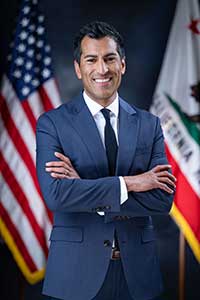
Asm. Robert Rivas
Sponsored bills
Existing law establishes the Board of State and Community Corrections to promote effective state and local efforts and partnerships in California's adult and juvenile criminal justice system and requires the board to inspect each local detention facility in the state biennially. Existing law requires a privately operated local detention facility responsible for the custody and control of a local prisoner to operate pursuant to a contract with the city, county, or city and county, as appropriate. Existing law requires each contract to include a provision whereby the private agency or entity agrees to operate in compliance with all appropriate state and local building, zoning, health, safety, and fire statutes, ordinances, and regulations, and with specified minimum jail standards established by regulations adopted by the board. Existing law provides that the failure of a privately operated local detention facility to comply with the appropriate health, safety, and fire laws, or with the minimum jail standards adopted by the board may be grounds for the termination of the contract. Under existing law, private detention facilities are generally prohibited, except for those operating pursuant to a valid contract in effect before January 1, 2020, as specified. This bill would require a private detention facility responsible for the custody and control of a prisoner or civil detainee to operate in compliance with these standards and to maintain specified insurance coverages, including general, automobile, and umbrella liability, and workers' compensation. The bill would authorize an insurer providing insurance to consider whether the private detention facility complies with prescribed standards. The bill would exempt identified detention facilities from specified provisions, and would provide that the bill does not create any additional authority or responsibility for the Board of State and Community Corrections and Department of Corrections and Rehabilitation, as specified. The bill would make provisions of the act severable.
Existing law provides for various memorials and monuments on the grounds of the State Capitol. Existing law requires the Department of Finance, subject to the approval of the Capitol Building and Planning Commission, to acquire and do all acts necessary to erect and maintain a monument to Father Junípero Serra on the grounds of the State Capitol. Existing law requires the Department of General Services to maintain state buildings and grounds. This bill would delete the requirement relating to the monument to Father Junípero Serra. The bill would authorize tribal nations in the Sacramento, California, region, in consultation with the Department of General Services, to plan, construct, and maintain a monument to the California Native people of the Sacramento, California, region on the grounds of the State Capitol. The bill would require the tribal nations to submit the plan for the monument to the Joint Rules Committee for its review and approval. The bill would prohibit the tribal nations from beginning construction of the monument until the Joint Rules Committee approves and adopts the plan and the Joint Rules Committee and the Department of Finance determine that sufficient private funding is available to construct and maintain the monument. The bill would require the planning, construction, and maintenance of the monument to be funded exclusively through private funding from the tribal nations in the Sacramento, California, region.
Existing law provides for the licensing and regulation of community care facilities, including foster family homes and group homes, by the State Department of Social Services, and requires the department to ensure that licensed or certified foster care facilities and providers accord children and nonminor dependents in foster care their personal rights. Existing law establishes the Office of the State Foster Care Ombudsperson to, among other things, investigate and attempt to resolve complaints made by or on behalf of children placed in foster care, related to their care, placement, or services. This bill would specify that these duties of the department and the Office of the State Foster Care Ombudsperson include children who are placed in residential facilities and homes by the Office of Refugee Resettlement of the United States Department of Health and Human Services. This bill would incorporate additional changes to Section 16164 of the Welfare and Institutions Code proposed by AB 317 to be operative only if this bill and AB 317 are enacted and this bill is enacted last.
Existing federal law, for purposes of various provisions related to immigration, defines "alien" to mean a person who is not a citizen or national of the United States. Existing state law uses the word "alien" on its own and within various other terms to refer to persons in provisions relating to, among other things, education, housing, natural resources, employment, probate, social services, drivers' licenses, firearm permits, service in the state militia, and criminal punishment. This bill would revise those state law provisions to refer instead to those persons using other terms that do not contain the word "alien," including a person who is not a citizen or national of the United States. The bill would make other related nonsubstantive changes. The bill would state the intent of the Legislature in enacting this measure to make only nonsubstantive changes, as specified. This bill would incorporate additional changes to Sections 7583.23 of the Business and Professions Code proposed by AB 607 and to Section 7596.7 of the Business and Professions Code proposed by AB 830, to be operative only if this bill and the other bill are enacted and this bill is enacted last. The bill would also incorporate additional changes to Section 7596.3 of the Business and Professions Code proposed by AB 229 and AB 830, to be operative only if this bill and AB 830, or if this bill, AB 229, and AB 830, are enacted and this bill is enacted last.
Existing law establishes the State Air Resources Board as the state agency responsible for monitoring and regulating sources emitting greenhouse gases. Existing law, the California Global Warming Solutions Act of 2006, requires the state board to ensure that statewide greenhouse gas emissions are reduced to at least 40% below the 1990 level by 2030. The act requires the state board to prepare and approve a scoping plan for achieving the maximum technologically feasible and cost-effective reductions in greenhouse gas emissions. Existing law establishes the Natural Resources Agency, composed of departments, boards, conservancies, and commissions responsible for the restoration, protection, and management of the state's natural and cultural resources. Existing law requires the agency to update the state's climate adaptation strategy, known as the Safeguarding California Plan, every 3 years. This bill would require, no later than July 1, 2023, the Natural Resources Agency, in coordination with the California Environmental Protection Agency, the state board, the Department of Food and Agriculture, and other relevant state agencies, to establish the Natural and Working Lands Climate Smart Strategy and, in developing the strategy, to create a framework to advance the state's climate goals. The bill would require the state board, as part of its scoping plan, to establish specified carbon dioxide removal targets for 2030 and beyond. This bill would require, no later than July 1, 2023, the Natural Resources Agency to establish and maintain a registry for the purposes of identifying and listing projects in the state that drive climate action on the state's natural and working lands and are seeking funding from state agencies or private entities. The bill would authorize the agency, in collaboration with relevant state agencies, to create an application process for applicants to have their projects located in the state listed on the registry, as specified. The bill would require the agency to establish a mechanism for retiring the listing of a project from the registry once it is funded and tracking the outcome of the project to ensure it is completed. The bill would require project proponents to notify the agency when a project is completed and provide monitoring and reporting data for the duration of the contract terms of the project. The bill would require the agency to track carbon removal and greenhouse gas emission reduction benefits derived from projects funded through the registry. The bill would authorize the agency to contract with a third-party organization to develop and operate the registry.
Existing law declares that small water suppliers and rural communities are often not covered by established water shortage requirements, and that the state should provide guidance to improve drought planning for small water suppliers and rural communities. Existing law required the Department of Water Resources, in consultation with the State Water Resources Control Board and other relevant state and local agencies and stakeholders, to use available data to identify, no later than January 1, 2020, small water suppliers and rural communities that may be at risk of drought and water shortage vulnerability. To implement this directive, the department formed a stakeholder advisory group, the County Drought Advisory Group. Existing law required the department, in consultation with the state board, to propose to the Governor and the Legislature, by January 1, 2020, recommendations and guidance relating to the development and implementation of countywide drought and water shortage contingency plans to address the planning needs of small water suppliers and rural communities, as provided. This bill would require small water suppliers, as defined, serving 1,000 to 2,999 service connections, inclusive, and nontransient noncommunity water systems that are schools, no later than July 1, 2023, to develop and maintain an abridged Water Shortage Contingency Plan that includes specified drought-planning elements. The bill would require a small water supplier serving fewer than 1,000 service connections to add drought planning elements to its emergency notification or response plan and submit the plan to the state board. The bill would require these water systems to report annually specified water supply condition information to the state board through the state board's Electronic Annual Reporting System or other reporting tool, as directed by the state board. The bill would require small water suppliers and nontransient noncommunity water systems that are schools to implement, subject to funding availability, specified drought resiliency measures, including, among others, having at least one backup source of water supply and metering each service connection. The bill would exempt from these provisions small water suppliers, or small water suppliers integrated into larger water systems, that voluntarily choose to instead comply with specified existing law relating to urban water management plans. This bill would require a county to establish a standing county drought and water shortage task force to facilitate drought and water shortage preparedness for state small water systems and domestic wells within the county's jurisdiction, as provided. The bill would authorize a county, in lieu of establishing a standing task force, to establish an alternative process that facilitates drought and water shortage preparedness for state small water systems and domestic wells within the county's jurisdiction, as provided. The bill would provide that a county that establishes a drought task force on or before January 1, 2022, shall be deemed in compliance with these requirements as long as the task force continues to exist. The bill would require a county to develop a plan that includes potential drought and water shortage risk and proposed interim and long-term solutions, as provided. Because the bill would impose additional duties on counties, the bill would impose a state-mandated local program. This bill would require the department to take specified actions to support implementation of the recommendations from the County Drought Advisory Group. The bill would require the department to establish a standing interagency drought and water shortage task force to, among other things, facilitate proactive planning and coordination, both for predrought planning and postdrought emergency response, which shall consist of various representatives, including representatives from local governments. Because the bill would impose additional duties on local governments, the bill would impose a state-mandated local program. The California Constitution requires the state to reimburse local agencies and school districts for certain costs mandated by the state. Statutory provisions establish procedures for making that reimbursement. This bill would provide that, if the Commission on State Mandates determines that the bill contains costs mandated by the state, reimbursement for those costs shall be made pursuant to the statutory provisions noted above.
The California Constitution establishes the Public Utilities Commission (PUC) , with jurisdiction over all public utilities, including electrical corporations. Existing decisions of the PUC institute an Electric Program Investment Charge (EPIC) to fund renewable energy and research, development, and demonstration programs. Existing law creates in the State Treasury the Electric Program Investment Charge Fund to be administered by the State Energy Resources Conservation and Development Commission (Energy Commission) and requires the PUC to forward to the Energy Commission, at least quarterly, moneys for those EPIC programs the PUC has determined should be administered by the Energy Commission for deposit in the fund. Existing law requires the Energy Commission, in administering moneys in the fund for research, development, and demonstration programs, to develop and implement the EPIC program for the purpose of awarding funds to projects that may lead to technological advancement and breakthroughs to overcome barriers that prevent the achievement of the state's statutory energy goals and that may result in a portfolio of projects that are strategically focused and sufficiently narrow to make advancement on the most significant technological challenges. Existing law, until January 1, 2023, requires the Energy Commission to expend certain percentages of the moneys appropriated from the fund for technology demonstration and deployment at sites that benefit certain communities. This bill would require the Energy Commission to consider, in the investment planning process for the EPIC program, funding for eligible biomass conversion to energy projects, as specified. The bill would require the commission, in determining the appropriate amount of EPIC funding for biomass conversion, to consider the recommendations of the State Air Resources Board and the State Board of Forestry and Fire Protection, and to coordinate with the Natural Resources Agency, the Department of Resources Recycling and Recovery, and the Department of Food and Agriculture about the need for biomass conversion. The bill would also require the Energy Commission to consider opportunities to reduce short-lived climate pollutant emissions, generate carbon negative emissions, reduce wildfire impacts, and increase energy reliability.
Existing law, the Alcoholic Beverage Control Act, which is administered by the Department of Alcoholic Beverage Control, regulates the application, issuance, and suspension of alcoholic beverage licenses. Existing law authorizes licensed winegrowers and brandy manufacturers to exercise their license privileges away from their licensed premises at, or from, branch offices or warehouses or United States bonded wine cellars located away from the place of production or manufacture, subject to specified exceptions. One of the exceptions to this authorization is the sale or delivery of wine to consumers in containers supplied, furnished, or sold by the consumer. This bill would delete the exception to the authorization applicable to winemakers, as described above, and would thus allow them to sell and deliver wine to consumers in containers supplied, furnished, or sold by the consumer away from their licensed premises.
Existing law establishes the Department of Community Services and Development within the California Health and Human Services Agency to supplement and coordinate public and private sector efforts to assist low-income participants, including homeless individuals and families, migrants, and the elderly poor, to secure and retain meaningful employment, attain an adequate education, make better use of available income, and obtain and maintain adequate housing and a suitable living environment. Existing law, the California Community Services Block Grant Program, requires the department to administer the federal Community Services Block Grant funds to provide financial assistance for activities designed to have a measurable and potentially major impact on causes of poverty in a community or areas of a community where poverty is a particularly acute problem. Existing law authorizes this funding to assist programs that, among other things, meet the needs of migrant and seasonal farmworkers and their families, such as daycare for children and elderly persons, education, health services, improved housing and sanitation, legal advice and representation, and consumer training and counseling, and assistance in processing applications for legalization and citizenship. This bill, upon appropriation by the Legislature, would require the department to establish a grant program for counties to establish farmworker resource centers that provide farmworkers and their families information and access to services related to, among other things, labor and employment rights, education, housing, immigration, and health and human services. The bill would make a county's eligibility for funding under the grant program contingent upon the county working with local or statewide community-based organizations to develop the center, providing 25% of the center's funding under the program, and requiring the center to provide services in at least English and Spanish, to provide an assessment of the population the center would serve, and to maintain a cost-effective database to track the number and type of calls received, referrals made, and claims filed, and to monitor local trends. The bill would require the department to convene and facilitate a workgroup to help inform the establishment and administration of the grant program, as specified.