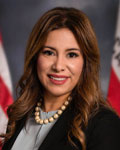
Photo of Nora Campos
D California Assembly · District 27 · Former member

Asm. Nora Campos

Compare
Total votes
16,228
all sessions
Attendance
97%
380 missed
Lower than 88% of chamber peers
With party
99%
of cast votes
Near the chamber average
Bipartisan score
0%
crosses aisle rarely
Near the chamber average
Sponsored
764
bills & resolutions
Near the chamber average
Committees
0
assignments
764 bills and resolutions

Sponsored bills

Total
764
Primary
109
Co-sponsor
655
This page
764
matching current filters
Co-sponsor AJR 14
Failed · California Assembly · Co-sponsor
Relative to sequestration.

This measure would request the Congress of the United States to, among other things, act immediately to avert federal spending cuts known as "sequestration" to protect the California and national economies.

Failed Nov 30, 2014 1 co-sponsor
Co-sponsor SB 1005
Failed · California Senate · Co-sponsor
Health care coverage: immigration status.

Existing law, the federal Patient Protection and Affordable Care Act (PPACA) , requires each state to establish an American Health Benefit Exchange that facilitates the purchase of qualified health plans by qualified individuals and qualified small employers, and meets certain other requirements. PPACA specifies that an individual who is not a citizen or national of the United States or an alien lawfully present in the United States shall not be treated as a qualified individual and may not be covered under a qualified health plan offered through an exchange. Existing law creates the California Health Benefit Exchange for the purpose of facilitating the enrollment of qualified individual and qualified small employers in qualified health plans as required under PPACA. Existing law governs health care service plans and insurers. A violation of the provisions governing health care service plans is a crime. This bill would create the California Health Exchange Program for All Californians within state government and would require that the program be governed by the executive board that governs the California Health Benefit Exchange. The bill would specify the duties of the board relative to the program and would require the board to, by January 1, 2016, facilitate the enrollment into qualified health plans of individuals who are not eligible for full-scope Medi-Cal coverage and would have been eligible to purchase coverage through the Exchange but for their immigration status. The bill would require the board to provide premium subsidies and cost-sharing reductions to eligible individuals that are the same as the premium assistance and cost-sharing reductions the individuals would have received through the Exchange. The bill would create the California Health Trust Fund For All Californians as a continuously appropriated fund, thereby making an appropriation, would require the board to assess a charge on qualified health plans, and would make the implementation of the program's provisions contingent on a determination by the board that sufficient financial resources exist or will exist in the fund. The bill would enact other related provisions. The bill would require health care services plans and health insurers to fairly and affirmatively offer, market, and sell in the Exchange at least one product within each of 5 levels of coverage, as specified. Because a violation of the requirements imposed on health care service plans would be a crime, the bill would impose a state-mandated local program. Existing law provides for the Medi-Cal program, which is administered by the State Department of Health Care Services, under which qualified low-income individuals receive health care services. The Medi-Cal program is, in part, governed and funded by federal Medicaid Program provisions. The federal Medicaid Program provisions prohibit payment to a state for medical assistance furnished to an alien who is not lawfully admitted for permanent residence or otherwise permanently residing in the United States under color of law. This bill would extend eligibility for full-scope Medi-Cal benefits to individuals who are otherwise eligible for those benefits but for their immigration status. The bill would require that benefits for those services be provided with state-only funds only if federal financial participation is not available. Because counties are required to make Medi-Cal eligibility determinations and this bill would expand Medi-Cal eligibility, the bill would impose a state-mandated local program. The California Constitution requires the state to reimburse local agencies and school districts for certain costs mandated by the state. Statutory provisions establish procedures for making that reimbursement. This bill would provide that with regard to certain mandates no reimbursement is required by this act for a specified reason. With regard to any other mandates, this bill would provide that, if the Commission on State Mandates determines that the bill contains costs so mandated by the state, reimbursement for those costs shall be made pursuant to the statutory provisions noted above.

Failed Nov 30, 2014 1 co-sponsor
Co-sponsor SB 866
Vetoed · California Senate · Co-sponsor
Water Quality, Supply, and Infrastructure Improvement Act of 2014.

(1) Existing law, the Safe, Clean, and Reliable Drinking Water Supply Act of 2012, if approved by the voters, would authorize the issuance of bonds in the amount of $11,140,000,000 pursuant to the State General Obligation Bond Law to finance a safe drinking water and water supply reliability program. Existing law provides for the submission of the bond act to the voters at the November 4, 2014, statewide general election. This bill would repeal these provisions. (2) Under existing law, various measures have been approved by the voters to provide funds for water supply and protection facilities and programs. Existing law, the Safe Drinking Water, Water Quality and Supply, Flood Control, River and Coastal Protection Bond Act of 2006, an initiative measure approved by the voters as Proposition 84 at the November 7, 2006, statewide general election, authorizes the issuance of bonds in the amount of $5,388,000,000 for the purposes of financing safe drinking water, water quality and supply, flood control, natural resource protection, and park improvements. Existing law, the Disaster Preparedness and Flood Prevention Bond Act of 2006, approved by the voters as Proposition 1E at the November 7, 2006, general statewide election, authorizes the issuance of bonds in the amount of $4,090,000,000 for the purposes of financing disaster preparedness and flood prevention projects. Existing law, the Water Security, Clean Drinking Water, Coastal and Beach Protection Act of 2002, an initiative measure approved by the voters as Proposition 50 at the November 5, 2002, statewide general election, authorizes, for the purposes of financing a safe drinking water, water quality, and water reliability program, the issuance of bonds in the amount of $3,440,000,000. Existing law, the Costa-Machado Water Act of 2000, approved by the voters as Proposition 13 at the March 7, 2000, statewide primary election, authorizes the issuance of general obligation bonds in the amount of $1,970,000,000 for the purposes of financing a safe drinking water, clean water, watershed protection, and flood protection program. Existing law, the Safe, Clean, Reliable Water Supply Act, approved by the voters as Proposition 204 at the November 5, 1996, statewide general election, authorizes the issuance of general obligation bonds in the amount of $995,000,000 for the purposes of financing a safe, clean, reliable water supply program. Existing law, the Water Conservation and Water Quality Bond Law of 1986, approved by the voters as Proposition 44 at the June 3, 1986, statewide primary election, authorizes the issuance of general obligation bonds in the amount of $150,000,000 for the purposes of financing a water conservation and water quality program. This bill would enact the Water Quality, Supply, and Infrastructure Improvement Act of 2014, which, if approved by the voters, would authorize the issuance of bonds in the amount of $7,120,000,000 pursuant to the State General Obligation Bond Law to finance a water quality, supply, and infrastructure improvement program. This bill, upon voter approval, would reallocate $425,000,000 of the unissued bonds authorized for the purposes of Propositions 1E, 13, 44, 50, 84, and 204 to finance the purposes of a water quality, supply, and infrastructure improvement program. This bill would provide for the submission of these provisions to the voters at the November 4, 2014, statewide general election. (3) This bill would declare that it is to take effect immediately as an urgency statute.


Vetoed Nov 30, 2014 1 co-sponsor
Primary ACA 3
Failed · California Assembly · Lead sponsor
A resolution to propose to the people of the State of California an amendment to the Constitution of the State, by amending Sections 1 and 4 of Article XIII   A thereof, by amending Section 2 of Article XIII   C thereof, by amending Section 3 of Article XIII   D thereof, and by amending Section 18 of Article XVI thereof, relating to local government finance.

(1) The California Constitution prohibits the general ad valorem tax rate on real property from exceeding 1% of the full cash value of the property, subject to certain exceptions. This measure would create an additional exception to the 1% limit for a rate imposed by a city, county, or special district to service bonded indebtedness incurred to fund certain fire, emergency response, police, or sheriff buildings or facilities, and equipment, that is approved by 55% of the voters of the city, county, or special district, as applicable. (2) The California Constitution conditions the imposition of a special tax by a city, county, or special district upon the approval of 23 of the voters of the city, county, or special district voting on that tax, and prohibits these entities from imposing an ad valorem tax on real property or a transactions or sales tax on the sale of real property. This measure would authorize the imposition, extension, or increase of a special tax by a city, county, or special district for the purpose of providing supplemental funding fire, emergency response, police, or sheriff services, upon the approval of 55% of the voters voting on the proposition, and would prohibit the revenues derived from such a tax from being expended to supplant any other funding source for the provision of these services. This measure would also make conforming changes to related provisions. (3) The California Constitution prohibits specified local government agencies from incurring any indebtedness exceeding in any year the income and revenue provided in that year, without the assent of 23 of the voters and subject to other conditions. In the case of a school district, community college district, or county office of education, the California Constitution permits a proposition for the incurrence of indebtedness in the form of general obligation bonds for the construction, reconstruction, rehabilitation, or replacement of school facilities, including the furnishing and equipping of school facilities, or the acquisition or lease of real property for school facilities, to be adopted upon the approval of 55% of the voters of the district or county, as appropriate, voting on the proposition at an election. This measure would similarly lower to 55% the voter-approval threshold for a city or county to incur bonded indebtedness, exceeding in any year the income and revenue provided in that year, that is in the form of general obligation bonds issued to fund certain fire, emergency response, police, or sheriff buildings or facilities, and equipment.

Failed Nov 30, 2014 0 co-sponsors
Co-sponsor SJR 31
Failed · California Senate · Co-sponsor
Immigration: unaccompanied minors.

This measure would urge the President and Congress of the United States to take specified action and adopt specified policies designed to protect unaccompanied minors immigrating to the United States.

Failed Nov 30, 2014 1 co-sponsor
Primary AB 2070
Failed · California Assembly · Lead sponsor
Community college employees: apprenticeship instructors: qualifications.

Existing law establishes the California Community Colleges, under the administration of the Board of Governors of the California Community Colleges, as one of the segments of public postsecondary education in this state. Existing law requires the board of governors to adopt regulations concerning the minimum qualifications for employment in the community colleges as an apprenticeship instructor. This bill would provide additional ways for a person to satisfy the minimum qualifications required to serve as an apprenticeship instructor teaching a credit apprenticeship course at a community college.

Failed Nov 30, 2014 0 co-sponsors
Primary AB 2642
died · California Assembly · Lead sponsor
Minors: sexualized portrayal.

Existing law makes it a felony, punishable by imprisonment in the state prison for 16 months, or 2 or 3 years, or in a county jail for up to one year, or by a fine not exceeding $2,500, or by both the fine and imprisonment, to knowingly possess or control any matter depicting a person under 18 years of age engaging in or simulating sexual conduct. This bill would state that it is the intent of the Legislature to enact legislation to limit the public display of sexualized images of female minors by restricting the advertising of products, services, and entertainment that portray female minors in a sexualized manner.

died Nov 30, 2014 0 co-sponsors
Co-sponsor AB 1799
Failed · California Assembly · Co-sponsor
Land use: mitigation lands.

The Planning and Zoning Law authorizes a state or local agency, where that agency requires a project proponent to transfer property to mitigate adverse project impacts upon natural resources, to in turn authorize a government entity, special district, or any of certain types of parties to hold title to, and manage, the transferred property. Existing law also allows a state or local agency that has required such a transfer of property for mitigation purposes to identify the funding needs for the long-term stewardship of the property, and establishes various requirements with respect to the amount and management of any endowment conveyed or secured for purposes of funding the protection of the property. This bill would where a governmental entity or specified district is the transferee of the property, specify that an endowment or other financial mechanism is not required if the governmental entity or special district provides evidence to the local or state agency that it possesses an investment-grade, as defined, credit rating by a nationally recognized statistical rating organization or other equivalent evidence of financial reliability, and enters into a contractual agreement, containing certain elements, with the local or state agency enforcing the mitigation requirements. This bill would require a participating governmental entity or special district to submit an annual report to the Department of Fish and Wildlife of the governmental entity's or special district's accounts receivables and discharged accounts, as specified.

Failed Nov 30, 2014 1 co-sponsor
Co-sponsor AB 2330
Failed · California Assembly · Co-sponsor
Income taxes: credits: research activities.

The Personal Income Tax Law and the Corporation Tax Law allow various credits against the taxes imposed by those laws, including a credit for a percentage of specified research expenses. These laws, in modified conformity, apply the provisions of the Internal Revenue Code, relating to the election of alternative incremental credit. These laws provide that the provisions of the Internal Revenue Code relating to election of alternative simplified credit shall not apply. This bill would, for taxable years beginning on or after January 1, 2015, not apply the provisions of the Internal Revenue Code, relating to the election of alternative incremental credit. This bill would, for taxable years beginning on or after January 1, 2015, and before January 1, 2022, apply the provisions of the Internal Revenue Code, relating to election of alternative simplified credit in modified conformity, and for taxable years beginning on or after January 1, 2015, would apply the provisions of the Internal Revenue Code, relating to the inclusion of qualified research expenses and gross receipts of an acquired person and aggregation of expenditures. This bill would include a change in state statute that would result in a taxpayer paying a higher tax within the meaning of Section 3 of Article XIIIA of the California Constitution, and thus would require for passage the approval of 23 of the membership of each house of the Legislature. This bill would take effect immediately as a tax levy.

Failed Nov 30, 2014 1 co-sponsor
Showing 311 to 320 of 764 bills
Previous 1 … 31 32 33 … 77 Next