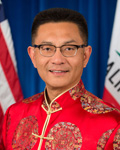
Existing law requires the State Board of Education to adopt statewide academically rigorous content standards as well as content standards specifically applicable to various academic disciplines. This bill would express the intent of the Legislature to enact legislation that would require the state board to adopt history-social science content standards relating to the China-Burma-India Theater of World War II.
Sponsored bills
Existing law establishes a workers' compensation system, administered by the Administrative Director of the Division of Workers' Compensation, to compensate an employee for injuries sustained in the course of his or her employment. Existing law requires every employer to establish a utilization review process, as described, and establishes an independent medical review process to resolve disputes over a utilization review decision, as specified. Existing law requires that aggregate disability payments for a single injury occurring on or after certain dates be limited, as provided. This bill would require that if a denial of treatment requested by a treating physician is subsequently overturned by independent medical review or by the Workers' Compensation Appeals Board, any temporary disability paid or owing from the date of the denial until the treatment is authorized would not be included in the calculation of the aggregate disability payments.
Existing law creates the Division of Labor Standards Enforcement in the Department of Industrial Relations for the purpose of enforcing labor laws. Existing law, with certain exceptions, establishes 8 hours as a day's work and a 40-hour workweek, and requires payment of prescribed overtime compensation for additional hours worked. This bill would create the Opportunity to Work Act. The bill would require an employer with 10 or more employees to offer additional hours of work to an existing nonexempt employee before hiring an additional employee or subcontractor, except as specified, would require an employer to post a notice of employee rights, as specified, and would require the employer to maintain certain documentation. The bill would authorize an employee to file a complaint for violation of these provisions with the division and to, in the alternative, bring a civil action for remedies under the act. The bill would require the division to enforce these provisions, as specified and would authorize the division to, among other things, adopt rules and regulations. The bill would make a violation of these provisions punishable by a civil penalty. The bill would also define various terms for these purposes.
Existing law establishes a basic speed law that prohibits a person from driving a vehicle upon a highway at a speed greater than is reasonable or prudent given the weather, visibility, traffic, highway conditions, and in no event at a speed that endangers the safety of persons or property. Existing law does not expressly authorize the use of automated speed enforcement in this state. This bill would authorize, no later than January 1, 2019, the City of San Jose (San Jose) and the City and County of San Francisco (San Francisco) to implement a 5-year pilot program utilizing an automated speed enforcement system (ASE system) for speed limit enforcement on certain streets, if the system meets specified requirements, including that the presence of a fixed or mobile ASE system is clearly identified by signs, as specified, and trained peace officers or other trained designated municipal employees are utilized to oversee the operation of the fixed and mobile ASE systems. The bill would require San Jose and San Francisco to adopt an ASE System Use Policy, as specified, and develop uniform guidelines for, among other things, the processing and storage of confidential information. The bill would provide that a speed violation that is recorded by an ASE system is subject to a civil penalty in an amount not to exceed $100. The bill would, among other things, provide for the issuance of a notice of violation, an initial review, an administrative hearing, and an appeals process, as specified, for a violation enforced by an ASE system. The bill would also authorize the processing agency to assess delinquent fees, as specified, if payment of the civil penalty is not received within a specified time. The bill would require the Department of Motor Vehicles to refuse to renew the registration of a vehicle if, among other things, the owner has not paid the civil penalty and delinquent fees, except as specified. The bill would require the department to remit all penalties and delinquent fees collected, after deducting its own administrative fees, to the processing agency. Existing law provides that payments for specified penalties, including penalties for offenses relating to the parking of a vehicle, required to register or transfer the registration of a vehicle, constitute a lien on the vehicle on which the payments are due or that was involved in the offenses, and on any other vehicle owned by the owner of that vehicle. This bill would, until January 1, 2024, also include payments for penalties for offenses related to the ASE system operated by San Jose or San Francisco for which a notice of violation has been served on the owner or recipient of a reissued citation and any delinquent fees added to the penalty as constituting a lien on the specified vehicles. Existing law transfers the responsibility and authority for the collection of specified delinquent amounts, including penalties for offenses relating to the standing or parking of a vehicle, from the department to the Franchise Tax Board. This bill would, until January 1, 2024, also transfer to the board the responsibility and authority to collect penalties for offenses related to the ASE system operated by San Jose or San Francisco for which a notice of violation has been served on the owner or recipient of a reissued notice of violation and any delinquent fees added to the penalty. This bill would make legislative findings and declarations as to the necessity of a special statute for the City of San Jose and the City and County of San Francisco. Existing constitutional provisions require that a statute that limits the right of access to the meetings of public bodies or the writings of public officials and agencies be adopted with findings demonstrating the interest protected by the limitation and the need for protecting that interest. This bill would make legislative findings to that effect.

Existing law requires every person or agency dealing with crimes or criminals to maintain the records necessary to report statistical data, and to report statistical data to the Department of Justice and the Attorney General. Existing law requires the Attorney General, subject to the availability of adequate funding, to direct local law enforcement agencies to report information related to hate crimes, as defined, to the Department of Justice. This bill would require specified reports of law enforcement agencies to include a check box and specified question that indicate whether an incident was bias related. The bill would require law enforcement agencies to implement the provisions of the bill on or before July 1, 2018. By imposing requirements on local law enforcement agencies, the bill would impose a state-mandated local program. The California Constitution requires the state to reimburse local agencies and school districts for certain costs mandated by the state. Statutory provisions establish procedures for making that reimbursement. This bill would provide that, if the Commission on State Mandates determines that the bill contains costs mandated by the state, reimbursement for those costs shall be made pursuant to the statutory provisions noted above.
Existing law declares that the fostering, continuance, and development of public transportation systems are a matter of statewide concern. Existing law authorizes the Department of Transportation to administer various programs and allocates moneys for various public transportation purposes. This bill would, upon an appropriation of moneys from the Public Transportation Account by the Legislature, create the Transit Pass Pilot Program to be administered by the department to provide free or reduced-fare transit passes, directly or through a 3rd party, including a transit agency, to specified pupils and students by supporting new, or expanding existing, transit pass programs. The bill would require the department to develop guidelines that describe the application process and selection criteria for awarding the moneys made available for the program, and would exempt the development of those guidelines from the Administrative Procedure Act. The bill would require the department to develop performance measures and reporting requirements to evaluate the effectiveness of the program, and would require the department to submit a report to specified committees of the Legislature on or before January 1, 2020, on the outcomes of the program and the status of transit pass programs statewide. The bill would provide that its requirements become effective only upon an appropriation that would trigger the creation of the program. The pilot program would be repealed on January 1, 2022.
This measure would recognize August 6, 2017, as the 52nd anniversary of the signing of the federal Voting Rights Act of 1965.