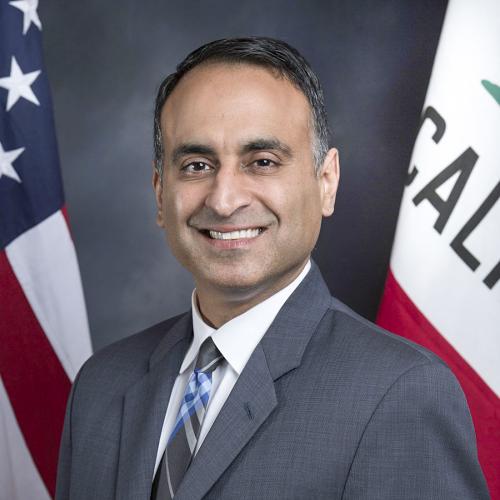
Photo of Ash Kalra
D California Assembly · District 25 On the 2026 ballot

Asm. Ash Kalra

Compare
Total votes
23,603
all sessions
Attendance
97%
541 missed
Near the chamber average
With party
99%
of cast votes
Near the chamber average
Bipartisan score
0%
crosses aisle rarely
Near the chamber average
Sponsored
2,377
bills & resolutions
Near the chamber average
Committees
12
assignments
2,377 bills and resolutions

Sponsored bills

Total
2,377
Primary
290
Co-sponsor
2,087
This page
2,377
matching current filters
Co-sponsor AJR 9
Signed into law · California Assembly · Co-sponsor
National parks: federal funding.

This measure would urge the President of the United States and Congress of the United States to immediately restore full and consistent funding and staffing for the National Park Service.

Signed into law Aug 25, 2026 1 co-sponsor
Co-sponsor AJR 17
Signed into law · California Assembly · Co-sponsor
The Renewing Immigration Provisions of the Immigration Act of 1929.

Maddy summaryAJR 17 is a legislative resolution that expresses support for the immigration provisions originally established in the Immigration Act of 1929. It serves to state the legislative body's position regarding these historical immigration policies.

Signed into law Aug 25, 2026 1 co-sponsor
Co-sponsor HR 140
Passed · California Assembly · Co-sponsor
Relative to Children's Get Offline and Get Outdoors Month.

Maddy summaryCalifornia Assembly Resolution 140 designates August 2026 as Children's Get Offline and Get Outdoors Month to promote awareness of the benefits of screen-free play for child development. The resolution cites research linking excessive social media use and reduced free play time to increased rates of anxiety, depression, and other behavioral issues among teenagers. It encourages families and communities to support unstructured outdoor activities and highlights ongoing federal efforts to protect children's mental health through technology guardrails.

Passed Aug 24, 2026 1 co-sponsor
Co-sponsor SJR 18
Signed into law · California Senate · Co-sponsor
Relative to campaign finance reform.

This measure would memorialize the Legislature's strong disagreement with the decision of the United States Supreme Court in Citizens United v. Federal Election Commission and encourage states to adopt policies to limit the powers of corporations to contribute to political campaigns, consistent with the United States Constitution.

Signed into law Aug 24, 2026 1 co-sponsor
Co-sponsor AB 2564
Passed · California Assembly · Co-sponsor
Surveillance pricing.

Existing law, the California Consumer Privacy Act of 2018 (CCPA) , grants a consumer various rights with respect to personal information that is collected or sold by a business, as defined, including the right to direct a business that sells or shares personal information about the consumer to third parties not to sell or share the consumer's personal information, as specified. Existing law, the California Privacy Rights Act of 2020, approved by the voters as Proposition 24 at the November 3, 2020, statewide general election, amended, added to, and reenacted the CCPA and establishes the California Privacy Protection Agency and vests the agency with full administrative power, authority, and jurisdiction to enforce those provisions. Existing law requires a retail grocery store or grocery department within a general retail merchandise store that uses a point-of-sale system to have a clearly readable price indicated on 85% of the total number of packaged consumer commodities offered for sale, subject to specified exemptions. This bill would, subject to certain exceptions, prohibit a retailer from engaging in surveillance pricing. The bill would define "surveillance pricing" to mean offering or setting a customized price for a good for a specific consumer or group of consumers, based, in whole or in part, on personally identifiable information, as specified, and determined in whole or in part through the use of any technology, software, program, machine-based system, or computational process that uses statistical modeling, data analytics, artificial intelligence, or other data processing techniques. The bill would also define "surveillance pricing" to mean random variations in prices to different consumers using a website, mobile application, or comparable online technology. The bill would provide that its provisions do not limit or impair any consumer right or remedy available under any other state or federal law. The bill would declare that any waiver of these provisions is against public policy and is void and unenforceable. This bill would declare that its provisions further the purposes and intent of the California Privacy Rights Act of 2020.

Passed Aug 24, 2026 1 co-sponsor
Co-sponsor SB 1194
Passed · California Senate · Co-sponsor
Immigration Legal Fellowship Project.

Existing law requires the State Department of Social Services, subject to an appropriation, to provide grants to qualified nonprofit organizations through contracts, in order to provide certain immigration-related legal services to persons residing in, or formerly residing in, the state. Under existing law, those grants are aimed at obtaining certain immigration remedies and benefits, assisting with the naturalization process and an appeal arising from the process, or providing legal training and technical assistance. This bill would establish the Immigration Legal Fellowship Project within the department for the purpose of expanding access to high-quality immigration legal services by supporting legal fellowships for qualified individuals who provide immigration legal services under the grant programs described above. The bill would require the department to award grants or enter into contracts with nonprofit entities to operate legal fellowships that include specified components, including, among other things, the recruitment, placement, coordination, and hosting of legal fellows. The bill would authorize the department to establish eligibility criteria, application requirements, and funding priorities for the program. The bill would require the department to include specified information relating to the use of funds appropriated for the purposes of the project in reports and updates provided to the Legislature regarding other immigration-related programs. The bill would provide that the implementation of these provisions is contingent on an appropriation for these purposes.

Passed Aug 24, 2026 1 co-sponsor
Primary AB 2042
Passed · California Assembly · Lead sponsor
Civil actions: setting aside default or default judgment.

(1) Existing law permits a defendant in a debt enforcement action, brought by a buyer of consumer debt who has obtained a default or default judgment against the defendant, to file a motion to set aside the default or default judgment and for leave to defend the action if the defendant did not receive actual notice of the action in time to defend against it. Existing law requires such a motion to be filed within 6 years after entry of the default or default judgment or 180 days after the first actual notice of the action, or, in the case of identity theft or mistaken identity, within a reasonable amount of time but in no case later than 180 days after the first actual notice of the action. This bill would clarify that a defendant who did not receive actual notice may file a motion to set aside and for leave to defend even if the service of the summons of the action was lawfully effected. (2) Existing law provides that if a copy of the summons and complaint cannot with reasonable diligence be personally delivered to the person to be served, the summons may be served by leaving a copy at the person's dwelling house, usual place of abode, usual place of business, or usual mailing address, in the presence of a person who is at least 18 years of age, and by thereafter mailing a copy of the summons and complaint as specified. Existing law also authorizes a summons in an action for unlawful detainer to be served by posting if the court is satisfied that the party to be served cannot with reasonable diligence be served in any authorized manner other than publication, and that other specified conditions are met. Existing law requires the proof of service of a summons to contain specified information and documentation. Beginning on January 1, 2027, existing law will define reasonable "diligence," for purposes of service of process in specified civil cases, to mean attempting personal delivery of the summons and complaint, in good faith, on at least three occasions on three different days at three different times. Beginning on January 1, 2027, existing law will require the proof of service of a summons and complaint, if served personally, by substituted service, or by posting, if the summons is for an action for unlawful detainer of real property, to include at least one photograph, if such can be obtained without compromising the safety of the process server, of the site of the effectuated or attempted service and contain a readable stamp and global positioning system (GPS) coordinates indicating the date, time, and location of service. Beginning on January 1, 2027, existing law will also require a process server to provide a detailed statement on the proof of service, as specified, if there is no GPS or cellular signal available at the time and place of the effected or attempted service. This bill would make nonsubstantive changes to this provision. (3) Existing law prescribes methods for the service of a summons in a civil action. Under existing law, a party that was not served in accordance with those methods may file a motion to set aside or vacate a default or default judgment and for leave to defend the action or move for dismissal. The party making such a motion is required to proffer evidence that service was not lawfully effected. This proffer rebuts the presumption of facts stated in the process server's return and place the burden of proving by a preponderance of the evidence that service of the summons and complaint was lawful on the party seeking the default or default judgment. Existing law makes these provisions operative on January 1, 2027. This bill would clarify that the provisions described above apply to service attempted or completed on or after January 1, 2027, and that those provisions do not alter a court's existing authority to determine a motion for relief from a judgment that involves a proof of service filed before January 1, 2027. The bill would also clarify that a party who is not served may move for dismissal as permitted by existing law.


Passed Aug 24, 2026 0 co-sponsors
Co-sponsor AB 1657
Passed · California Assembly · Co-sponsor
Domestic violence: restraining orders.

Existing law authorizes a court to issue an ex parte restraining order to prevent abuse based on reasonable proof of a past act or acts of abuse. Existing law authorizes the order to be issued solely on the affidavit or testimony of the person requesting the ex parte restraining order. Existing law requires the ex parte order to be issued or denied on the same day the application is submitted to the court, except as specified. Existing law prohibits an ex parte restraining order from being denied solely because the other party was not provided with notice. This bill would instead prohibit a court from requiring that notice be provided to the party to be restrained in advance of accepting a filing for, or deciding, an application for an ex parte restraining order. The bill would also prohibit a court from requiring an explanation or declaration for not providing notice in advance of accepting a filing for, or deciding, an application for an ex parte restraining order. The bill would prohibit a court from adopting or maintaining any rule, form, or practice that is inconsistent with these provisions.

Passed Aug 24, 2026 1 co-sponsor
Co-sponsor SJR 7
Signed into law · California Senate · Co-sponsor
Relative to tariffs.

This measure would urge President Donald J. Trump to avoid raising the cost of living for American consumers by rescinding the tariffs that he has imposed since taking office in January 2025 and refunding the American people for the costs passed on to them by his tariffs. The measure would also urge the United States Congress to enact a joint resolution to rescind President Trump's tariffs and to oppose all future unilateral and arbitrary tariff increases imposed by President Trump.

Signed into law Aug 24, 2026 1 co-sponsor
Co-sponsor SB 1375
Passed · California Senate · Co-sponsor
California Environmental Quality Act: exemption: urban intermodal rail station project.

The California Environmental Quality Act (CEQA) requires a lead agency, as defined, to prepare, or cause to be prepared, and certify the completion of, an environmental impact report on a project that it proposes to carry out or approve that may have a significant effect on the environment or to adopt a negative declaration if it finds that the project will not have that effect. CEQA also requires a lead agency to prepare a mitigated negative declaration for a project that may have a significant effect on the environment if revisions in the project would avoid or mitigate that effect and there is no substantial evidence that the project, as revised, would have a significant effect on the environment. Existing law exempts from CEQA a public project for the improvement, institution, or increase of passenger rail service, including the maintenance, construction, or rehabilitation of stations, terminals, or existing operations facilities that will be exclusively used by zero-emission trains or specified rolling stock or locomotives, as provided. This bill would exempt from CEQA, except as specified, a public urban, intermodal rail station project within a long-urbanized area within the statewide passenger rail network, at which high-capacity light, commuter, and intercity rail services converge that meets specified conditions, including, among other requirements, a requirement for compliance with various environmental laws and for the adoption of a plan for how any displacement from the project will be fully addressed, as provided. The bill would require a lead agency, if it determines that a project is not subject to CEQA pursuant to this exemption, and it determines to carry out the project, to file a notice of exemption with the Office of Land Use and Climate Innovation and the county clerk of the county in which the project is located, as provided. The bill would permit exemption only for projects for which a notice of exemption is filed before January 1, 2032. Because a lead agency would be required to determine the applicability of this exemption, the bill would impose a state-mandated local program. The California Constitution requires the state to reimburse local agencies and school districts for certain costs mandated by the state. Statutory provisions establish procedures for making that reimbursement. This bill would provide that no reimbursement is required by this act for a specified reason.

Passed Aug 21, 2026 1 co-sponsor
Showing 71 to 80 of 2,377 bills
Previous 1 … 7 8 9 … 238 Next