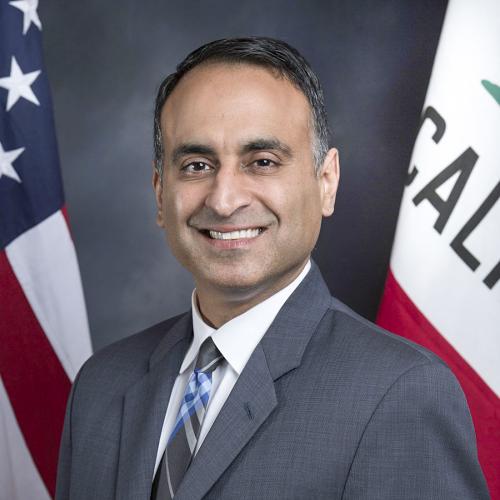
Photo of Ash Kalra
D California Assembly · District 25 On the 2026 ballot

Asm. Ash Kalra

Compare
Total votes
23,729
all sessions
Attendance
97%
547 missed
Higher than 75% of chamber peers
With party
99%
of cast votes
Near the chamber average
Bipartisan score
0%
crosses aisle rarely
Near the chamber average
Sponsored
2,377
bills & resolutions
Higher than 97% of chamber peers
Committees
12
assignments
2,377 bills and resolutions

Sponsored bills

Total
2,377
Primary
290
Co-sponsor
2,087
This page
2,377
matching current filters
Co-sponsor ACR 208
Signed into law · California Assembly · Co-sponsor
Relative to the Senior Master Sergeant John James Paoletti Memorial Highway.

This measure would designate the portion of State Route 5 from El Horno Street, at postmile 10.001, to Crown Valley Parkway, at postmile 13.776, in the County of Orange as the Senior Master Sergeant John James Paoletti Memorial Highway. The measure would request that the Department of Transportation determine the cost of appropriate signs showing this special designation and, upon receiving donations from nonstate sources covering that cost, erect those signs.

Signed into law Sep 6, 2022 1 co-sponsor
Co-sponsor ACR 211
Signed into law · California Assembly · Co-sponsor
Relative to Corporal Luis Carlos Ruan Memorial Highway.

This measure would designate a portion of State Route 119, between E Kern Street, postmile 0.34, and Cedar Street, postmile 1.300, in the County of Kern as the Corporal Luis Carlos Ruan Memorial Highway. The measure would request the Department of Transportation to determine the cost of appropriate signs showing this special designation and, upon receiving donations from nonstate sources covering that cost, to erect those signs.

Signed into law Sep 6, 2022 1 co-sponsor
Co-sponsor AB 257
Signed into law · California Assembly · Co-sponsor
Food facilities and employment.

Existing law prescribes various protections for employees and generally charges the Labor Commissioner with the enforcement of labor laws. Existing law establishes the powers and responsibilities of the Division of Occupational Safety and Health and the Division of Labor Standards and Enforcement, which are within the Department of Industrial Relations. This bill would enact the Fast Food Accountability and Standards Recovery Act or FAST Recovery Act. The bill would establish, until January 1, 2029, the Fast Food Council (council) within the Department of Industrial Relations, to be composed of 10 members to be appointed by the Governor, the Speaker of the Assembly, and the Senate Rules Committee, and would prescribe its powers. The purpose of the council would be to establish sectorwide minimum standards on wages, working hours, and other working conditions related to the health, safety, and welfare of, and supplying the necessary cost of proper living to, fast food restaurant workers, as well as effecting interagency coordination and prompt agency responses in this regard. The bill would define the characteristics of a fast food restaurant, including that the establishment be part of a set of fast food restaurants consisting of 100 or more establishments nationally that share a common brand, or that are characterized by standardized options for decor, marketing, packaging, products, and services. This bill would require the council to promulgate minimum fast food restaurant employment standards, including standards on wages, working conditions, and training, and to issue, amend, and repeal any other rules and regulations, as necessary to carry out its duties, subject to a petition signed by 10,000 fast food restaurant employees approving the creation of the council, as specified. Under the bill, if a conflict exists between council's standards, rules, or regulations and those issued by another state agency, the standards, rules, or regulations issued by the council would apply to fast food restaurant workers and fast food restaurant franchisees and franchisors, and the conflicting rules or regulations of the other state agency would not have force or effect with respect to these parties. The bill would except from this application proposed standards within the jurisdiction of the Occupational Safety and Health Standards Board and would prescribe a process for the council to petition the board to adopt, amend, or repeal a standard. This bill would require the council to submit a report to the Legislature, as specified, for a standard, or repeal or amendment of a standard, to become effective, and would specify that a standard, repeal, or amendment shall not take effect before October 15 of the same year. The bill would also require the council to provide information as requested by the appropriate committees of the Legislature on labor to facilitate a review of the council's performance and standards, as specified. This bill would require the council to conduct a full review of the adequacy of minimum fast food restaurant health, safety, and employment standards at least once every 3 years. The bill would require the council, following that review, to issue, amend, or repeal, or make recommendations to issue, amend, or repeal, any fast food employment, health or safety standard applicable to fast food restaurants, as appropriate. The bill would require the council to hold meetings or hearings no less than every 6 months that would be open to the public, as specified, and would authorize the council to coordinate with and authorize local agencies to hold such meetings. The bill would authorize a county, or a city with a population greater than 200,000, to establish a Local Fast Food Council, and would prescribe its powers and requirements for its composition. The bill would authorize a Local Fast Food Council to provide recommendations to the council. This bill would require standards for minimum wages, maximum hours of work, and other working conditions fixed by the council to be the minimum standards for fast food restaurant employees, absent a valid collective bargaining agreement, as specified, and would require that they be enforced by the commissioner, as specified, and the Division of Labor Standards Enforcement. By expanding the application of crimes associated with those enforcement procedures, this bill would impose a state-mandated local program. The bill would require the Labor Commissioner and the commissioner's deputies to take assignments of violations of standards issued by the council upon the filing of a claim in writing by an employee or an employee's authorized representative. This bill would prohibit a fast food restaurant operator from discharging or in any manner discriminating or retaliating against any fast food restaurant employee for specified reasons and would create a cause of action and right to reinstatement for employees in this connection, as well as a presumption of unlawful discrimination and retaliation in certain circumstances. The California Constitution requires the state to reimburse local agencies and school districts for certain costs mandated by the state. Statutory provisions establish procedures for making that reimbursement. This bill would provide that no reimbursement is required by this act for a specified reason.


Signed into law Sep 5, 2022 1 co-sponsor
Co-sponsor SB 971
Signed into law · California Senate · Co-sponsor
Housing: household pets.

Existing law requires the Department of Housing and Community Development to require each housing development, as defined, that is financed on or after January 1, 2018, pursuant to the Zenovich-Moscone-Chacon Housing and Home Finance Act, to authorize a resident of the housing development to own or otherwise maintain one or more common household pets, as defined, within the resident's dwelling unit, subject to applicable state laws and local government ordinances related to public health, animal control, and animal anticruelty. Existing law establishes a low-income housing tax credit program pursuant to which the California Tax Credit Allocation Committee (CTCAC) provides procedures and requirements for the allocation, in modified conformity with federal law, of state insurance, personal income, and corporation tax credit amounts to qualified low-income housing projects that have been allocated, or qualify for, a federal low-income housing tax credit, and farmworker housing. This bill would require any housing development that is financed on or after January 1, 2023, pursuant to the act or by any moneys administered or otherwise provided by the department, or that is the basis for the receipt, on or after January 1, 2023, of any low-income housing tax credit, as described, to authorize a resident of the housing development to own or otherwise maintain one or more common household pets, as defined, within the resident's dwelling unit, subject to applicable state laws and local government ordinances related to public health, animal control, and animal anticruelty and other reasonable conditions, as defined. The bill would, among other things, prohibit the imposition of a monthly fee for the ownership or maintenance of a common household pet in these housing developments.

Signed into law Sep 2, 2022 1 co-sponsor
Co-sponsor SB 260
Failed · California Senate · Co-sponsor
Climate Corporate Accountability Act.

The California Global Warming Solutions Act of 2006 requires the State Air Resources Board to adopt regulations to require the reporting and verification of statewide greenhouse gas emissions and to monitor and enforce compliance with the act. The act requires the state board to make available, and update at least annually, on its internet website the emissions of greenhouse gases, criteria pollutants, and toxic air contaminants for each facility that reports to the state board, as provided. This bill would require the state board, on or before January 1, 2024, to develop and adopt regulations requiring United States partnerships, corporations, limited liability companies, and other business entities with total annual revenues in excess of $1,000,000,000 and that do business in California, defined as "reporting entities," to publicly disclose to the emissions registry, as defined, and verify, starting in 2025 on a date to be determined by the state board, and annually thereafter, their greenhouse gas emissions, categorized as scope 1, 2, and 3 emissions, as defined, from the prior calendar year, as provided. The bill would require the state board, on or before January 1, 2029, to review, and update as necessary, these deadlines to evaluate trends in scope 3 emissions reporting and to consider changes to the deadlines, as provided. The bill would require reporting entities to disclose their greenhouse gas emissions in a manner that is easily understandable and accessible to residents of the state. The bill would require reporting entities to ensure that their public disclosures have been independently verified by the emissions registry or a third-party auditor, approved by the state board, with expertise in greenhouse gas emissions accounting. The bill would require the state board, in developing these regulations, to consult with the Attorney General, other government stakeholders, stakeholders representing consumer and environmental justice interests, and reporting entities that have demonstrated leadership in full-scope greenhouse gas emissions accounting and public disclosure and greenhouse gas emissions reductions. The bill would also require the state board to establish auditor qualifications and a process for approval of auditors that ensures sufficient auditor capacity, as well as timely reporting implementation, as required. The bill would further require the state board to contract with an emissions registry to develop a reporting and registry program to receive and make publicly available the required disclosures. This bill would require the state board, on or before July 1, 2026, to contract with the University of California, the California State University, a national laboratory, or another equivalent academic institution to prepare a report on the public disclosures made by reporting entities to the emissions registry. The bill would require, in preparing the report, consideration to be given to, at a minimum, greenhouse emissions from reporting entities in the context of state greenhouse gas emissions reduction and climate goals. The bill would require the state board to provide the report to the emissions registry to post on a digital platform that would be required to be created by the emissions registry, and publicly accessible, to house the state board's report and the reporting entities' public disclosures. The bill would require the emissions registry to provide the state board's report to the relevant policy committees of the Legislature. This bill would authorize the Attorney General to bring a civil action against a reporting entity, in the name of the people of the State of California, seeking civil penalties for violations of these provisions. This bill would make implementation of these provisions contingent upon an appropriation by the Legislature in the annual Budget Act or another statute for its purposes.

Failed Aug 31, 2022 1 co-sponsor
Co-sponsor ACA 3
Failed · California Assembly · Co-sponsor
A resolution to propose to the people of the State of California an amendment to the Constitution of the State, by amending Section 6 of Article I thereof, relating to slavery.

The California Constitution prohibits slavery. The California Constitution also prohibits involuntary servitude except as punishment to a crime. This measure would define slavery to include involuntary servitude and forced labor compelled by the use or threat of physical or legal coercion. The measure would clarify that the provisions are not intended to have any effect on voluntary work programs in corrections settings.

Failed Aug 31, 2022 1 co-sponsor
Co-sponsor AB 937
Failed · California Assembly · Co-sponsor
Immigration enforcement.

Existing law, the California Values Act, prohibits a California law enforcement agency from providing a person's release date, or responding to a request for notification of a release date, unless that information is available to the public, and prohibits the transfer of an individual to immigration authorities, as specified, unless the person has been convicted of specified crimes or arrested for a serious or violent felony. This bill would prohibit any state or local agency from arresting or assisting with the arrest, confinement, detention, transfer, interrogation, or deportation of an individual for an immigration enforcement purpose, except as specified. The bill would additionally prohibit state or local agencies or courts from using immigration status as a factor to deny or to recommend denial of probation or participation in any diversion, rehabilitation, mental health program, or placement in a credit-earning program or class, or to determine custodial classification level, to deny mandatory supervision, or to lengthen the portion of supervision served in custody. The bill would authorize a person to bring an action for equitable or declaratory relief in a court of competent jurisdiction against a state or local agency or state or local official that violates these provisions, and would make those agencies or officials liable for actual and general damages and reasonable attorney's fees. Existing law requires the Department of Corrections and Rehabilitation to implement and maintain procedures to identify inmates serving terms in state prison who are undocumented felons subject to deportation. Existing law requires the department to annually report to the Legislature the number of persons identified as undocumented aliens, as specified. This bill would repeal those provisions. Existing law requires all basic information stored in state or local criminal offender record information systems to be recorded in the form of specified standard data elements, including, among other things, place of birth. This bill would no longer require that information to include place of birth.

Failed Aug 31, 2022 1 co-sponsor
Co-sponsor AB 1577
Passed · California Assembly · Co-sponsor
Collective bargaining: Legislature.

Existing law, the Ralph C. Dills Act (Dills Act) , governs collective bargaining between the state and recognized state public employee organizations. Existing law excludes certain employees from coverage under the Dills Act, including, among others, managerial employees, supervisory employees, and confidential employees, as defined. Existing law creates the Public Employment Relations Board and authorizes it, among other things, to determine appropriate state employee bargaining units, as specified. This bill would enact the Legislature Employer-Employee Relations Act, to provide employees of the Legislature the right to form, join, and participate in the activities of employee organizations of their own choosing for the purpose of representation on all matters of employer-employee relations. The bill would prescribe rights, duties, and prohibitions in this context that parallel those in the Dills Act. The bill would prohibit the Public Employment Relations Board from including employees of the Legislature in a bargaining unit that includes employees other than those of the Legislature. The bill would make it a misdemeanor for any person to willfully resist, prevent, impede, or interfere with any member of the board, or any of its agents, in the performance of duties pursuant to its provisions. By expanding the definition of a crime, this bill would impose a state-mandated local program. The bill would provide that the provisions of the Legislature Employer-Employee Relations Act are severable. The bill would become operative on July 1, 2024. The California Constitution requires the state to reimburse local agencies and school districts for certain costs mandated by the state. Statutory provisions establish procedures for making that reimbursement. This bill would provide that no reimbursement is required by this act for a specified reason.
Passed Aug 31, 2022 1 co-sponsor
Co-sponsor AB 1816
Passed · California Assembly · Co-sponsor
Reentry Housing and Workforce Development Program.

Existing law establishes the Department of Housing and Community Development in the Business, Consumer Services, and Housing Agency and makes the department responsible for administering various housing programs throughout the state, including, among others, the Multifamily Housing Program, the Housing for a Healthy California Program, and the California Emergency Solutions Grants Program. Upon appropriation by the Legislature for this express purpose, this bill would require the department to create the Reentry Housing and Workforce Development Program, and would require the department to take specified actions to provide grants to applicants, as defined, for innovative or evidence-based housing, housing-based services, and employment interventions to allow people with recent histories of incarceration to exit homelessness and remain stably housed. The bill would require the department to establish a process, in collaboration with the Department of Corrections and Rehabilitation and with counties in which recipients are operating, for referral of participants, in accordance with certain guidelines and procedures. The bill would require the department to score applicants to the program competitively according to specified criteria. The bill would require recipients of funds from the program to use those funds for, among other things, long-term rental assistance in permanent housing, incentives to landlords, and innovative or evidence-based services to assist participants in accessing permanent supportive housing. The bill would require the department to distribute funds allocated by executing contracts with awarded entities for a term of 5 years, subject to automatic renewal. The bill would require a recipient of the program to submit an annual report to the department. The bill would require the department to hire an independent evaluator to assess outcomes from the program and would require the department to submit the analysis of that assessment to specified committees of the Legislature.

Passed Aug 30, 2022 1 co-sponsor
Co-sponsor SB 1014
Passed · California Senate · Co-sponsor
Enhanced Clinically Integrated Program for Federally Qualified Health Centers.

Existing law establishes the Medi-Cal program, which is administered by the State Department of Health Care Services and under which qualified low-income individuals receive health care services. The Medi-Cal program is, in part, governed and funded by federal Medicaid program provisions. Under existing law, federally qualified health center (FQHC) services are covered benefits under the Medi-Cal program, to be reimbursed on a per-visit basis, as specified, to the extent that federal financial participation is obtained. Existing federal law authorizes a state plan to provide for payment in any fiscal year to an FQHC for specified services in an amount that is determined under an alternative payment methodology (APM) if it is agreed to by the state and the FQHC and results in a payment to the FQHC of an amount that is at least equal to the amount otherwise required to be paid to the FQHC. Existing state law requires the department to authorize an APM pilot project for FQHCs that agree to participate, for implementation with respect to a county for a period of up to 3 years. This bill would require the department to authorize a new supplemental payment program for FQHCs pursuant to federal law, or as specified, to be named the Enhanced Clinically Integrated Program (ECIP) . Under the bill, ECIP funding would be subject to an appropriation. The bill would require the department to request an amount, as necessary to fund, implement, and maintain ECIP at sufficient capacity, on an ongoing basis in future fiscal years. Under the bill, participation in ECIP would be optional for FQHCs, funding under ECIP would be provided in addition to all other funding received by FQHCs, as specified, and participation in ECIP would result in total payments to participating FQHCs that are greater than the prospective payment system (PPS) rate otherwise required to be paid to the FQHC. The bill would, subject to an appropriation, require the department, no later than July 1, 2023, to make funding available for the purpose of direct compensation of health center workers. The bill would require ECIP to improve quality and access to care by allocating funds, if appropriated, to FQHCs that meet certain standards relating to wage thresholds and commitment to participation in bona fide labor-management cooperation committees (LMCCs) , as specified. The bill would set forth various requirements for funding allocations to, and uses by, participating FQHCs. The bill would require the department to develop eligibility criteria, an application process, a fund distribution process, reporting requirements, and a methodology for adjusting funding allocations based on health care inflation. The bill would authorize the department to choose to implement the program as a state-only funded program, as specified. If the department seeks federal financial participation in the first year of the program, the bill would require the department to apply for federal approval no later than February 1, 2023, but would authorize seeking federal financial participation in subsequent years. If federal financial participation is sought, the department would have discretion to modify the terms of ECIP if necessary to obtain federal approval so long as the modifications further the goals of increasing FQHC workforce compensation particularly for lower-paid workers and furthering the creation of, and participation in, bona fide LMCCs for FQHC worker education and training. The bill would authorize the department to implement these provisions through all-county letters or similar instructions, until any necessary regulations are adopted. The bill would make these provisions severable.

Passed Aug 30, 2022 1 co-sponsor
Showing 1,111 to 1,120 of 2,377 bills