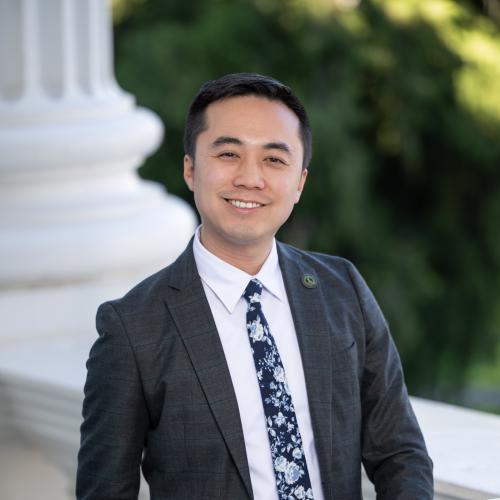
Photo of Alex Lee
D California Assembly · District 24 On the 2026 ballot

Asm. Alex Lee

Compare
Total votes
14,493
all sessions
Attendance
94%
702 missed
Near the chamber average
With party
99%
of cast votes
Near the chamber average
Bipartisan score
0%
crosses aisle rarely
Near the chamber average
Sponsored
1,076
bills & resolutions
Near the chamber average
Committees
12
assignments
1,076 bills and resolutions

Sponsored bills

Total
1,076
Primary
123
Co-sponsor
953
This page
1,076
matching current filters
Co-sponsor ACR 177
Signed into law · California Assembly · Co-sponsor
Christopher Columbus Transcontinental Highway: removal of designation.

This measure would request that the Department of Transportation remove the "The Christopher Columbus Transcontinental Highway" designation from the portion of Interstate 10 in the state, as well as any signage and markers memorializing that designation, and advise the Federal Highway Administration of the state's action.

Signed into law Sep 13, 2022 1 co-sponsor
Co-sponsor AJR 22
Signed into law · California Assembly · Co-sponsor
Relative to the Select Committee to Investigate the January 6th Attack on the United States Capitol.

This measure would, among other things, on the first anniversary of the attack on the United States Capitol on January 6, 2021, urge the Select Committee to Investigate the January 6th Attack on the United States Capitol to uncover the facts, circumstances, and causes relating to the attack, and honor the individuals who died or were injured as a result of the attack.

Signed into law Sep 6, 2022 1 co-sponsor
Primary AB 1680
Signed into law · California Assembly · Lead sponsor
Transportation: San Francisco Bay Area Rapid Transit District: policing responsibilities.

Existing law creates the San Francisco Bay Area Rapid Transit District (BART) . Existing law authorizes BART to acquire, construct, own, operate, control, or use rights-of-way, rail lines, bus lines, stations, platforms, switches, yards, terminals, parking lots, and any and all other facilities necessary or convenient for rapid transit service, as specified. Section 99171 of the Public Utilities Code authorizes specified transit districts, including BART, to issue prohibition orders to any person that is cited 3 times within a period of 90 days for specified infractions committed in or on a vehicle, bus stop, or train or light rail station of a transit district, and prohibits a person issued a prohibition order from entering the property, facilities, or vehicles of the transit district, as specified. AB 1337 (Chapter 534 of the Statutes of 2021) , effective January 1, 2022, amended Section 99171 of the Public Utilities Code to authorize a prohibition order to also be issued for those infractions committed in or on a property, facility, or vehicle upon which BART owes policing responsibilities, and to also prohibit a person issued a prohibition order from additionally entering the property, facilities, or vehicles upon which BART owes policing responsibilities, as specified. SB 357 (Chapter 86 of the Statutes of 2022) , effective January 1, 2023, among other things, amended Section 99171 of the Public Utilities Code to strike a cross-reference to a statute the bill repeals. SB 357 also made the same changes to Section 99171 of the Public Utilities Code made by AB 1337, but only if SB 357 and AB 1337 were enacted and became effective on or before January 1, 2022, and SB 357 was enacted last. SB 357 was not enacted and did not become effective on or before January 1, 2022. Thus, SB 357, in addition to striking the cross-reference, deletes the amendments AB 1337 made to Section 99171 of the Public Utilities Code, as described above. This bill would amend the above-described provision of SB 357 to instead incorporate the changes to Section 99171 of the Public Utilities Code made by AB 1337 if SB 357 and AB 1337 are enacted and become effective on or before January 1, 2023, rather than January 1, 2022, thereby preserving the changes AB 1337 made to Section 99171 of the Public Utilities Code that would otherwise be deleted by SB 357.

Signed into law Sep 6, 2022 0 co-sponsors
Co-sponsor AJR 26
Signed into law · California Assembly · Co-sponsor
Student loan debt repayment.

This measure would urge the United States Secretary of Education to establish and submit to the United States Congress for approval a monthly student loan payment plan for federal student loans, based on the personal savings rate as published by the federal Bureau of Economic Analysis.

Signed into law Sep 6, 2022 1 co-sponsor
Co-sponsor SB 260
Failed · California Senate · Co-sponsor
Climate Corporate Accountability Act.

The California Global Warming Solutions Act of 2006 requires the State Air Resources Board to adopt regulations to require the reporting and verification of statewide greenhouse gas emissions and to monitor and enforce compliance with the act. The act requires the state board to make available, and update at least annually, on its internet website the emissions of greenhouse gases, criteria pollutants, and toxic air contaminants for each facility that reports to the state board, as provided. This bill would require the state board, on or before January 1, 2024, to develop and adopt regulations requiring United States partnerships, corporations, limited liability companies, and other business entities with total annual revenues in excess of $1,000,000,000 and that do business in California, defined as "reporting entities," to publicly disclose to the emissions registry, as defined, and verify, starting in 2025 on a date to be determined by the state board, and annually thereafter, their greenhouse gas emissions, categorized as scope 1, 2, and 3 emissions, as defined, from the prior calendar year, as provided. The bill would require the state board, on or before January 1, 2029, to review, and update as necessary, these deadlines to evaluate trends in scope 3 emissions reporting and to consider changes to the deadlines, as provided. The bill would require reporting entities to disclose their greenhouse gas emissions in a manner that is easily understandable and accessible to residents of the state. The bill would require reporting entities to ensure that their public disclosures have been independently verified by the emissions registry or a third-party auditor, approved by the state board, with expertise in greenhouse gas emissions accounting. The bill would require the state board, in developing these regulations, to consult with the Attorney General, other government stakeholders, stakeholders representing consumer and environmental justice interests, and reporting entities that have demonstrated leadership in full-scope greenhouse gas emissions accounting and public disclosure and greenhouse gas emissions reductions. The bill would also require the state board to establish auditor qualifications and a process for approval of auditors that ensures sufficient auditor capacity, as well as timely reporting implementation, as required. The bill would further require the state board to contract with an emissions registry to develop a reporting and registry program to receive and make publicly available the required disclosures. This bill would require the state board, on or before July 1, 2026, to contract with the University of California, the California State University, a national laboratory, or another equivalent academic institution to prepare a report on the public disclosures made by reporting entities to the emissions registry. The bill would require, in preparing the report, consideration to be given to, at a minimum, greenhouse emissions from reporting entities in the context of state greenhouse gas emissions reduction and climate goals. The bill would require the state board to provide the report to the emissions registry to post on a digital platform that would be required to be created by the emissions registry, and publicly accessible, to house the state board's report and the reporting entities' public disclosures. The bill would require the emissions registry to provide the state board's report to the relevant policy committees of the Legislature. This bill would authorize the Attorney General to bring a civil action against a reporting entity, in the name of the people of the State of California, seeking civil penalties for violations of these provisions. This bill would make implementation of these provisions contingent upon an appropriation by the Legislature in the annual Budget Act or another statute for its purposes.


Failed Aug 31, 2022 1 co-sponsor
Co-sponsor SB 299
Passed · California Senate · Co-sponsor
Victim compensation: use of force by a law enforcement officer.

(1) Existing law provides for the compensation of victims and derivative victims of specified types of crimes by the California Victim Compensation Board from the Restitution Fund, a continuously appropriated fund, for specified losses suffered as a result of those crimes. Existing law defines various terms for purposes of these provisions. This bill would define "law enforcement officer" consistently with specified provisions. The bill would define "victim services provider" to mean an individual, whether paid or serving as a volunteer, who provides services to victims under the supervision of either an agency or organization that has a documented record of providing services to victims, or a law enforcement or prosecution agency. (2) Existing law requires that a person be ineligible for compensation under specified conditions, including, among other things, if the board determines that denial of the claim for compensation is appropriate because of the nature of the victim's involvement in the events leading to the crime or the involvement of the person whose injury or death gives rise to the application. Existing law requires the board to deny an application if it finds that the victim failed to cooperate reasonably with a law enforcement agency in the apprehension and conviction of a criminal committing the crime. This bill, in the case of a claim based on a victim's serious bodily injury or death that resulted from a law enforcement officer's use of force, would prohibit the board from denying an application based on the victim's or other applicant's involvement in the crime, except as specified, or the victim's failure to cooperate. The bill would require the board, solely for the purposes of eligibility for compensation, to accept as sufficient evidence forms of documentation, as described, that describe or demonstrate a person suffered serious bodily injury or death as a result of a law enforcement officer's use of force. The bill, in the case of a claim based on a victim's death as a result of a crime, would prohibit the board from denying an application based on the deceased victim's involvement in the crime or the victim's or derivative victim's failure to cooperate, except as provided. By expanding the types of crime for which compensation can be paid from a continuously appropriated fund, the bill would make an appropriation. (3) Existing law requires that the California Victim Compensation Board be subrogated to the rights of the recipient to the extent of any compensation granted by the board. This bill would specify that the above-described subrogation of the board applies to compensation by the board for a claim based on serious bodily injury or death that resulted from a law enforcement officer's use of force, as specified.

Passed Aug 31, 2022 1 co-sponsor
Co-sponsor AB 937
Failed · California Assembly · Co-sponsor
Immigration enforcement.

Existing law, the California Values Act, prohibits a California law enforcement agency from providing a person's release date, or responding to a request for notification of a release date, unless that information is available to the public, and prohibits the transfer of an individual to immigration authorities, as specified, unless the person has been convicted of specified crimes or arrested for a serious or violent felony. This bill would prohibit any state or local agency from arresting or assisting with the arrest, confinement, detention, transfer, interrogation, or deportation of an individual for an immigration enforcement purpose, except as specified. The bill would additionally prohibit state or local agencies or courts from using immigration status as a factor to deny or to recommend denial of probation or participation in any diversion, rehabilitation, mental health program, or placement in a credit-earning program or class, or to determine custodial classification level, to deny mandatory supervision, or to lengthen the portion of supervision served in custody. The bill would authorize a person to bring an action for equitable or declaratory relief in a court of competent jurisdiction against a state or local agency or state or local official that violates these provisions, and would make those agencies or officials liable for actual and general damages and reasonable attorney's fees. Existing law requires the Department of Corrections and Rehabilitation to implement and maintain procedures to identify inmates serving terms in state prison who are undocumented felons subject to deportation. Existing law requires the department to annually report to the Legislature the number of persons identified as undocumented aliens, as specified. This bill would repeal those provisions. Existing law requires all basic information stored in state or local criminal offender record information systems to be recorded in the form of specified standard data elements, including, among other things, place of birth. This bill would no longer require that information to include place of birth.

Failed Aug 31, 2022 1 co-sponsor
Co-sponsor AB 1227
Passed · California Assembly · Co-sponsor
Firearms and ammunition: excise tax.

Existing law establishes the California Violence Intervention and Prevention (CalVIP) Grant Program, administered by the Board of State and Community Corrections, to award competitive grants for the purpose of violence intervention and prevention. Existing law imposes various taxes, including taxes on the privilege of engaging in certain activities. The Fee Collection Procedures Law, the violation of which is a crime, provides procedures for the collection of certain fees and surcharges. This bill, the Gun Violence Prevention, Healing, and Recovery Act, would, commencing July 1, 2023, impose an excise tax in the amount of 10% of the gross receipts from the retail sale in this state of a handgun and 11% of the gross receipts from the retail sale in this state of a long gun, rifle, firearm precursor part, and ammunition, as specified. The tax would be collected by the state pursuant to the Fee Collection Procedures Law. The bill would require that the revenues collected be deposited in the Gun Violence Prevention, Healing, and Recovery Fund, which the bill would establish in the State Treasury. The bill would require that 12 of the moneys received in the fund be used to fund gun violence prevention programs, gun violence prevention education, and gun violence prevention research, upon appropriation by the Legislature, and would continuously appropriate the other 12 of the moneys received in the fund to the Board of State and Community Corrections for the CalVIP Grant Program, thereby making an appropriation. The bill would require the Director of Finance to transfer, as a loan, $2,400,000 from the General Fund to the California Department of Tax and Fee Administration to implement these provisions, as specified. This bill would include a change in state statute that would result in a taxpayer paying a higher tax within the meaning of Section 3 of Article XIII A of the California Constitution, and thus would require for passage the approval of 23 of the membership of each house of the Legislature. Because this bill would expand the scope of the Fee Collection Procedures Law, the violation of which is a crime, this bill would impose a state-mandated local program. The California Constitution requires the state to reimburse local agencies and school districts for certain costs mandated by the state. Statutory provisions establish procedures for making that reimbursement. This bill would provide that no reimbursement is required by this act for a specified reason. This bill would declare that it is to take effect immediately as an urgency statute.

Passed Aug 31, 2022 1 co-sponsor
Co-sponsor AB 1577
Passed · California Assembly · Co-sponsor
Collective bargaining: Legislature.

Existing law, the Ralph C. Dills Act (Dills Act) , governs collective bargaining between the state and recognized state public employee organizations. Existing law excludes certain employees from coverage under the Dills Act, including, among others, managerial employees, supervisory employees, and confidential employees, as defined. Existing law creates the Public Employment Relations Board and authorizes it, among other things, to determine appropriate state employee bargaining units, as specified. This bill would enact the Legislature Employer-Employee Relations Act, to provide employees of the Legislature the right to form, join, and participate in the activities of employee organizations of their own choosing for the purpose of representation on all matters of employer-employee relations. The bill would prescribe rights, duties, and prohibitions in this context that parallel those in the Dills Act. The bill would prohibit the Public Employment Relations Board from including employees of the Legislature in a bargaining unit that includes employees other than those of the Legislature. The bill would make it a misdemeanor for any person to willfully resist, prevent, impede, or interfere with any member of the board, or any of its agents, in the performance of duties pursuant to its provisions. By expanding the definition of a crime, this bill would impose a state-mandated local program. The bill would provide that the provisions of the Legislature Employer-Employee Relations Act are severable. The bill would become operative on July 1, 2024. The California Constitution requires the state to reimburse local agencies and school districts for certain costs mandated by the state. Statutory provisions establish procedures for making that reimbursement. This bill would provide that no reimbursement is required by this act for a specified reason.

Passed Aug 31, 2022 1 co-sponsor
Co-sponsor ACR 176
Signed into law · California Assembly · Co-sponsor
Relative to cruising.

This measure would celebrate the history and culture of cruising and encourage local officials and law enforcement to work with local car clubs to conduct safe cruising events.

Signed into law Aug 30, 2022 1 co-sponsor
Showing 761 to 770 of 1,076 bills
Previous 1 … 76 77 78 … 108 Next