

(1) Existing state and federal law, including the federal Voting Rights Act of 1965, require the Secretary of State and county elections officials to provide language assistance to voters in order to access voting information, register to vote, and cast their votes at the polling place. Existing law requires a county elections official to provide a facsimile copy of the ballot with the ballot measures and ballot instructions printed in Spanish and other languages if the Secretary of State has determined that doing so is appropriate, as specified. This bill would, by December 15, 2025, and by December 15 of every subsequent year following a presidential election, require the Secretary of State to determine the number of residents of voting age in each county and precinct who are members of a single language minority group and who lack sufficient skills in English to vote without assistance, as specified. The bill would require that, by that same date, the Secretary of State make publicly available on the Secretary of State's internet website a list of languages used by single language minority groups, as specified. Beginning January 1, 2028, this bill would further require the Secretary of State and county elections officials to provide specified materials in the language of the applicable language minority group as well as in the English language. (2) Existing law requires the Secretary of State to make specified findings and determinations regarding the provision of ballot materials in languages other than English. Until January 1, 2028, this bill would direct the Secretary to make those findings and determinations by December 15 of each year following a presidential election, and it would further limit the expansion of categories of covered languages for the purpose of providing facsimile ballots. As of January 1, 2028, this bill would impose new requirements relating to translated ballots, including requiring the training of specified precinct board members. The bill would make conforming changes. By increasing the duties of county elections officials, the bill would impose a state-mandated local program. (3) Existing law requires the elections official to send a voter information guide that contains the written statement of each candidate. Existing law requires the elections official to provide a Spanish translation of the written statement to each candidate who wishes to have one and to select a person to provide the translation who is, among other things, a certified and registered interpreter on the judicial council master list or a current voting member in good standing of the American Translators Association. This bill would add a language speaker with relevant experience in providing certified translations of legal documents who has been referred by a nonprofit agency to the list of eligible individuals that may provide the translation. (4) This bill would incorporate additional changes to Section 3019 of the Elections Code proposed by AB 3184 to be operative only if this bill and AB 3184 are enacted and this bill is enacted last. The bill would incorporate changes to Section 4005 of the Elections Code proposed by SB 1450 to be operative only if this bill and SB 1450 are enacted and this bill is enacted last. (5) The California Constitution requires the state to reimburse local agencies and school districts for certain costs mandated by the state. Statutory provisions establish procedures for making that reimbursement. This bill would provide that, if the Commission on State Mandates determines that the bill contains costs mandated by the state, reimbursement for those costs shall be made pursuant to the statutory provisions noted above.
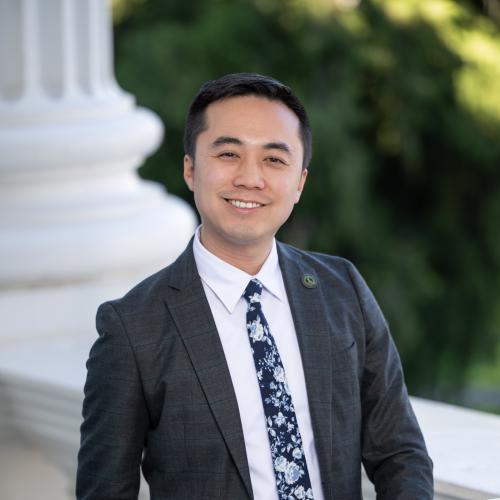
Asm. Alex Lee
Sponsored bills
Existing law, commonly known as the code of ethics, prohibits a Member of the Legislature, state elective or appointive officer, or judge or justice from having any interest, engaging in any business, transaction, or professional activity, or incurring any obligation that is in substantial conflict with the proper discharge of their duties in the public interest and of their responsibilities, as specified. Existing law, the Political Reform Act of 1974, provides for the comprehensive regulation of campaign financing, including requiring the reporting of campaign contributions and expenditures, and regulates the making of gifts to public officials. Existing law, the State Civil Service Act, creates the Department of Human Resources and grants to the department the powers, duties, and authority necessary to operate the state civil service system. Existing law requires that a California Science and Technology Policy Fellow provided by the California Council on Science and Technology (CCST) be selected according to criteria, and pursuant to a process, approved by the Senate Committee on Rules, the Assembly Committee on Rules, or the Joint Committee on Rules and requires the CCST to execute an agreement for a policy fellow to be bound to abide by standards of conduct, economic interest disclosure requisites, and other requirements specified by the Senate Committee on Rules, the Assembly Committee on Rules, or the Joint Committee on Rules, to be considered duly authorized by those rules committees. Under existing law, for purposes of the code of ethics, the services of a duly authorized policy fellow provided by the CCST are not compensation, a reward, or a gift to a Member of the Legislature and are not an interest, business, transaction, professional activity, or obligation of a Member of the Legislature, state elective or appointive officer, judge, or justice that is in substantial conflict with the proper discharge of their duties in the public interest or of their responsibilities, and a policy fellow is not an employee of either house of the Legislature. Existing law also provides that the services of a duly authorized policy fellow are not a gift for purposes of the Political Reform Act of 1974 and not compensation of a state elective or appointive officer, and the policy fellow is not included in "state civil service" for the purposes of the State Civil Service Act, as specified. The bill would provide that the services of a policy fellow provided by an association, as defined, are not compensation, a reward, a gift, an interest, a business, a transaction, a professional activity, or an obligation, and a policy fellow is not an employee of the Legislature or included in the state civil service, similar to the above-described provisions that apply to a California Science and Technology Policy Fellow provided by the CCST. The bill would state that these provisions are declaratory of existing law.
This measure would, among other things, urge the United States Congress and President Joseph R. Biden to fully fund the United States Environmental Protection Agency's Comprehensive Infrastructure Solution for the Tijuana River due to the ongoing impacts to public health, the environment, and the local economy caused by cross-border pollution and would urge President Joseph R. Biden to declare a national emergency due to those ongoing impacts.
This measure would urge the Congress of the United States to repeal the state and local tax deduction limitation so that residents of California and married taxpayers are no longer penalized by the federal tax code.
Maddy summaryAssembly Concurrent Resolution 120 designates January 2024 as Positive Parenting Awareness Month in California. This measure does not change laws or allocate funding but instead encourages state agencies, communities, and organizations to focus on the importance of positive parenting strategies. The resolution highlights how supportive family environments can improve children's health and well-being while acknowledging the diverse forms families take in the state. It serves as a formal acknowledgment of existing programs and resources rather than creating new mandates or policies.
This measure would proclaim September 20, 2024, and September 20 of each year thereafter, as California Youth Climate Action Day to honor and support the efforts of young people in their pursuit of environmental sustainability, climate justice, and the preservation of biodiversity.
The False Advertising Law (FAL) makes it a crime for a person or a firm, corporation, or association, or any employee thereof, to engage in specified false or misleading advertising practices. The Unfair Competition Law (UCL) makes various unfair competition practices unlawful, including any unlawful, unfair, or fraudulent business act or practice and unfair, deceptive, untrue, or misleading advertising. Existing law requires every keeper of a hotel, inn, or lodginghouse to post a statement of rates by the day for lodging and prohibits collection of a sum greater than that amount, as specified. This bill would, beginning July 1, 2024, require a person or an internet website, application, or other similar centralized platform that advertises a hotel room rate or short-term rental rate before the public in this state, or from this state before the public in any state, to include in the advertised hotel room rate or short-term rental rate all mandatory fees, as defined, that will be charged in order for the consumer to stay in the hotel room or short-term rental and include in the total price to be paid, before the consumer reserves the stay, all taxes and fees imposed by a government on the stay. This bill would authorize certain public attorneys, including the Attorney General, to bring an enforcement action against a person or an internet website, application, or other similar centralized platform that knew or should have known that it has advertised a hotel room rate or short-term rental rate in violation of these provisions, and would require a court to impose a civil penalty of not more than $10,000 for each violation after consideration of specified factors.
Maddy summaryThis bill officially designates the week of January 26 through February 2, 2024, as CalEITC Awareness Week to highlight the California Earned Income Tax Credit program. The measure aims to increase public knowledge about this refundable tax credit, which assists low-income working families in meeting basic needs like housing, food, and health care. By drawing attention to the program, the resolution seeks to inform residents that the credit is available to many households, including those led by non-citizens and families with young children. The text includes findings on poverty levels and the economic benefits of the credit but does not change any laws or funding.
Maddy summaryThis bill designates September 2024 as Ovarian Cancer Awareness Month in California. It serves as a symbolic gesture to highlight the importance of early detection and support for those affected by the disease. The resolution does not create new laws or funding but aims to encourage public awareness and education about ovarian cancer risks and symptoms. Copies of the proclamation will be distributed to the bill's author for sharing with the community.
This measure would urge the United States Congress to explore policy options to improve the timeliness of the United States Food and Drug Administration's approval pathways for sunscreen ingredients and filters.