

Existing law designates the State Air Resources Board as the state agency with the primary responsibility for the control of vehicular air pollution and as the state agency charged with monitoring and regulating sources of emissions of greenhouse gases that cause global warming in order to reduce emissions of greenhouse gases. Existing law requires the state board to adopt rules and regulations to achieve the maximum technologically feasible and cost-effective greenhouse gas emissions reductions to ensure that the statewide greenhouse gas emissions are reduced to at least 40% below the statewide greenhouse gas emissions limit, as defined, no later than December 31, 2030. On September 23, 2020, the Governor issued Executive Order No. N-79-20 establishing a goal that 100% of in-state sales of new passenger cars and trucks be zero-emission by 2035. This bill would declare that, to help achieve the state's climate and air quality goals and mandates, it is the goal of the state, as established in Executive Order No. N-79-20, that 100% of in-state sales of new passenger vehicles and light-duty trucks be zero-emission by 2035. The bill would require the state board, to the extent consistent with state and federal law, to develop and adopt passenger vehicle and light-duty truck regulations requiring increasing volumes of new zero-emission vehicles sold in the state towards the target of 100% of in-state sales by 2035.
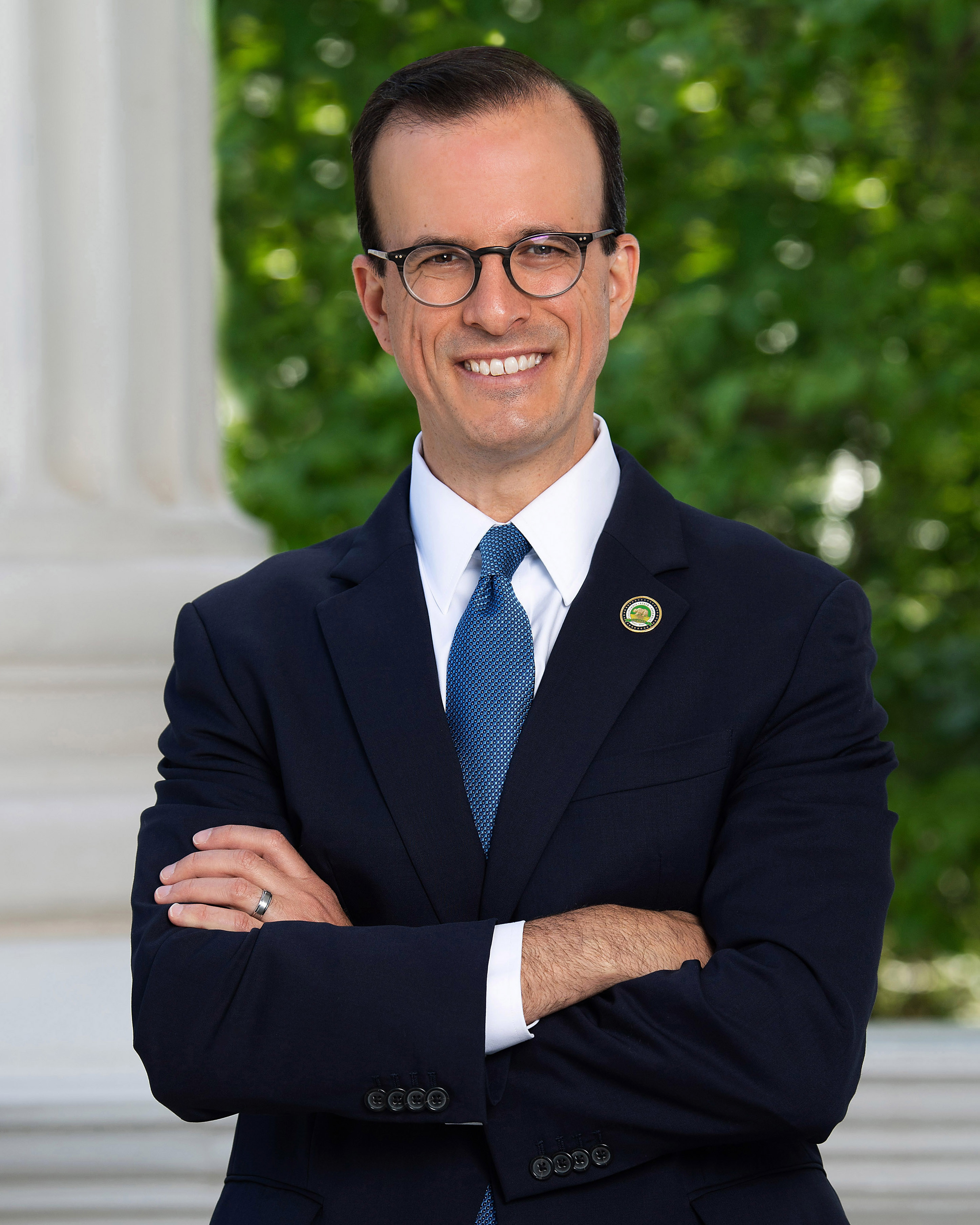
Asm. Marc Berman
Sponsored bills
The federal Higher Education Act of 1965 prohibits, as a condition of participating in federal student aid programs, a for-profit private postsecondary educational institution from deriving less than 10 percent of its revenues for each fiscal year from sources other than federal financial assistance, as defined. Under the federal act, if an institution fails to comply with the requirement for 2 consecutive fiscal years, it loses its eligibility to participate in federal financial assistance programs for at least two fiscal years. The California Private Postsecondary Education Act of 2009 provides for the regulation of private postsecondary educational institutions by the Bureau for Private Postsecondary Education in the Department of Consumer Affairs. This bill would prohibit private postsecondary educational institutions, commencing with the 2023–24 academic year, from enrolling California residents if, pursuant to that federal law, for the previous 2 consecutive fiscal years or 2 out of the previous 3 fiscal years it derived less than 10 percent of its revenues from sources other than federal financial assistance.
The Rechargeable Battery Recycling Act of 2006 requires every retailer, as defined, to have in place a system for the acceptance and collection of used rechargeable batteries for reuse, recycling, or proper disposal. The act requires the system for the acceptance and collection of used rechargeable batteries to include, at a minimum, specified elements, including, among others, the take-back at no cost to the consumer of a used rechargeable battery of the type or brand that the retailer sold or previously sold. The Cell Phone Recycling Act of 2004 prohibits the sale of a cell phone in this state to a consumer unless the retailer of that cell phone has in place a take-back system for the acceptance and collection of used cell phones for reuse, recycling, or proper disposal. This bill would make the Rechargeable Battery Recycling Act of 2006 and the Cell Phone Recycling Act of 2004 inoperative as of June 30, 2025, and would repeal those acts as of January 1, 2026. The bill would enact the Battery and Battery-Embedded Product Recycling and Fire Risk Reduction Act of 2021, which would require producers, as defined, either individually or through the creation of one or more stewardship organizations, to establish a stewardship program for batteries and battery-embedded products. The bill would require a stewardship organization or producer, on or before June 30, 2025, to submit to the Department of Resources Recycling and Recovery a stewardship plan for the collection, transportation, and recycling, and the safe and proper management, of batteries or battery-embedded products in the state. The bill would require the plan to include specified elements, including consultation with an advisory body, which the bill would require the department to create, a collection system for batteries and battery-embedded products with a specified minimum distribution of collection sites, and a funding mechanism to provide sufficient funding for implementation of the plan. The bill would provide for review and approval of the stewardship plan by the department and any other state agency with relevant jurisdiction and would require the stewardship organization or producer to fully implement its stewardship program on or before June 30, 2026. The bill would require a stewardship organization or producer to annually be audited and submit a report and budget to the department, as prescribed, and would require a stewardship organization, producer, manufacturer, distributor, retailer, importer, recycler, or collection site to, among other things, provide the department with relevant records necessary to determine compliance with the bill. The bill would require reports and records provided to the department pursuant to the bill to be provided under penalty of perjury, thereby creating a state-mandated local program by expanding the crime of perjury. The bill would restrict public access to certain information collected for the purpose of administering a stewardship program. The bill would require the department, on or before July 1, 2026, and each year thereafter, to post on its internet website a list of producers, brands, and batteries and battery-embedded products that are in compliance with the bill. The bill would prohibit a retailer or distributor from selling, distributing, offering for sale, or importing a battery or battery-embedded product in or into the state unless the producer of the battery or battery-embedded product is listed as in compliance on that list for that brand and battery or battery-embedded product, except as specified. The bill would require a stewardship organization or producer to quarterly reimburse the department and any other relevant state agency for their respective reasonable regulatory costs that are directly related to implementing and enforcing the bill in relation to the stewardship organization's or producer's activities. The bill would require the department and each state agency to deposit those moneys into the Battery and Battery-Embedded Product Recycling Fund, which the bill would establish, and would authorize the department and any other relevant state agency to expend those moneys, upon appropriation by the Legislature, to administer and enforce the stewardship program. The bill would provide for enforcement of its provisions, including authorizing the department to impose an administrative civil penalty on a stewardship organization, producer, manufacturer, distributor, retailer, importer, recycler, or collection site in violation of the bill not to exceed $10,000 per day, unless the violation is intentional, knowing, or reckless, then in that case not to exceed $50,000 per day. The bill would require the department to deposit those moneys into the Battery and Battery-Embedded Product Recycling Penalty Account, which the bill would establish in the fund, and would require the department to expend those moneys, upon appropriation by the Legislature, to administer and enforce the stewardship program. The bill would require the department, by January 1, 2024, and in consultation with the Department of Toxic Substances Control, to adopt regulations to implement the bill. Existing constitutional provisions require that a statute that limits the right of access to the meetings of public bodies or the writings of public officials and agencies be adopted with findings demonstrating the interest protected by the limitation and the need for protecting that interest. This bill would make legislative findings to that effect. The California Constitution requires the state to reimburse local agencies and school districts for certain costs mandated by the state. Statutory provisions establish procedures for making that reimbursement. This bill would provide that no reimbursement is required by this act for a specified reason.
(1) Existing law generally designates the State Air Resources Board as the state agency with the primary responsibility for the control of vehicular air pollution and air pollution control and air quality management districts with the primary responsibility for the control of air pollution from all sources other than vehicular sources. Existing law makes a violation of a rule or regulation of the state board a misdemeanor. This bill would require the state board to regulate a mobile fueling on-demand tank vehicle, as defined, as a mobile source, and, contingent upon an appropriation by the Legislature for this purpose, to adopt regulations on or before a specified date to control emissions attributable to mobile fueling on-demand tank vehicles and to certify equipment for those vehicles, as provided. The bill would authorize the state board to allow the use of onboard refueling vapor recovery (ORVR) systems to achieve or maintain the standards and procedures adopted in those regulations for the control of gasoline vapors resulting from the motor vehicle fueling operations of a mobile fueling on-demand tank vehicle. As part of those regulations, the bill would require the state board, in consultation with air pollution control and air quality management districts, to adopt regulations to govern the motor vehicle fueling operations of a mobile fueling on-demand tank vehicle to ensure the protection of public health and safety and the environment. The bill would authorize a district to enter into a memorandum of understanding to enforce the regulations applicable to the motor vehicle fueling operations of a mobile fueling on-demand tank vehicle. Because a violation of those regulations would be a crime, the bill would impose a state-mandated local program. The bill would prohibit a person from operating, or allowing the operation of, a mobile fueling on-demand tank vehicle, unless it is equipped with a vapor recovery system that is certified by the state board, or that meets permeation and spillage performance standards determined by the state board, and is installed, operated, and maintained in compliance with the state board's requirements for certification. The bill would require the state board to assess a fee on mobile fueling on-demand tank vehicles to recover the reasonable costs of implementing these provisions, and would require the fee to be deposited in the Air Pollution Control Fund and to be available for expenditure upon appropriation by the Legislature. The bill would require that the fee be adjusted annually based on the California Consumer Price Index as compiled and reported by the Department of Industrial Relations. The bill would require the state board to transfer, upon appropriation by the Legislature, the amount of revenues generated by these fees necessary to reimburse a district for the costs of enforcing any regulation pursuant to a memorandum of understanding described above. (2) Existing law prohibits a person from installing or maintaining a stationary gasoline tank with a capacity of 250 gallons or more that is not equipped for loading through a permanent submerged fill pipe, unless the tank is a pressure tank, as specified, or is equipped with a vapor recovery system, as specified, or with a floating roof, as specified, or unless the tank is equipped with other apparatus of equal efficiency that has been approved by the air pollution control officer in whose district the tank is located. This bill would allow a person to install or maintain a mobile fueling on-demand tank vehicle, or a system on that vehicle, that is certified by the state board and meets certain requirements and that is not equipped for loading through a permanent submerged fill pipe, even if the tank is a pressure tank, as specified, or is not equipped with a vapor recovery system, as specified, or does not have a floating roof, as specified, or if the tank is not equipped with other apparatus of equal efficiency that has been approved by the air pollution control officer in whose district the tank is located. The bill would require that a mobile fueling on-demand tank vehicle be loaded exclusively through bottom loading equipment certified by the state board, unless the vehicle includes a vapor recovery system that is certified by the state board. (3) Existing law requires the state board to adopt performance standards to ensure that systems for the control of gasoline vapors resulting from motor vehicle fueling operations do not cause excessive gasoline liquid spillage when used in a proper manner. Existing law requires the state board to adopt test procedures to determine the compliance with vapor emission standards of vapor recovery systems of cargo tanks on tank vehicles used to transport gasoline, as provided. Existing law prohibits an air district from adopting test procedures for, or requiring certification of, cargo tank vapor recovery systems and from imposing fees on, or requiring a permit of, tank vehicles with vapor recovery systems, but provides that an air district is not prohibited from inspecting and testing cargo tank vapor recovery systems on tank vehicles for specified purposes. This bill would provide that an air district is additionally not prohibited from inspecting and testing emissions control systems on mobile fueling on-demand tank vehicles for those same purposes. (4) The California Constitution requires the state to reimburse local agencies and school districts for certain costs mandated by the state. Statutory provisions establish procedures for making that reimbursement. This bill would provide that no reimbursement is required by this act for a specified reason.
Existing law, the Public Employees' Retirement Law (PERL) , creates the Public Employees' Retirement System (PERS) , which provides defined benefits to its members based on age at retirement, service credit, and final compensation. PERL vests the Board of Administration of PERS with management and control of the system. Existing law, the Public Employees' Medical and Hospital Care Act (PEMHCA) , which is administered by the Board of Administration of PERS, governs the funding and provision of postemployment health care benefits for eligible retired public employees and their families. PEMHCA authorizes an employee or annuitant, as those terms are defined, of the state to enroll in a health benefit plan approved or maintained by the Board of Administration of PERS. The act generally requires the state and each employee or annuitant to contribute a portion of the cost of providing the benefit coverage afforded under the approved health benefit plan in which the employee or annuitant is enrolled. PEMHCA also prohibits, among other things, employees, annuitants, and family members who become eligible to enroll on or after January 1, 1985, in Part A and Part B of Medicare from being enrolled in a basic health benefit plan. PEMHCA, however, permits the employee, annuitant, or family member to enroll in a Medicare health benefit plan if they are enrolled in Part A and Part B of Medicare. PEMHCA establishes the Public Employees' Contingency Reserve Fund for the purpose of funding health benefits and funding administrative expenses. This fund is continuously appropriated, except with respect to administrative purposes, as specified. PEMHCA also establishes the Annuitants' Health Care Coverage Fund, which is continuously appropriated, for the purpose of prefunding health care coverage for annuitants, including administrative costs. This bill would preclude a person who has retired under PERS and who obtains work with a subsequent employer from receiving any health benefits offered under PEMHCA if the person's subsequent employer offers health care coverage that provides reasonably comparable benefits. The bill would grant the person reinstatement rights upon termination of employment with the subsequent employer. The bill would authorize the board to request information regarding employment and health care coverage offered by a person's subsequent employer. The bill would also prohibit, except as provided and by January 1, 2023, persons who have retired under a public retirement system, as defined, annuitants of a public retirement system, and their beneficiaries who become eligible to enroll on or after January 1, 1985, in Part A and Part B of Medicare from being enrolled in a basic health benefit plan, as defined, offered by the public retirement system.
Existing law, the Mental Health Services Act, an initiative statute enacted by the voters as Proposition 63 at the November 2, 2004, statewide general election, funds a system of county mental health plans for the provision of mental health services, as specified. Existing law establishes the continuously appropriated Mental Health Services Fund. Existing law requires the Controller, prior to distributing the balance of the funds to the counties, as specified, to reserve up to 5% of the total annual revenues of the fund for the costs for the State Department of Health Care Services, the California Behavioral Health Planning Council, the Office of Statewide Health Planning and Development, the Mental Health Services Oversight and Accountability Commission, the State Department of Public Health, and any other state agency to implement all duties pursuant to the programs set forth in the act. This bill would amend Proposition 63 by appropriating $20,000,000 annually from the administrative account of the Mental Health Services Fund to the University of California, if the University of California chooses to accept the moneys, the California State University, and the California Community Colleges, as specified, to implement the College Mental Health Services Program. The bill would require those funds to be used for the purpose of funding programs to increase campus student mental health services and mental health-related education and training. The bill would require campuses that participate in the program to report on the use of those grant funds, as specified, and to post that information on their internet websites.
Existing law establishes as policy of the state that eligible renewable energy resources and zero-carbon resources supply 100% of retail sales of electricity to California end-use customers and 100% of electricity procured to serve all state agencies by December 31, 2045. This bill would state the intent of the Legislature to enact subsequent legislation to accelerate the state's progress toward having 100% of electricity provided by renewable or other zero-carbon sources while maintaining a reliable and resilient electricity grid.
The Early Childhood Development Act of 2020 sets forth legislative findings and declarations regarding the need for an integrated early childhood learning and care system to promote high-quality, affordable learning to comprehensively and effectively serve children and families and to address societal inequities and disproportionalities. This bill would make additional legislative findings and declarations regarding childcare supportive services. This bill would require the State Department of Social Services to report on various topics related to early childhood supports in light of the COVID-19 pandemic by October 1, 2021. This bill would declare that it is to take effect immediately as an urgency statute.
(1) Existing law creates the Metropolitan Transportation Commission as a local area planning agency for the 9-county San Francisco Bay area with comprehensive regional transportation planning and other related responsibilities. Existing law creates various transit districts located in the San Francisco Bay area, with specified powers and duties relative to providing public transit services. Existing law requires the commission to develop regional transit service objectives, develop performance measures of efficiency and effectiveness, specify uniform data requirements to assess public transit service benefits and costs, and formulate procedures for establishing regional transportation priorities in the allocation of funds for transportation purposes. This bill would require the commission to consult with transit agencies, local jurisdictions, county transportation agencies, and the general public to establish and maintain a transit priority network for the San Francisco Bay area that designates corridors that will most benefit from interventions to support fast and reliable transit service. (2) Existing law requires the Metropolitan Transportation Commission, in coordination with a specified regional transit coordinating council, to adopt rules and regulations to promote the coordination of fares and schedules for all public transit systems within its jurisdiction. This bill would require the commission on or before February 1, 2022, to submit a copy of a specified transit fare study undertaken by the commission to certain committees of the Legislature. The bill would require the commission to submit a report on or before January 1, 2023, to those entities on the progress of implementing the recommendations of that study. The bill would require the commission, on or before July 1, 2023, to create a pilot program to implement an accumulator pass among multiple operators providing service in at least 3 adjacent counties. (3) Existing law authorizes the Metropolitan Transportation Commission to improve service coordination and effectiveness in specified transit corridors by recommending improvements in those corridors, including the reduction of duplicative service and institution of coordinated service across public transit system boundaries. This bill would require the commission, in consultation with transit agencies, on or before July 1, 2024, to develop a comprehensive, standardized regional transit mapping and wayfinding system and to develop an implementation and maintenance strategy and funding plan for deployment of the system. The bill would require each transit agency to use only this system by July 1, 2025, unless the commission adopts a schedule that sets out an alternate deployment timeline. The bill would require a transit operator in the San Francisco Bay area to use open data standards to make available all routes, schedules, and fares in a specified data format and to track actual transmission of real-time information by transit vehicles and report that information to the commission to ensure that schedule predictions are available. The bill would require the commission to coordinate these activities and to develop an implementation and funding plan for deployment of real-time information. (4) Existing law authorizes a regional transportation agency or the Department of Transportation to apply to the California Transportation Commission to develop and operate high-occupancy toll lanes or other toll facilities. The bill would require, on or before January 1, 2024, the Metropolitan Transportation Commission, in partnership with the Department of Transportation and the operators of managed lanes in the San Francisco Bay area, to take specified steps to ensure the regional managed lanes network supports seamless operation of high-capacity transit. (5) By imposing new duties on local agencies, this bill would impose a state-mandated local program. (6) The California Constitution requires the state to reimburse local agencies and school districts for certain costs mandated by the state. Statutory provisions establish procedures for making that reimbursement. This bill would provide that, if the Commission on State Mandates determines that the bill contains costs mandated by the state, reimbursement for those costs shall be made pursuant to the statutory provisions noted above.
Existing law, the Personal Income Tax Law and Corporation Tax Law, in modified conformity with federal income tax laws, generally allow various deductions in computing the income that is subject to taxes imposed by those laws, including a deduction for a net operating loss as specified. Existing law suspends the deduction for a net operating loss, as specified, for taxable years beginning on or after January 1, 2020, and before January 1, 2023. The Personal Income Tax Law and Corporation Tax Law generally authorize various credits against the taxes imposed by those laws. Existing law provides that, except as specified, the total credits allowable under those laws may not reduce the taxes imposed by those laws by more than $5,000,000, as provided, for taxable years beginning on or after January 1, 2020, and before January 1, 2023. This bill, the Golden State Innovation Act of 2021, would, for taxable years beginning on or after January 1, 2021, and before January 1, 2023, exclude a taxpayer that performs research and development in biotechnology, as described, from the above-described suspension of the deduction for net operating losses and the above-described limitation on the total credits allowable. Existing law requires any bill authorizing a new tax expenditure to contain, among other things, specific goals, purposes, and objectives that the tax expenditure will achieve, detailed performance indicators, and data collection requirements. The bill also would include additional information required for any bill authorizing a new tax expenditure. This bill would take effect immediately as a tax levy.