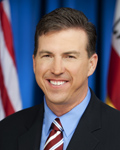
Photo of Kevin Mullin
D California Assembly · District 22 · Former member

Asm. Kevin Mullin

Compare
Total votes
31,650
all sessions
Attendance
97%
797 missed
Near the chamber average
With party
99%
of cast votes
Higher than 88% of chamber peers
Bipartisan score
0%
crosses aisle rarely
Lower than 90% of chamber peers
Sponsored
2,233
bills & resolutions
Near the chamber average
Committees
0
assignments
2,233 bills and resolutions

Sponsored bills

Total
2,233
Primary
287
Co-sponsor
1,946
This page
2,233
matching current filters
Co-sponsor ACR 141
Signed into law · California Assembly · Co-sponsor
Relative to California Fitness Week.

This measure would declare the week of January 7 to January 13, 2018, as California Fitness Week and would encourage Californians to enrich their lives through proper nutrition and exercise.

Signed into law Feb 7, 2018 1 co-sponsor
Co-sponsor ACR 134
Signed into law · California Assembly · Co-sponsor
Relative to Gang Awareness and Prevention Month.

This measure would designate the month of January 2018 as Gang Awareness and Prevention Month in the State of California and would encourage cities and constituents across the state to observe the month with appropriate programs, ceremonies, and activities to prevent future gang activity and honor those who lost their lives due to gang activity.

Signed into law Feb 7, 2018 1 co-sponsor
Co-sponsor AB 403
Signed into law · California Assembly · Co-sponsor
Legislature: Legislative Employee Whistleblower Protection Act.

Existing law generally protects employees who disclose illegal or improper workplace activities by prohibiting interference with, and retaliation for, making such disclosures. Existing law provides procedures for a person to file a complaint alleging violations of legislative ethics. Existing law also authorizes each house of the Legislature to adopt rules for its proceedings and to select committees necessary for the conduct of its business. This bill would impose criminal and civil liability on a Member of the Legislature or legislative employee, as defined, who interferes with, or retaliates against, a legislative employee's exercise of the right to make a protected disclosure, which is defined as a good faith allegation made by a legislative employee to specified entities that a Member of the Legislature or a legislative employee has engaged in, or will engage in, activity that may constitute a violation of law, including sexual harassment, or a violation of a legislative standard of conduct. The bill would also impose civil liability on an entity that interferes with, or retaliates against, a legislative employee's exercise of the right to make a protected disclosure, as specified. By creating new crimes, the bill would impose a state-mandated local program. The California Constitution requires the state to reimburse local agencies and school districts for certain costs mandated by the state. Statutory provisions establish procedures for making that reimbursement. This bill would provide that no reimbursement is required by this act for a specified reason. This bill would declare that it is to take effect immediately as an urgency statute.

Signed into law Feb 5, 2018 1 co-sponsor
Primary AB 482
Failed · California Assembly · Lead sponsor
Real estate brokers.

Existing law prohibits any person from engaging in the business of, acting in the capacity of, advertising as, or assuming to act as, a real estate broker or a real estate salesperson without first obtaining a real estate license, as specified. Existing law defines a real estate broker for this purpose as a person who, for a compensation or in expectation of a compensation, regardless of the form or time of payment, does or negotiates to do one or more specified acts for another or others, except when performed by, among other specified persons, a regular officer of a corporation or a general partner of a partnership with respect to real property owned or leased by the corporation or partnership, respectively, or in connection with the proposed purchase or leasing of real property by the corporation or partnership, respectively, if the acts are not performed by the officer or partner in expectation of special compensation. This bill would exempt from this definition a person who performs the above-described acts for another or others as a regular officer of a nonprofit limited liability company that provides affordable housing through a housing development approved by the federal Department of Housing and Urban Development, the California Tax Credit Allocation Committee, and the California Housing Finance Agency.


Failed Feb 1, 2018 0 co-sponsors
Primary AB 1614
died · California Assembly · Lead sponsor
Tree removal.

The Tree Planting Act of 1931 authorizes a board of park commissioners, a park department, or other similar municipal authority having control of or jurisdiction over parks, trees, shrubs, and vegetation in a municipality to remove any tree or part thereof if it appears to be dead, is dangerous, or is an obstruction to public travel, including trees on private property, as specified. This bill would make nonsubstantive changes to these provisions.

died Feb 1, 2018 0 co-sponsors
Primary AB 293
Failed · California Assembly · Lead sponsor
Real estate.

The Real Estate Law provides for the regulation and licensure of real estate brokers and salespersons by the Real Estate Commissioner. That law requires the commissioner to ascertain by written examination that the applicant for a license has specific knowledge and understanding relating to real estate and business opportunity practices. That law authorizes an applicant who fails the qualifying examination, upon application and payment of a fee, to apply for reexamination within 2 years of filing the first application for examination. This bill would change references to reexamination to refer, instead, to the retaking of a qualifying examination. The bill would authorize an applicant who fails his or her 2nd qualifying examination for the same license, after 120 days from the notification date of failure, to retake that qualifying examination upon application and payment of the required examination fees.

Failed Feb 1, 2018 0 co-sponsors
Primary AB 914
Failed · California Assembly · Lead sponsor
Transmission planning: energy storage and demand response.

Existing law vests the Public Utilities Commission with jurisdiction over the delivery of electrical services. Existing law provides for the establishment of an Independent System Operator (ISO) as a nonprofit public benefit corporation and requires the ISO to make certain filings with the Federal Energy Regulatory Commission (FERC) and to seek authority from FERC as needed to give the ISO the ability to secure generating and transmission resources necessary to guarantee achievement of planning and operating reserve criteria no less stringent than those established by the Western Electricity Coordinating Council and the North American Electric Reliability Council. This bill would require the commission, in its oversight of large electrical corporations and its participation in the ISO's transmission planning process, to promote the consideration of the use of nonwire alternatives, as defined, as means to address the state's transmission needs before the use of transmission wires. The bill would require the commission to ensure that transmission facility owners take certain actions in the transmission planning process regarding nonwire alternatives. The bill would require the commission to ensure that large electrical corporations include nonwire alternatives for consideration and select a nonwire alternative if it is the most cost effective or provides net benefits when compared with traditional transmission solutions. The Public Utilities Act makes any public utility that violates the act, or that fails to comply with any part of any order, decision, rule, direction, demand, or requirement of the commission, guilty of a crime. Because the provisions of this bill would be a part of the act and because a violation of an order or decision of the commission implementing its requirements would be a crime, the bill would impose a state-mandated local program by creating a new crime. The California Constitution requires the state to reimburse local agencies and school districts for certain costs mandated by the state. Statutory provisions establish procedures for making that reimbursement. This bill would provide that no reimbursement is required by this act for a specified reason.

Failed Feb 1, 2018 0 co-sponsors
Co-sponsor AB 445
Failed · California Assembly · Co-sponsor
Career technical education: the California Career Technical Education Grant Program.

(1) Existing law establishes the California Career Technical Education Incentive Grant Program as a state education, economic, and workforce development initiative with the goal of providing pupils in kindergarten and grades 1 to 12, inclusive, with the knowledge and skills necessary to transition to employment and postsecondary education. Existing law appropriates $200,000,000 from the General Fund to the State Department of Education for purposes of this grant program for the 2017–18 fiscal year. Existing law requires applicants for grants under the program to demonstrate that they have local matching funds, as specified. Existing law specifies that no applicant may receive a renewal grant under the program for the 2018–19 fiscal year. This bill would change the name of the program to the California Career Technical Education Grant Program. The bill would increase to $300,000,000 the General Fund appropriation to the State Department of Education for this program for the 2017–18 fiscal year, and would further provide for an appropriation to the department in this amount for the 2018–19, 2019–20, and 2020–21 fiscal years. The bill would lower the amount of local matching funds required of an applicant from $1.50 for every dollar received to $1 for every dollar received, for the 2017–18, 2018–19, 2019–20, and 2020–21 fiscal years. The bill would also provide that an applicant receiving a grant from this program in the 2017–18, 2018–19, or 2019–20 fiscal year would be eligible for a renewal grant in the next fiscal year if that applicant demonstrates continued compliance with program requirements. (2) The funds appropriated by this bill would be applied toward the minimum funding requirements for school districts and community college districts imposed by Section 8 of Article XVI of the California Constitution.

Failed Feb 1, 2018 1 co-sponsor
Primary AB 761
Failed · California Assembly · Lead sponsor
Pupil assessment: optional history-social science performance task assessments.

Existing law establishes the California Assessment of Student Performance and Progress (CAASPP) as the statewide system of pupil assessments, under which various assessments are required or authorized to be administered in public schools, as specified. Existing law requires the Superintendent of Public Instruction to submit to the State Board of Education recommendations on expanding the CAASPP to include additional assessments, including a history-social science assessment. This bill would require the Superintendent to develop, and the state board to adopt, optional performance task assessments in history-social science, as specified. The bill would require the Superintendent to develop the optional performance task assessments within the time period approved by the state board. The bill would authorize the optional performance task assessments to be administered in grades 4 and 8, and in high school. The bill would make these provisions operative only to the extent that funding is provided in the annual Budget Act or another statute for purposes of the CAASPP.

Failed Feb 1, 2018 0 co-sponsors
Showing 891 to 900 of 2,233 bills
Previous 1 … 89 90 91 … 224 Next