This measure would declare May 23, 2024, as GM1 Gangliosidosis Awareness Day in California.
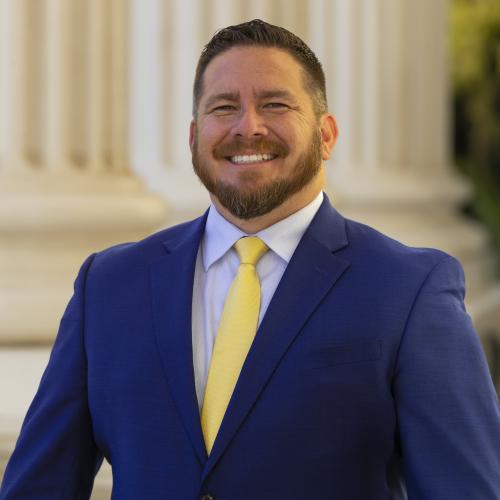
Asm. Juan Alanis
Sponsored bills
Existing sales and use tax laws impose taxes on retailers measured by gross receipts from the sale of tangible personal property sold at retail in this state, or on the storage, use, or other consumption in this state of tangible personal property purchased from a retailer for storage, use, or other consumption in this state, measured by sales price. The Sales and Use Tax Law defines the term "gross receipts" for these purposes to mean the total amount of the sale or lease or rental price of the retail sales of retailers, valued in money, whether received in money or otherwise, as specified, unless an exclusion applies. The Sales and Use Tax Law defines the term "sales price" for these purposes to mean the total amount for which tangible personal property is sold or leased or rented, valued in money, whether received in money or otherwise, as specified, unless an exclusion applies. The Motor Vehicle Fuel Tax Law, administered by the California Department of Tax and Fee Administration, imposes a tax upon each gallon of motor vehicle fuel removed from a refinery or terminal rack in this state, entered into this state, or sold in this state, at a specified rate per gallon. Existing sales and use tax laws provide a partial exemption from the taxes imposed by those laws for motor vehicle fuel that is subject to the taxes imposed by the Motor Vehicle Fuel Tax Law. This bill, beginning January 1, 2025, would exclude from the terms "gross receipts" and "sales price" under the Sales and Use Tax Law the amount of any motor vehicle fuel tax imposed pursuant to the Motor Vehicle Fuel Tax Law. This bill would take effect immediately as a tax levy.

Existing law requires the State Air Resources Board to adopt and implement motor vehicle emission standards, in-use performance standards, and motor vehicle fuel specifications for the control of air contaminants and sources of air pollution that the state board has found necessary, cost effective, and technologically feasible. The California Global Warming Solutions Act of 2006 establishes the state board as the state agency responsible for monitoring and regulating sources emitting greenhouse gases and requires the state board to adopt rules and regulations to achieve the maximum technologically feasible and cost-effective greenhouse gas emission reductions from those sources. Pursuant to its authority, the state board has adopted the Advanced Clean Fleets Regulation, which imposes various requirements for transitioning local, state, and federal government fleets of medium- and heavy-duty trucks, other high-priority fleets of medium- and heavy-duty trucks, and drayage trucks to zero-emission vehicles. The Advanced Clean Fleets Regulation authorizes entities subject to the regulation to apply for exemptions from its requirements under certain circumstances. This bill would require the state board to establish the Advanced Clean Fleets Regulation Appeals Advisory Committee by an unspecified date for purposes of reviewing appeals of denied requests for exemptions from the requirements of the Advanced Clean Fleets Regulation. The bill would require the committee to include representatives of specified state agencies, other state and local government representatives, and representatives of private fleet owners, the electric vehicle manufacturing industry, and electrical corporations, as provided. The bill would require the committee to meet monthly and would require recordings of its meetings to be made publicly available on the state board's internet website. The bill would require the committee to consider, and make a recommendation on, an appeal of an exemption request denial no later than 60 days after the appeal is made. The bill would require specified information relating to the committee's consideration of an appeal to be made publicly available on the state board's internet website. The bill would require the state board to consider a recommendation of the committee at a public meeting no later than 60 days after the recommendation is made.
This measure would proclaim March 2024 as American Red Cross Month and would dedicate it to all those who continue to advance the noble legacy of the organization's founder. The measure would encourage all Californians to reach out, support the organization's humanitarian mission, and join in their commitment to care for people in need.
This measure would proclaim March 4, 2024, to March 8, 2024, inclusive, as School Breakfast Week.
This measure would declare 2024 as the year to Coexist with Wildlife, California.
Existing law governs motor vehicle conditional sale contracts, as defined, and requires sellers of motor vehicles to make certain disclosures to buyers. Existing law governs the offer, sale, provision, or administration, in connection with a conditional sale contract, of a guaranteed asset protection waiver, defined to mean an optional contractual obligation under which a seller agrees, for additional consideration, to cancel or waive all or part of amounts due on the buyer's conditional sale contract subject to existing law in the event of a total loss or unrecovered theft of the motor vehicle specified in the conditional sale contract. Existing law requires the terms and conditions of the guaranteed asset protection waiver, as specified, to appear on a document separate from the conditional sale contract. If the conditional sale contract is assigned, existing law requires the above-described separate document to provide written notice of the assignment of both the conditional sale contract and guaranteed asset protection waiver, as specified, to the buyer in person, by mail, or by a means of notice that the buyer previously agreed to with the seller or holder in connection with the conditional sale contract within 30 days of the assignment. This bill would require, if a conditional sale contract is assigned specific to securitization, as specified, and the seller of the conditional sale contract and guaranteed asset protection waiver remains the point of contact with the buyer, as specified, the entity who received the assignment from the seller to notify the consumer in accordance with specified requirements. The bill would require the seller to assume the legal liability of the holder for violations of these provisions, as described, if the holder does not comply with the specified notice requirements.
Existing law requires the Department of Water Resources, on or before January 1, 2028, and in coordination with the State Water Resources Control Board, to submit a report to the Legislature on the progress of urban retail water suppliers towards achieving their urban water use objective. This bill would instead require the report to be submitted to the Legislature on or before January 1, 2029.
Existing sales and use tax laws impose taxes on retailers measured by the gross receipts from the sale of tangible personal property sold at retail in this state, or on the storage, use, or other consumption in this state of tangible personal property purchased from a retailer for storage, use, or other consumption in this state, and provides various exemptions from the taxes imposed by those laws. This bill, on and after January 1, 2025, and before January 1, 2030, would exempt from those taxes the gross receipts from the sale of, and the storage, use, or other consumption of, qualified school supplies, as defined, purchased during the first weekend in August, beginning at 12:01 a.m. on Saturday and ending at 11:59 p.m. on Sunday. Existing law requires any bill authorizing a new tax expenditure to contain, among other things, specific goals that the tax expenditure will achieve, detailed performance indicators, and data collection requirements. This bill would include additional information required for any bill authorizing a new tax expenditure. The Bradley-Burns Uniform Local Sales and Use Tax Law authorizes counties and cities to impose local sales and use taxes in conformity with the Sales and Use Tax Law, and existing laws authorize districts, as specified, to impose transactions and use taxes in accordance with the Transactions and Use Tax Law, which generally conforms to the Sales and Use Tax Law. Amendments to the Sales and Use Tax Law are automatically incorporated into the local tax laws. Existing law requires the state to reimburse counties and cities for revenue losses caused by the enactment of sales and use tax exemptions. This bill would provide that, notwithstanding Section 2230 of the Revenue and Taxation Code, no appropriation is made and the state shall not reimburse any local agencies for sales and use tax revenues lost by them pursuant to this bill. This bill would take effect immediately as a tax levy.