

Existing law generally regulates the business of renting passenger vehicles to the public. The law prohibits a rental company from taking various actions, including requiring the purchase of a damage waiver, optional insurance, or another optional good or service, and using electronic surveillance technology to track a renter in order to impose fines or surcharges relating to the renter's use of a rental vehicle. This bill would require any privately owned vehicle rented by, or furnished to, any federal, state, or local law enforcement agency for the use of detaining, arresting, or transporting persons who have violated, or are suspected of having violated, any law, to display a temporary decal displaying the agency name and logo, as specified. The bill would authorize certain attorneys, including the Attorney General, to pursue a civil action against the entity renting the vehicle from the private owner for failure to comply with these provisions. The bill would require the rental car contract to include a term that compliance with state law is mandatory. The bill would exempt privately owned vehicles rented or otherwise furnished or loaned to a law enforcement agency for specified purposes and rental car contracts entered into prior to January 1, 2027, from these provisions. The bill would make related findings and declarations.
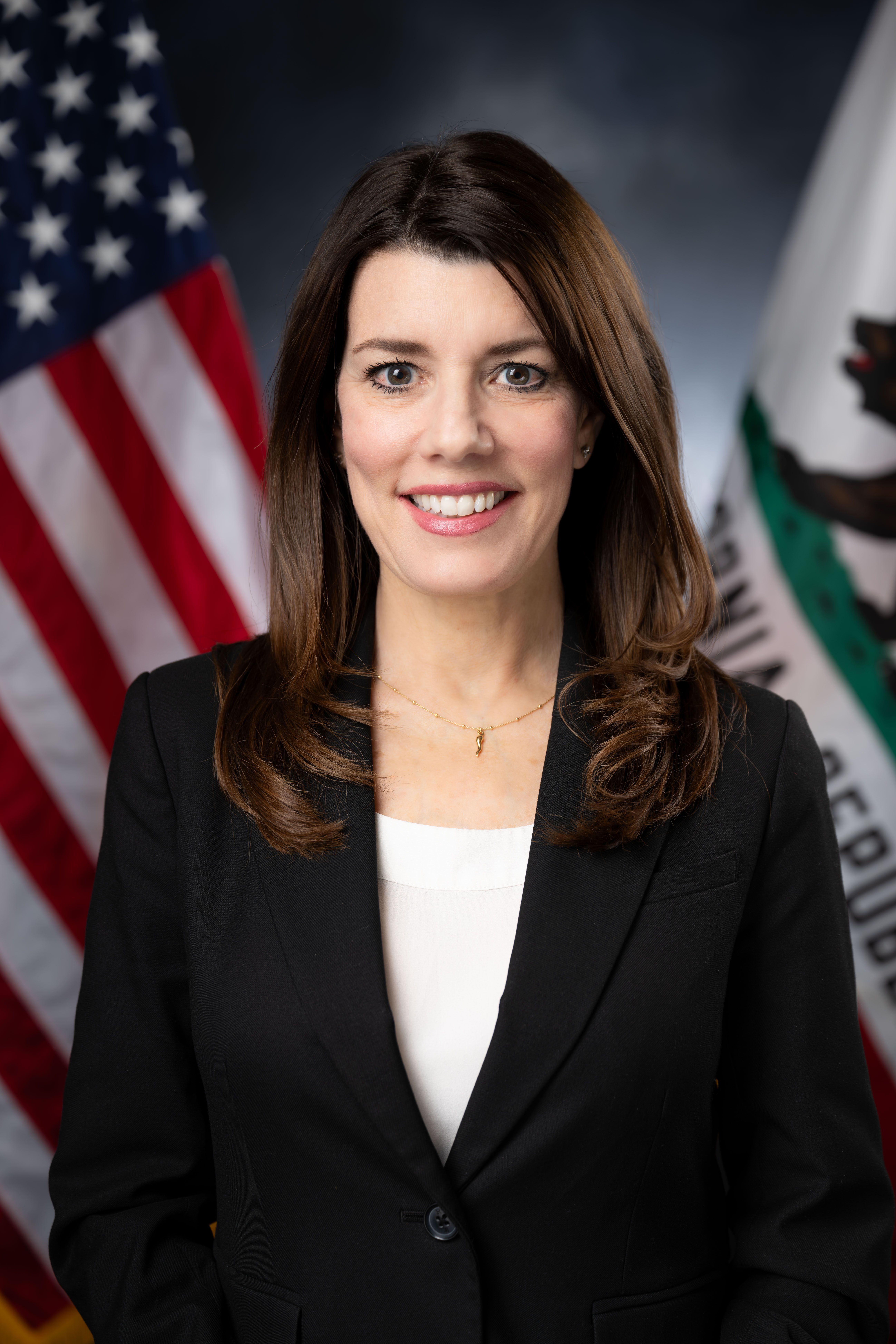
Rep. Catherine Stefani
Sponsored bills
Existing law, the Elder Abuse and Dependent Adult Civil Protection Act, establishes procedures for the reporting, investigation, and prosecution of elder and dependent adult abuse. Existing law requires a mandated reporter of suspected financial abuse of an elder or dependent adult, as defined, to report financial abuse in a specified manner, including by telephone or through a confidential internet reporting tool, as specified, immediately, or as soon as practicably possible. If reported by telephone, existing law requires a written report to be sent, or an internet report to be made through the internet reporting tool, to the local adult protective services agency or the local law enforcement agency within 2 working days. Existing law deems all officers and employees of a financial institution to be mandated reporters of suspected financial abuse of an elder or dependent adult. A mandated reporter who fails to report financial abuse of an elder or dependent adult is liable for civil penalties, as specified. If a report of financial abuse is made by a mandated reporter, as described above, this bill would also require a report to be made to the Federal Bureau of Investigation Internet Crime Complaint Center within 2 working days. Within 48 hours of filing a report, the bill would require a financial institution to notify the elder or dependent adult identified in the report, as specified, and provide additional required information. The bill would require a financial institution to provide annual training to its mandated reporters on how to escalate internally and report suspected financial abuse of an elder or a dependent adult to both local and federal authorities, as specified. The bill would specify that violations of these provisions would not incur the above-described liability for civil penalties. The bill would make its provisions operative on January 1, 2028.
(1) Existing law tolls the periods of limitation to bring specific civil actions for up to 2 years, if during that time that the claimant is imprisoned on a criminal charge, as specified. However, under existing law these tolling provisions do not apply to an action brought against a public entity or public employee, as specified. This bill would, notwithstanding any other law, provide that the period for bringing an action for sexual assault against a public entity or public employee that is alleged to have occurred while the claimant was imprisoned on a criminal charge, or in execution under the sentence of a criminal court, is tolled during the entire period of the claimant's imprisonment or sentence. Under the bill, any claim for sexual assault against a public entity or public employee subject to that provision is exempt from all state and local government claim presentation requirements. (2) Existing law establishes the Office of the Sexual Abuse in Detention Elimination Ombudsperson with the authority to inspect all of the Department of Corrections and Rehabilitation institutions and to interview all inmates and wards. Under existing law, if an investigation confirms that any employee of the department has sexually abused an inmate or ward, that employee is required to be terminated. Existing law prohibits retaliation against an inmate or ward for making an allegation of sexual abuse. Existing law requires the department to keep statistics on the sexual abuse of inmates and wards and make that data available to the Office of the Sexual Abuse in Detention Elimination Ombudsperson. This bill would prohibit an employee who has been terminated after an investigation confirms that the employee has sexually abused an incarcerated person or ward from future employment with the department. This bill would require the department to monitor for 90 days an incarcerated person who reports sexual assault, and the incarcerated person reported to have suffered the sexual assault, by a staff member for possible retaliation. The bill would require the department to make specific notifications and reporting after an incarcerated person is reported to have suffered a sexual assault. The bill would require the department, on or before January 1, 2028, to develop and implement procedures for notifications of an incarcerated person's contact person, as defined. The bill would require the department to minimize the transfer of an incarcerated person who is reported to have suffered a sexual assault by a staff member for 90 days following the report, unless there is an operational need to do so or there are safety, security, or health concerns. The bill would define terms for its purposes and declare these provisions are severable.
Under existing law, the Tom Bane Civil Rights Act (act) , if a person or persons, whether or not acting under color of law, interferes or attempts to interfere, by threats, intimidation, or coercion, with the exercise or enjoyment by any individual or individuals of rights secured by the Constitution or laws of the United States, or of the rights secured by the Constitution or laws of this state, the Attorney General, or any district attorney or city attorney, is authorized to bring a civil action for injunctive and other appropriate equitable relief in the name of the people of the State of California, in order to protect the exercise or enjoyment of the right or rights secured. Under that act, an individual may also institute and prosecute in their own name and on their own behalf a civil action for damages, as described, for any resulting interference or attempt at interference of the individual's exercise or enjoyment of rights secured by the Constitution or laws of the United States or this state. The act authorizes the court to award the petitioner or plaintiff reasonable attorney's fees in addition to any damages, injunction, or other equitable relief awarded in these civil actions (attorney's fees authorization) . Existing federal law provides that every person who, under color of any statute, ordinance, regulation, custom, or usage, of any state, territory, or the District of Columbia, subjects or causes to be subjected any United States citizen or other person within the jurisdiction to the deprivation of any rights, privileges, or immunities secured by the Constitution and laws, is liable to the party injured in an action at law, suit in equity, or other proper proceeding for redress, except as provided. This bill would also provide that every natural person, as defined, who, under color of any law, statute, ordinance, regulation, custom, or usage, as defined, subjects or causes to be subjected any citizen of this state or any person within the jurisdiction thereof to the deprivation of any rights, privileges, or immunities secured by the United States Constitution, shall be liable to the party injured in an action at law, suit in equity, or other proper proceeding for redress, except as specified. The bill would apply the aforementioned attorney's fees authorization, except as specified, to any action brought under these provisions. The bill would authorize a court, in its discretion, to also award costs, except as specified, to the prevailing plaintiff in any action brought under these provisions. This bill would authorize a defendant in an action brought under these provisions to assert and receive the benefit of a defense of absolute or qualified immunity only to the same extent as a person sued under certain federal provisions under like circumstances, as specified, and would specify that nothing in these provisions is to be construed to waive or abrogate any defense of sovereign immunity otherwise available to a party, as specified. The bill would prohibit any civil action brought under these provisions from being commenced later than 2 years after the date that the cause of action accrues. The bill would make its provisions severable. The bill would specify that these provisions apply retroactively to March 1, 2025, as provided. This bill would declare the intent of the Legislature in enacting these provisions. This bill would declare that it is to take effect immediately as an urgency statute.
Existing law establishes the California Reproductive and TGI Health Equity Program within the Department of Health Care Access and Information for the purpose of ensuring abortion, contraception, and gender-affirming care are affordable for and accessible to all patients, regardless of their ability to pay, and to provide financial support for safety net providers of these services to offset the costs of providing uncompensated care to patients with low incomes who would otherwise lack access to care. Existing law authorizes a Medi-Cal enrolled provider to apply for a grant, and a continuation award after the initial grant, if they agree to provide abortion, contraception, and gender-affirming care services in accordance with specified requirements, including that the services are provided at no cost or a reduced cost to individuals with a household income at or below 400% of the federal poverty level who are uninsured or have health care coverage that does not include both abortion and contraception or does not include gender-affirming care and are not otherwise eligible to receive both abortion and contraception care at no cost through the Medi-Cal and Family PACT programs or receive gender-affirming care at no cost through the Medi-Cal program. This bill would additionally authorize a Medi-Cal enrolled provider to apply for a grant or a continuation of a grant if they provide the above-described services to patients who are veterans, as defined, who are uninsured or have health care coverage that does not include both abortion and contraception and are not otherwise eligible to receive both abortion and contraception care at no cost through the Medi-Cal and Family PACT programs. The bill would make other conforming changes and would make related findings and declarations. Existing law establishes the Department of Veterans Affairs and vests the department with specified duties related to veterans in the state, including the development of a transition program to assist veterans in successfully transitioning from military to civilian life by providing information related to, among other things, health care programs and services. This bill would require the Department of Veterans Affairs to publish a link to the State Department of Public Health's abortion information internet website on the women veterans resources page of its internet website.
Existing law, the Knox-Keene Health Care Service Plan Act of 1975, provides for the licensure and regulation of health care service plans by the Department of Managed Health Care and makes a willful violation of the act a crime. Existing law provides for the regulation of disability insurers by the Department of Insurance. Existing law requires a health care service plan or disability insurer to allow an individual to enroll in or change their health benefit plan as a result of a specified triggering event. This bill would make pregnancy a triggering event for purposes of enrollment or changing a health benefit plan. Because a willful violation of this provision by a health care service plan would be a crime, the bill would impose a state-mandated local program. The California Constitution requires the state to reimburse local agencies and school districts for certain costs mandated by the state. Statutory provisions establish procedures for making that reimbursement. This bill would provide that no reimbursement is required by this act for a specified reason.
Existing law requires a social media platform to take certain actions with respect to child sexual abuse material on the social media platform, including requiring the platform to provide, in a mechanism that is reasonably accessible to users, a means for a user who is a California resident to report material to the platform that the user reasonably believes meets certain criteria, including that the reported material is child sexual abuse material and that the reporting user is depicted in the material. Existing law also requires the social media platform to collect information reasonably sufficient to enable the platform to contact, as specified, a reporting user. Existing law defines child sexual abuse material for these purposes to include obscene matter that depicts a minor personally engaging in, or personally simulating, sexual conduct. This bill would revise the definition of child sexual abuse material to instead include an intimate visual depiction, as defined, of an identifiable individual who is a minor. The bill would additionally require the above-described mechanism to be clear and conspicuous, as defined, and would delete the requirement that the reporting user be depicted in the material. The bill would require a social media platform to, among other things, ensure review by a natural person if there is not an established or known hash match to child sexual abuse material with respect to the reported material and the reported material is not otherwise blocked. The bill would require a social media platform to restore availability or functionality of the reporting mechanism if the reporting mechanism is unavailable or nonfunctional. Existing law makes a noncomplying social media company liable to a reporting user for actual damages and statutory damages, as specified. This bill would instead make a social media company liable to a depicted individual, as defined, for actual and statutory damages, as provided. The bill would also impose specified civil penalties on a noncomplying company to be collected in a civil action by certain public attorneys, including the Attorney General. Existing law establishes the Survivor Support Fund within the state treasury and makes moneys in the fund available, upon appropriation by the Legislature, for grants by the California Victim Compensation Board to community-based organizations that provide direct services to vulnerable individuals in areas with a high concentration of sex trafficking. This bill would require any penalty collected in a civil action by the Attorney General under these provisions to be deposited into the Survivor Support Fund. Existing law prohibits a social media platform from knowingly facilitating, aiding, or abetting commercial sexual exploitation, as defined. Existing law deems a social media platform to have knowledge for the purposes of this prohibition if material was reported to the social media platform using the reporting mechanism for 4 consecutive months, as provided. Existing law exempts a social media platform from being deemed in violation of this prohibition if it instituted a specified audit program and provided to each member of its board of directors a true and correct copy of each audit, as prescribed. This bill would remove the requirement that material was reported for 4 consecutive months to deem a social media platform to have knowledge for the purposes of the above-described prohibition. The bill would, in order to be exempt from that prohibition, require the social media platform to also submit the audit to the Attorney General, and if requested, to certain other public officials. The bill would provide that an audit submitted as described above is confidential and shall be exempt from disclosure under the California Public Records Act. This bill would declare its provisions severable. Existing constitutional provisions require that a statute that limits the right of access to the meetings of public bodies or the writings of public officials and agencies be adopted with findings demonstrating the interest protected by the limitation and the need for protecting that interest. This bill would make legislative findings to that effect. The California Constitution requires local agencies, for the purpose of ensuring public access to the meetings of public bodies and the writings of public officials and agencies, to comply with a statutory enactment that amends or enacts laws relating to public records or open meetings and contains findings demonstrating that the enactment furthers the constitutional requirements relating to this purpose. This bill would make legislative findings to that effect.
Existing law includes various provisions limiting how state and local entities may use their resources for immigration enforcement purposes. This bill would prohibit the use of state-owned property for purposes of immigration enforcement, as specified. In this regard, the bill would prohibit, among other uses, staging, assembling, mobilizing, or deploying vehicles, equipment, or personnel for immigration enforcement purposes. The bill would require the Department of General Services and state agencies to work together to identify state-owned property previously or likely to be used for immigration enforcement purposes. The bill would require state agencies to post signage at those properties regarding the prohibition and to use physical barriers limiting access, as provided. The bill would require state agencies to develop procedures to ensure that an attempted or actual use of state-owned property for immigration enforcement purposes is documented in writing, that the documentation includes any photographic or video evidence, and that the Attorney General's office or the Attorney General's designee is notified. The bill would direct state agencies to make educational materials available regarding the rights of employees, tenants, and security staff if federal agents enter state-owned property. The bill would further require the Attorney General's office to design standardized signage and to make the signage available to download free of charge on the Attorney General's internet website.
Existing law establishes the Medi-Cal program, which is administered by the State Department of Health Care Services and under which qualified low-income individuals receive health care services. The Medi-Cal program is in part governed by, and funded pursuant to, federal Medicaid program provisions. Existing federal law generally requires, commencing in 2027, Medicaid beneficiaries between 19 and 64 years of age, inclusive, with income up to 138% of the federal poverty level, commonly known as Medicaid expansion adults, to demonstrate community engagement as a condition of Medicaid eligibility. Existing state law sets forth various provisions to conform to that federal requirement. Existing law requires, no sooner than January 1, 2027, as specified, an applicable individual to demonstrate work or community engagement. Existing law sets forth the mechanisms for an applicable individual to comply with that requirement on a monthly basis, including, among others, a minimum of 80 hours of work, community service, or participation in a work program, or a minimum of half-time enrollment in an educational program. This bill would make changes to the definitions of "applicable individual," "work program," and "educational program," and to some of the compliance mechanisms regarding monthly income, for purposes of the above-described provisions. When there is a conflict in reliable data sources that adversely impacts the eligibility of an applicant or beneficiary, the bill would require the county to request the applicant or beneficiary to confirm information before taking any adverse action on the application or renewal. Existing law requires a county, if it is unable to verify that an applicable individual either has met the requirement to demonstrate work or community engagement or was deemed to have demonstrated work or community engagement, to provide the individual with a notice of noncompliance, as specified, and to continue to provide the individual with Medi-Cal services during a 30-calendar-day period if the individual is enrolled in the Medi-Cal program. This bill would require the county to notify applicable individuals enrolled in the Medi-Cal program of the requirement to demonstrate work or community engagement based on certain delivery formats. For an applicable individual renewing their Medi-Cal enrollment during a 6-month redetermination period and who otherwise meets all other eligibility criteria, the bill would require the county to maintain active eligibility pending verification of work or community engagement until at least the last day of the month of the 30-calendar-day period. Under the bill, an applicable individual would be deemed to have received the notice of noncompliance 5 days after the date on the notice. Under the bill, self-attestation that the individual did not receive a timely notice would constitute good cause for not providing a satisfactory showing within the 30-calendar-day period. If no satisfactory showing is made after the 30-calendar-day period, the bill would require the department to consider all other bases of eligibility for medical assistance under the Medi-Cal state plan prior to denying coverage at application or determining that an individual is ineligible. The bill would authorize the department to defer implementation of any of the above-described changes if the change would result in a fiscal impact that would require an additional appropriation and that additional appropriation has not been made, as specified. By creating new duties for counties relating to Medi-Cal eligibility determinations with regard to work or community engagement, the bill would impose a state-mandated local program. The California Constitution requires the state to reimburse local agencies and school districts for certain costs mandated by the state. Statutory provisions establish procedures for making that reimbursement. This bill would provide that, if the Commission on State Mandates determines that the bill contains costs mandated by the state, reimbursement for those costs shall be made pursuant to the statutory provisions noted above.
Existing law provides that the State of California recognizes and accepts responsibility for the harms and atrocities committed by the state in promoting, facilitating, enforcing, and permitting chattel slavery and apologizes for perpetuating the harms African Americans have faced, as specified. Existing law requires a plaque memorializing this apology to be publicly and conspicuously installed and maintained in the State Capitol Building. This bill, the Rowena Mae Ramos Act, would provide that the State of California recognizes and accepts responsibility for all of the harms and atrocities committed by its representatives who promoted, permitted, facilitated, and enforced policies of violence against California Native Americans. The bill would further provide that the State of California apologizes for perpetuating the harms experienced by California Native Americans as a result of policies enacted, sanctioned, or tolerated by the Legislature. The bill would require a plaque memorializing this apology to be publicly and conspicuously installed and maintained in the State Capitol Building. The bill would impose specified duties on the Department of General Services and the Joint Rules Committee relating to the installation and maintenance of the plaque. The bill would authorize the Department of General Services and the Joint Rules Committee to receive money from grants and private donations and would continuously appropriate those funds for this purpose, as specified. The bill would require the Legislature to prepare the formal apology and would request it be signed by specified state leaders. The bill would require the Secretary of State to submit a final copy of this formal apology to the State Archives, where it would be available for viewing by the general public in perpetuity. The bill would include related legislative findings.