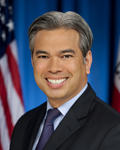
Photo of Rob Bonta
D California Assembly · District 18

Asm. Rob Bonta

Compare
Total votes
21,683
all sessions
Attendance
98%
243 missed
Higher than 91% of chamber peers
With party
99%
of cast votes
Higher than 96% of chamber peers
Bipartisan score
0%
crosses aisle rarely
Lower than 99% of chamber peers
Sponsored
1,483
bills & resolutions
Lower than 98% of chamber peers
Committees
0
assignments
1,483 bills and resolutions

Sponsored bills

Total
1,483
Primary
217
Co-sponsor
1,266
This page
1,483
matching current filters
Co-sponsor AJR 3
Signed into law · California Assembly · Co-sponsor
Relative to the Cuban embargo.

This measure would urge the Congress of the United States to support President Obama's initiative to normalize diplomatic relations with Cuba and to move forward with legislation to help increase trade with Cuba.

Signed into law Sep 1, 2016 1 co-sponsor
Primary AB 533
died · California Assembly · Lead sponsor
Health care coverage: out-of-network coverage.

Existing law, the Knox-Keene Health Care Service Plan Act of 1975, provides for the licensure and regulation of health care service plans by the Department of Managed Health Care. A willful violation of the act is a crime. Existing law requires a health care service plan to reimburse providers for emergency services and care provided to its enrollees, until the care results in stabilization of the enrollee. Existing law prohibits a health care service plan from requiring a provider to obtain authorization prior to the provision of emergency services and care necessary to stabilize the enrollee's emergency medical care, as specified. Existing law also provides for the regulation of health insurers by the Insurance Commissioner. Existing law requires a health insurance policy issued, amended, or renewed on or after January 1, 2014, that provides or covers benefits with respect to services in an emergency department of a hospital to cover emergency services without the need for prior authorization, regardless of whether the provider is a participating provider, and subject to the same cost sharing required if the services were provided by a participating provider, as specified. This bill would require a health care service plan contract or health insurance policy issued, amended, or renewed on or after July 1, 2016, to provide that if an enrollee or insured receives covered services from a contracting health facility, as defined, at which, or as a result of which, the enrollee or insured receives covered services provided by a noncontracting individual health professional, as defined, the enrollee or insured would be required to pay the noncontracting individual health professional only the same cost sharing required if the services were provided by a contracting individual health professional. The bill would prohibit an enrollee or insured from owing the noncontracting individual health professional at the contracting health facility more than the in-network cost-sharing amount if the noncontracting individual health professional receives reimbursement for services provided to the enrollee or insured at a contracting health facility from the health care service plan or health insurer. However, the bill would make an exception from this prohibition if the enrollee or insured provides written consent that satisfies specified criteria. The bill would require a noncontracting individual health professional who collects more than the in-network cost-sharing amount from the enrollee or insured to refund any overpayment to the enrollee or insured, as specified, and would provide that interest on any amount overpaid by, and not refunded to, the enrollee or insured shall accrue at 15% per annum, as specified. Existing law requires a contract between a health care service plan and a provider, or a contract between an insurer and a provider, to contain provisions requiring a fast, fair, and cost-effective dispute resolution mechanism under which providers may submit disputes to the plan or insurer. Existing law requires that dispute resolution mechanism also be made accessible to a noncontracting provider for the purpose of resolving billing and claims disputes. This bill would require the department and the commissioner to each establish an independent dispute resolution process that would allow a noncontracting individual health professional who rendered services at a contracting health facility, or a plan or insurer, to appeal a claim payment dispute, as specified. The bill would authorize the department and the commissioner to contract with one or more independent dispute resolution organizations to conduct the independent dispute resolution process, as specified. The bill would provide that the decision of the organization would be binding on the parties. The bill would require a plan or insurer to base reimbursement for covered services on the amount the individual health professional would have been reimbursed by Medicare for the same or similar services in the general geographic area in which the services were rendered. The bill would require a noncontracting individual health professional who disputes that claim reimbursement to utilize the independent dispute resolution process. The bill would provide that these provisions do not apply to emergency services and care, as defined. Because a willful violation of the bill's provisions relative to a health care service plan would be a crime, the bill would impose a state-mandated local program. The California Constitution requires the state to reimburse local agencies and school districts for certain costs mandated by the state. Statutory provisions establish procedures for making that reimbursement. This bill would provide that no reimbursement is required by this act for a specified reason.

died Aug 31, 2016 0 co-sponsors
Co-sponsor AB 1664
Passed · California Assembly · Co-sponsor
Firearms: assault weapons.

(1) Existing law generally prohibits the possession or transfer of assault weapons, except for the sale, purchase, importation, or possession of assault weapons by specified individuals, including law enforcement officers. Under existing law, "assault weapon" means, among other things, a semiautomatic centerfire rifle or a semiautomatic pistol that has the capacity to accept a detachable magazine and has any one of specified attributes, including, for rifles, a thumbhole stock, and for pistols, a 2nd handgrip. This bill would revise this definition of "assault weapon" to mean a semiautomatic centerfire rifle or a semiautomatic pistol that does not have a fixed magazine but has any one of those specified attributes. The bill would also define "fixed magazine" to mean an ammunition feeding device contained in, or permanently attached to, a firearm in such a manner that the device cannot be removed without disassembly of the firearm action. By expanding the definition of an existing crime, the bill would impose a state-mandated local program. (2) Existing law makes any person who, within this state, possesses an assault weapon, except as otherwise provided, guilty of a misdemeanor or a felony. This bill would exempt from punishment under that prohibition a person who possessed an assault weapon prior to January 1, 2017, if specified requirements are met. (3) Existing law requires that, with specified exceptions, any person who, prior to January 1, 2001, lawfully possessed an assault weapon prior to the date it was defined as an assault weapon, and which was not specified as an assault weapon at the time of lawful possession, register the firearm with the Department of Justice. Existing law permits the Department of Justice to charge a fee for registration of up to $20 per person but not to exceed the actual processing costs of the department. Existing law, after the department establishes fees sufficient to reimburse the department for processing costs, requires fees charged to increase at a rate not to exceed the legislatively approved annual cost-of-living adjustment for the department's budget or as otherwise increased through the Budget Act. Existing law requires those fees to be deposited into the Dealers' Record of Sale Special Account. Existing law, the Administrative Procedure Act, establishes the requirements for the adoption, publication, review, and implementation of regulations by state agencies. This bill would require that any person who, from January 1, 2001, to December 31, 2016, inclusive, lawfully possessed an assault weapon that does not have a fixed magazine, as defined, including those weapons with an ammunition feeding device that can be removed readily from the firearm with the use of a tool, register the firearm with the Department of Justice before January 1, 2018, but not before the effective date of specified regulations. The bill would permit the department to increase the $20 registration fee as long as it does not exceed the reasonable processing costs of the department. The bill would also require registrations to be submitted electronically via the Internet utilizing a public-facing application made available by the department. The bill would require the registration to contain specified information, including, but not limited to, a description of the firearm that identifies it uniquely and specified information about the registrant. The bill would permit the department to charge a fee of up to $15 per person for registration through the Internet, not to exceed the reasonable processing costs of the department to be paid and deposited, as specified, for purposes of the registration program. The bill would require the department to adopt regulations for the purpose of implementing those provisions and would exempt those regulations from the Administrative Procedure Act. The bill would also make technical and conforming changes. (4) The California Constitution requires the state to reimburse local agencies and school districts for certain costs mandated by the state. Statutory provisions establish procedures for making that reimbursement. This bill would provide that no reimbursement is required by this act for a specified reason. (5) This bill would become operative only if SB 880 of the 2015–16 Regular Session is enacted and takes effect on or before January 1, 2017.


Passed Aug 30, 2016 1 co-sponsor
Co-sponsor AJR 42
Signed into law · California Assembly · Co-sponsor
Relative to the transport by rail of flammable and combustible liquids.

This measure would urge the United States Department of Transportation, Department of Energy, and the Office of Management and Budget to expedite the rulemaking and implementation processes for federal safety regulations governing the transport by rail of flammable and combustible liquids, including crude oil, and would also urge the President and the Congress of the United States to pass specified federal legislation mandating public safety measures regulating the transport by rail of those liquids.

Signed into law Aug 30, 2016 1 co-sponsor
Co-sponsor AB 2471
Passed · California Assembly · Co-sponsor
Health care districts: dissolution.

Existing law, the Cortese-Knox-Hertzberg Local Government Reorganization Act of 2000, provides the authority and procedures for the initiation, conduct, and completion of changes of organization and reorganization of cities and districts by local agency formation commissions. Existing law establishes the procedures for the dissolution of the existence of a district and sets forth provisions for winding up the affairs of a dissolved district, as specified. Existing law generally authorizes the dissolution of a district without voter approval, except as specified. Notwithstanding those provisions, existing law subjects the dissolution of a health care district to voter approval. This bill would require the Alameda County local agency formation commission to order the dissolution of the Eden Township Healthcare District if that health care district meets certain criteria, as specified. The bill would subject a dissolution under these provisions to specified provisions of the act that require dissolution by voter approval only if a majority protest exists, as specified. By requiring a higher level of service from the Alameda County local agency formation commission to analyze the criteria described above, the bill would impose a state-mandated local program. This bill would make legislative findings and declarations as to the necessity of a special statute for the Eden Township Healthcare District in Alameda County. The California Constitution requires the state to reimburse local agencies and school districts for certain costs mandated by the state. Statutory provisions establish procedures for making that reimbursement. This bill would provide that, if the Commission on State Mandates determines that the bill contains costs mandated by the state, reimbursement for those costs shall be made pursuant to these statutory provisions.

Passed Aug 29, 2016 1 co-sponsor
Co-sponsor SB 1279
Signed into law · California Senate · Co-sponsor
California Transportation Commission: funding prohibition: coal shipment.

Existing law creates the California Transportation Commission, with various duties and responsibilities relative to the programming and allocation of funds for transportation capital projects. This bill would, except as specified, prohibit the commission from programming or allocating any state funds for new bulk coal terminal projects, as defined. The bill would require terminal project grantees to annually report to the commission that the project is not being used to handle, store, or transport coal in bulk.

Signed into law Aug 26, 2016 1 co-sponsor
Co-sponsor ACR 155
Signed into law · California Assembly · Co-sponsor
Relative to Equal Pay Day.

This measure would proclaim April 12, 2016, as Equal Pay Day in recognition of the need to eliminate the gender gap in earnings by women and to promote policies to ensure equal pay for all.

Signed into law Aug 25, 2016 1 co-sponsor
Showing 881 to 890 of 1,483 bills
Previous 1 … 88 89 90 … 149 Next