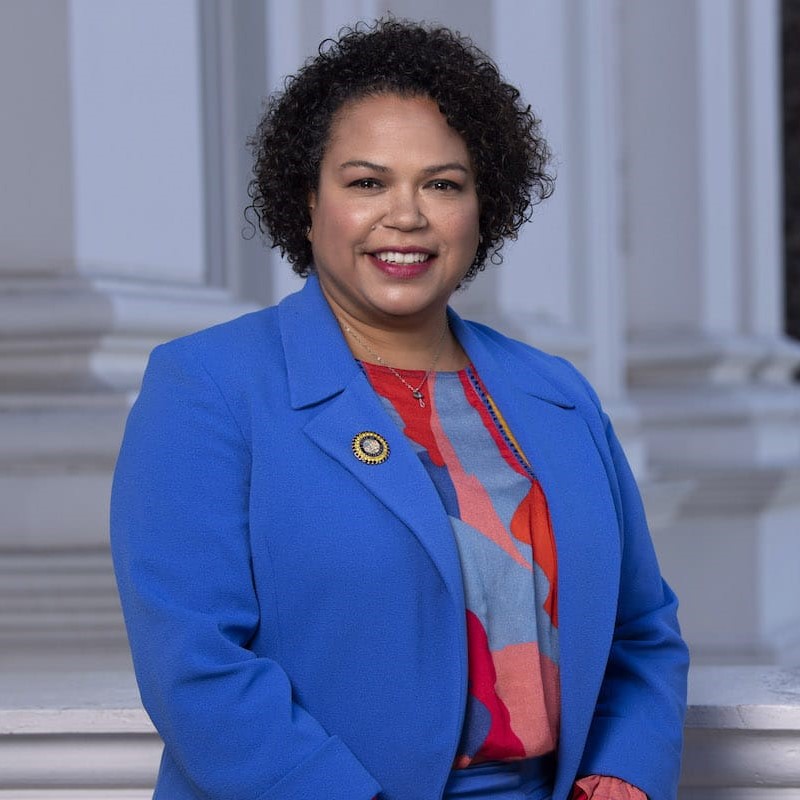
Photo of Mia Bonta
D California Assembly · District 18 On the 2026 ballot

Asm. Mia Bonta

Compare
Total votes
12,577
all sessions
Attendance
92%
902 missed
Near the chamber average
With party
99%
of cast votes
Near the chamber average
Bipartisan score
0%
crosses aisle rarely
Near the chamber average
Sponsored
1,139
bills & resolutions
Near the chamber average
Committees
14
assignments
1,139 bills and resolutions

Sponsored bills

Total
1,139
Primary
116
Co-sponsor
1,023
This page
1,139
matching current filters
Co-sponsor SCR 97
Signed into law · California Senate · Co-sponsor
Relative to the Stan Statham Memorial Highway.

This measure would designate a specified portion of State Highway Route 44, near Oak Run in the County of Shasta, as the Stan Statham Memorial Highway. This measure would request the Department of Transportation to determine the cost of appropriate signs showing this special designation and, upon receiving donations from nonstate sources covering that cost, to erect those signs.

Signed into law Sep 13, 2022 1 co-sponsor
Co-sponsor SCR 70
Signed into law · California Senate · Co-sponsor
Relative to state government.

This measure would designate the East End Complex-Block 171 in Sacramento as the Mario Obledo Building, and would request the Department of General Services to determine the cost of erecting appropriate plaques and markers showing the designation and, upon receiving donations from nonstate sources, to cover that cost to erect signage.

Signed into law Sep 13, 2022 1 co-sponsor
Co-sponsor SJR 5
Signed into law · California Senate · Co-sponsor
Relative to Social Security benefits.

This measure would urge the United States Congress to amend the United States Social Security Administration's index of earnings to ensure that a decline in aggregate wages due to COVID-19 does not result in decreased benefits.

Signed into law Sep 13, 2022 1 co-sponsor
Co-sponsor ACR 177
Signed into law · California Assembly · Co-sponsor
Christopher Columbus Transcontinental Highway: removal of designation.

This measure would request that the Department of Transportation remove the "The Christopher Columbus Transcontinental Highway" designation from the portion of Interstate 10 in the state, as well as any signage and markers memorializing that designation, and advise the Federal Highway Administration of the state's action.

Signed into law Sep 13, 2022 1 co-sponsor
Co-sponsor AJR 22
Signed into law · California Assembly · Co-sponsor
Relative to the Select Committee to Investigate the January 6th Attack on the United States Capitol.

This measure would, among other things, on the first anniversary of the attack on the United States Capitol on January 6, 2021, urge the Select Committee to Investigate the January 6th Attack on the United States Capitol to uncover the facts, circumstances, and causes relating to the attack, and honor the individuals who died or were injured as a result of the attack.

Signed into law Sep 6, 2022 1 co-sponsor
Primary AB 1912
Signed into law · California Assembly · Lead sponsor
Emergency apportionments: closure and consolidation requirements.

Existing law authorizes the governing board of a school district, if it determines during a fiscal year that its revenues are less than the amount necessary to meet its current year expenditure obligations, to request an emergency apportionment through the Superintendent of Public Instruction, as provided. Existing law imposes certain conditions and requirements on a school district that accepts an emergency apportionment, including, among others, that the governing board of the school district prepare a report on the financial condition of the school district. Existing law requires the report to include, among other things, specific actions taken to reduce expenditures or increase income, and the cost savings and increased income resulting from those actions. This bill would require a school district under financial distress, as defined, before approving the closure or consolidation of a school, to conduct an equity impact analysis in its consideration of school closures or consolidations, as provided. The bill would require the governing board of the school district to develop a set of metrics, as specified, for the development of the equity impact analysis, and to make those metrics public at a regularly scheduled meeting of the governing board of the school district so that the public can provide input regarding the metrics being used to conduct the analysis, as provided. To the extent the bill imposes additional duties on local educational agencies, the bill would impose a state-mandated local program. The bill would provide that its provisions do not apply to a school district's closure of a school due solely to the unsafe condition of the school's facilities. The bill would make these provisions inoperative as of July 1, 2028. The California Constitution requires the state to reimburse local agencies and school districts for certain costs mandated by the state. Statutory provisions establish procedures for making that reimbursement. This bill would provide that, if the Commission on State Mandates determines that the bill contains costs mandated by the state, reimbursement for those costs shall be made pursuant to the statutory provisions noted above. This bill would declare that it is to take effect immediately as an urgency statute.

Signed into law Sep 6, 2022 0 co-sponsors
Co-sponsor AJR 26
Signed into law · California Assembly · Co-sponsor
Student loan debt repayment.

This measure would urge the United States Secretary of Education to establish and submit to the United States Congress for approval a monthly student loan payment plan for federal student loans, based on the personal savings rate as published by the federal Bureau of Economic Analysis.

Signed into law Sep 6, 2022 1 co-sponsor
Co-sponsor ACR 208
Signed into law · California Assembly · Co-sponsor
Relative to the Senior Master Sergeant John James Paoletti Memorial Highway.

This measure would designate the portion of State Route 5 from El Horno Street, at postmile 10.001, to Crown Valley Parkway, at postmile 13.776, in the County of Orange as the Senior Master Sergeant John James Paoletti Memorial Highway. The measure would request that the Department of Transportation determine the cost of appropriate signs showing this special designation and, upon receiving donations from nonstate sources covering that cost, erect those signs.

Signed into law Sep 6, 2022 1 co-sponsor
Co-sponsor ACR 211
Signed into law · California Assembly · Co-sponsor
Relative to Corporal Luis Carlos Ruan Memorial Highway.

This measure would designate a portion of State Route 119, between E Kern Street, postmile 0.34, and Cedar Street, postmile 1.300, in the County of Kern as the Corporal Luis Carlos Ruan Memorial Highway. The measure would request the Department of Transportation to determine the cost of appropriate signs showing this special designation and, upon receiving donations from nonstate sources covering that cost, to erect those signs.

Signed into law Sep 6, 2022 1 co-sponsor
Co-sponsor AB 257
Signed into law · California Assembly · Co-sponsor
Food facilities and employment.

Existing law prescribes various protections for employees and generally charges the Labor Commissioner with the enforcement of labor laws. Existing law establishes the powers and responsibilities of the Division of Occupational Safety and Health and the Division of Labor Standards and Enforcement, which are within the Department of Industrial Relations. This bill would enact the Fast Food Accountability and Standards Recovery Act or FAST Recovery Act. The bill would establish, until January 1, 2029, the Fast Food Council (council) within the Department of Industrial Relations, to be composed of 10 members to be appointed by the Governor, the Speaker of the Assembly, and the Senate Rules Committee, and would prescribe its powers. The purpose of the council would be to establish sectorwide minimum standards on wages, working hours, and other working conditions related to the health, safety, and welfare of, and supplying the necessary cost of proper living to, fast food restaurant workers, as well as effecting interagency coordination and prompt agency responses in this regard. The bill would define the characteristics of a fast food restaurant, including that the establishment be part of a set of fast food restaurants consisting of 100 or more establishments nationally that share a common brand, or that are characterized by standardized options for decor, marketing, packaging, products, and services. This bill would require the council to promulgate minimum fast food restaurant employment standards, including standards on wages, working conditions, and training, and to issue, amend, and repeal any other rules and regulations, as necessary to carry out its duties, subject to a petition signed by 10,000 fast food restaurant employees approving the creation of the council, as specified. Under the bill, if a conflict exists between council's standards, rules, or regulations and those issued by another state agency, the standards, rules, or regulations issued by the council would apply to fast food restaurant workers and fast food restaurant franchisees and franchisors, and the conflicting rules or regulations of the other state agency would not have force or effect with respect to these parties. The bill would except from this application proposed standards within the jurisdiction of the Occupational Safety and Health Standards Board and would prescribe a process for the council to petition the board to adopt, amend, or repeal a standard. This bill would require the council to submit a report to the Legislature, as specified, for a standard, or repeal or amendment of a standard, to become effective, and would specify that a standard, repeal, or amendment shall not take effect before October 15 of the same year. The bill would also require the council to provide information as requested by the appropriate committees of the Legislature on labor to facilitate a review of the council's performance and standards, as specified. This bill would require the council to conduct a full review of the adequacy of minimum fast food restaurant health, safety, and employment standards at least once every 3 years. The bill would require the council, following that review, to issue, amend, or repeal, or make recommendations to issue, amend, or repeal, any fast food employment, health or safety standard applicable to fast food restaurants, as appropriate. The bill would require the council to hold meetings or hearings no less than every 6 months that would be open to the public, as specified, and would authorize the council to coordinate with and authorize local agencies to hold such meetings. The bill would authorize a county, or a city with a population greater than 200,000, to establish a Local Fast Food Council, and would prescribe its powers and requirements for its composition. The bill would authorize a Local Fast Food Council to provide recommendations to the council. This bill would require standards for minimum wages, maximum hours of work, and other working conditions fixed by the council to be the minimum standards for fast food restaurant employees, absent a valid collective bargaining agreement, as specified, and would require that they be enforced by the commissioner, as specified, and the Division of Labor Standards Enforcement. By expanding the application of crimes associated with those enforcement procedures, this bill would impose a state-mandated local program. The bill would require the Labor Commissioner and the commissioner's deputies to take assignments of violations of standards issued by the council upon the filing of a claim in writing by an employee or an employee's authorized representative. This bill would prohibit a fast food restaurant operator from discharging or in any manner discriminating or retaliating against any fast food restaurant employee for specified reasons and would create a cause of action and right to reinstatement for employees in this connection, as well as a presumption of unlawful discrimination and retaliation in certain circumstances. The California Constitution requires the state to reimburse local agencies and school districts for certain costs mandated by the state. Statutory provisions establish procedures for making that reimbursement. This bill would provide that no reimbursement is required by this act for a specified reason.


Signed into law Sep 5, 2022 1 co-sponsor
Showing 891 to 900 of 1,139 bills
Previous 1 … 89 90 91 … 114 Next