

(1) Existing law regulates the employment of workers in grocery establishments, as defined, including requiring an incumbent grocery employer, as defined, where there is a change of control, as defined, to post a public notice of the change in control at the location of the affected grocery establishment within 5 business days following the execution of the transfer document, as specified. Existing law requires the notice to include, among other specified information, the name of the incumbent grocery employer, and to be posted in a conspicuous place at the grocery establishment in a manner where it can be readily viewed by specified persons, including eligible grocery workers. Existing law, the Pharmacy Law, provides for the licensure and regulation of pharmacies by the California State Board of Pharmacy. Existing law authorizes a pharmacy to furnish prescription drugs only to certain entities, including specific health care entities, and individual patients or another pharmacy either pursuant to prescription or as otherwise authorized by law. Existing law defines a pharmacy as an area, place, or premises licensed by the board in which the profession of pharmacy is practiced and where prescriptions are compounded. This bill would require a covered establishment, defined to include a grocery establishment or a pharmacy establishment, to satisfy specified requirements no later than 45 days before its closure, as defined, takes effect, including providing written notice of the closure to specified entities, including the employees of the covered establishment affected by the closure and their authorized representatives if the covered establishment employs more than 5 employees, and the Employment Development Department. The bill would require, notwithstanding that provision, a covered establishment that employs 5 or fewer employees to, no later than 30 days before a closure of the covered establishment takes effect, provide written notice of the closure to the employees of the covered establishment affected by the closure. The bill would exempt, notwithstanding the same provision, specified covered establishments, including a covered establishment that, among other things, is a pharmacy and is owned by a person or entity who owns 15 or fewer pharmacies nationwide, from providing written notice to specified persons and entities, including the Employment Development Department. The bill would exempt a covered establishment from these requirements if specified circumstances apply, including that the closure is necessitated by a physical calamity or an act of war, except as specified. (2) Existing law authorizes an aggrieved employee of a grocery establishment or their representative, as described, to bring an action, as specified, for violations of the above-described change of control provisions to recover, among other awards, reasonable attorney's fees and costs, if specified requirements are met, including that the employee provided written notice to the employer of the violations, as specified. Existing law also authorizes a civil penalty not to exceed $100 against, among other specified entities, the grocery employer for each employee whose rights are violated under those provisions. Existing law also authorizes an additional amount of $100 per employee payable as liquidated damages for each day of the violation until the violation is cured, as specified, and authorizes that amount to be recovered by the Labor Commissioner, as specified, and paid to the employee as compensatory damages. This bill would authorize a civil penalty not to exceed $10,000 for each closure to be assessed and collected in a civil action against a covered establishment that violates the above-described written notice provisions brought by specified persons or entities, including any person injured by the violation, except as specified. The bill would require the court, in assessing the amount of the civil penalty, to consider relevant circumstances, including the nature and severity of the misconduct, and require the court to award a prevailing plaintiff reasonable attorney's fees and costs. The bill would require, if the action is pursued by specified entities, including the Attorney General, that specified portions of the civil penalty collected be paid to, among other specified sources, the treasurer of the county in which the judgment was entered. The bill would entitle an employee that does not receive the written notice to recover in a civil action an additional sum of $100 payable as liquidated damages per employee for each day of the violation until the violation is cured, as specified. The bill would specify that these provisions do not preempt or alter any other rights or remedies, including any causes of action, available under any other federal or state law, except as specified. (3) Existing law, the California Workforce Innovation and Opportunity Act, establishes local workforce development boards to perform duties related to the planning, oversight, and evaluation of local workforce investment, including identifying workforce training programs. This bill would require a county, after receiving a written notice described above from any covered establishment, to provide the local workforce development board of the county in which the covered establishment is located with information about safety net programs, including the CalWORKs program, and would require a local workforce development board to provide the covered establishment with information about safety net programs and the availability of local workforce training services. The bill would require a covered establishment that receives information from a county or a local workforce development board as described above, no later than 30 days before its closure, to provide any of that information it receives to each of its employees. By increasing the duties of a county and a local workforce development board, the bill would impose a state-mandated local program. (4) Existing law provides for various public social services programs in the state, which are administered by the State Department of Social Services, including the CalFresh program, under which supplemental nutrition assistance benefits allocated to the state by the federal government are distributed to eligible individuals by each county, and the California Work Opportunity and Responsibility to Kids (CalWORKs) program, under which each county provides cash assistance and other benefits to qualified low-income families and individuals. This bill would require the department, after receiving a written notice described above from a grocery establishment, to transmit to the Food and Nutrition Service of the United States Department of Agriculture information stating that the grocery establishment will be closing and the closing date. (5) This bill would make findings and declarations relating to these provisions. (6) The California Constitution requires the state to reimburse local agencies and school districts for certain costs mandated by the state. Statutory provisions establish procedures for making that reimbursement. This bill would provide that, if the Commission on State Mandates determines that the bill contains costs mandated by the state, reimbursement for those costs shall be made pursuant to the statutory provisions noted above.
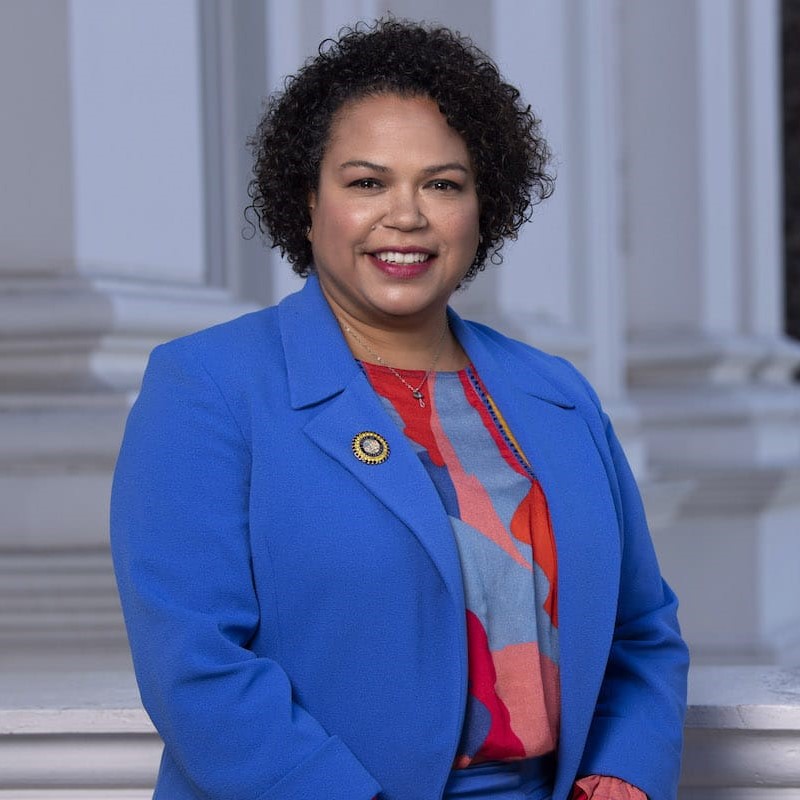
Asm. Mia Bonta
Sponsored bills
Under existing law, human trafficking is a crime and law enforcement officers who are assigned field and investigative duties are required to complete minimum training pertaining to the handling of human trafficking complaints. Existing law generally provides support services for individuals who are survivors of human trafficking, including public social services and address confidentiality, as specified. Existing law establishes the Commission on Peace Officer Standards and Training to prescribe selection and training standards for peace officers. Existing law requires the commission to develop training curriculum in specified areas and to develop model policies that may be used by local law enforcement agencies, including model policies for investigations of missing persons, elder and dependent adult abuse, and hate crimes. This bill would require the commission to, by no later than June 1, 2026, develop guidelines for interacting with survivors of human trafficking. The bill would require each law enforcement agency to, by no later than December 1, 2026, adopt a written policy for interacting with survivors of human trafficking based on the guidelines developed by the commission. By requiring local agencies to adopt a new policy, this bill would impose a state-mandated local program. The California Constitution requires the state to reimburse local agencies and school districts for certain costs mandated by the state. Statutory provisions establish procedures for making that reimbursement. This bill would provide that, if the Commission on State Mandates determines that the bill contains costs mandated by the state, reimbursement for those costs shall be made pursuant to the statutory provisions noted above.
Existing law requires the State Department of Public Health to maintain a program of maternal and child health, which may include, among other things, facilitating services directed toward reducing infant mortality and improving the health of mothers and children. Existing law requires the Office of Health Equity within the department to serve as a resource for ensuring that programs collect and keep data and information regarding ethnic and racial health statistics, and strategies and programs that address multicultural health issues, including, but not limited to, infant and maternal mortality. Existing law makes legislative findings relating to implicit bias and racial disparities in maternal mortality rates. Existing law requires a hospital that provides perinatal care, and an alternative birth center or a primary clinic that provides services as an alternative birth center, to implement an evidence-based implicit bias program, as specified, for all health care providers involved in perinatal care of patients within those facilities. Existing law requires the health care provider to complete initial basic training through the program and a refresher course every 2 years thereafter, or on a more frequent basis if deemed necessary by the facility. Existing law requires the facility to provide a certificate of training completion upon request, to accept certificates of completion from other facilities, and to offer training to physicians not directly employed by the facility. Existing law requires the department to track and publish data on pregnancy-related death and severe maternal morbidity, as specified. This bill would make a legislative finding that the Legislature recognizes all birthing people, including nonbinary persons and persons of transgender experience. The bill would extend the evidence-based implicit bias training requirements to specified health care providers at hospitals that provide perinatal care, alternative birth centers, or primary care clinics, as specified. The bill would require an implicit bias program to include recognition of intersecting identities and the potential associated biases. The bill would require initial basic training for the implicit bias program to be completed by June 1, 2025, for current health care providers, and within 6 months of their start date for new health care providers, unless exempted. The bill would require specified facilities to, by February 1 of each year, commencing in 2026, provide the Attorney General with proof of compliance with these provisions, as specified. The bill would authorize the Attorney General to pursue civil penalties for violations of these provisions, as specified. The bill would require that Attorney General be awarded all attorney's fees and costs in any civil action in which a court imposes any of those civil penalties. The bill would authorize the Attorney General to post on its internet website a list of facilities that did not timely submit proof of compliance or were assessed penalties under these provisions, as specified. The bill would authorize the Attorney General to post any other compliance data they deem necessary and would authorize the Attorney General to biennially publish a report outlining compliance data related to these provisions. The bill would make the provisions of the act severable.
Existing law establishes the Medi-Cal program, which is administered by the State Department of Health Care Services and under which qualified low-income individuals receive health care services. The Medi-Cal program is, in part, governed and funded by federal Medicaid program provisions. Existing law requires the department to establish the Medically Tailored Meals Pilot Program and the Short-Term Medically Tailored Meals Intervention Services Program, to operate in specified counties and during limited periods for the purpose of providing medically tailored meal intervention services to eligible Medi-Cal beneficiaries with certain health conditions, including congestive heart failure, cancer, diabetes, chronic obstructive pulmonary disease, or renal disease. Existing law, subject to implementation of the California Advancing and Innovating Medi-Cal (CalAIM) initiative, authorizes a Medi-Cal managed care plan to elect to cover community supports approved by the department as cost effective and medically appropriate in a comprehensive risk contract that are in lieu of applicable Medi-Cal state plan services. Under existing law, community supports that the department is authorized to approve include, among other things, medically supportive food and nutrition services, including medically tailored meals. This bill would make medically supportive food and nutrition interventions a covered benefit under the Medi-Cal program, through both the fee-for-service and managed care delivery systems, no sooner than July 1, 2026, upon appropriation and subject to federal approval and the issuance of final guidance by the department. The bill would require those interventions to be covered if determined to be medically necessary by a health care provider or health care plan, as specified. The bill would require the provision of interventions for 12 weeks, or longer if deemed medically necessary. The bill would require the department to define the qualifying medical conditions for covered interventions and delineate the services included in the definition of a medically supportive food and nutrition intervention. The bill would require a health care provider, to the extent possible, to match the acuity of a patient's condition to the intensity and duration of the covered intervention and to include culturally appropriate foods. The bill would require the department, upon appropriation, to establish a medically supportive food and nutrition benefit stakeholder group, with a specified composition, to advise the department on certain related items, such as the scope of the benefit, among others.
Existing law establishes, until January 1, 2030, the Racial Equity Commission within the Office of Planning and Research and requires the commission to develop resources, best practices, and tools for advancing racial equity by, among other things, developing a statewide Racial Equity Framework that includes methodologies and tools that can be employed to advance racial equity and address structural racism in California. This bill would require the Office of Legal Affairs, which would be established within the California American Freedmen Affairs Agency as provided by SB 1403 of the 2023–24 Regular Session, to, upon appropriation by the Legislature, review, investigate, and make certain determinations regarding applications from persons who claim they are the dispossessed owner, as defined, of property taken as a result of racially motivated eminent domain. The bill would define "racially motivated eminent domain" to mean when the state, county, city, city and county, district, or other political subdivision of the state acquires private property for public use and does not distribute just compensation to the owner at the time of the taking, and the taking, or the failure to provide just compensation, was due, in whole or in part, to the owner's ethnicity or race. Upon a determination that providing property or just compensation is warranted, as provided, the bill would require the Office of Legal Affairs to certify that the dispossessed owner is entitled to the return of the taken property, as specified, or other publicly held property, as defined, of equal value, or financial compensation, as specified. Upon a determination that the dispossessed owner is entitled to other publicly held property of equal value, the bill would require the Office of Legal Affairs to solicit and select, as specified, a list of recommendations of publicly held properties that are suitable as compensation, as provided. Upon a rejection of the determination of the Office of Legal Affairs by the state or local agency that took property by racially motivated eminent domain, the bill would authorize the dispossessed owner, as specified, to bring an action to challenge the taking or the amount of compensation, as provided. Upon a determination that an applicant is not a dispossessed owner or issuing property or just compensation is not warranted, the bill would require the Office of Legal Affairs to notify the applicant of its finding and provide an appeal process, as specified. The bill would make every finding, decision, determination, or other official act of the California American Freedmen Affairs Agency subject to judicial review. Existing law generally prohibits state agencies from employing in-house counsel to act on behalf of the agency or its employees in judicial or administrative adjudicative proceedings, but exempts specified agencies from this provision. This bill would exempt the California American Freedmen Affairs Agency from that provision. This bill would make related findings and declarations, including those related to a gift of public funds.
Existing law establishes the Medi-Cal program, which is administered by the State Department of Health Care Services and under which qualified low-income individuals receive medically necessary health care services, through fee-for-service or managed care delivery systems. The Medi-Cal program is, in part, governed and funded by federal Medicaid program provisions. Under existing law, early and periodic screening, diagnostic, and treatment (EPSDT) services are covered under Medi-Cal for an individual under 21 years of age in accordance with certain federal provisions. Existing federal regulations require the state to provide for a combination of written and oral methods designed to inform individuals eligible for EPSDT services, or their families, about the EPSDT program, within 60 days of the individual's initial Medicaid eligibility determination and, in the case of families that have not utilized EPSDT services, annually thereafter, as specified. Under those regulations, required information includes, among other components, the benefits of preventive health care and the services available under the EPSDT program and where and how to obtain those services. This bill would require the department to prepare written informational materials that effectively explain and clarify the scope and nature of EPSDT services, as defined, that are available under the Medi-Cal program. Under the bill, the materials would include, but would not be limited to, the information required in the above-described federal regulations or their successor. Under the bill, the informational materials would also include content designed for youth, for purposes of delivery of that content to a beneficiary who is 12 years of age or older but under 21 years of age. The bill would authorize the department to standardize the materials, as specified, and would require the department to regularly review the materials to ensure that they are up to date. The bill would require the department to test the quality, clarity, and cultural concordance of translations of the informational materials with Medi-Cal beneficiaries, in order to ensure that the materials use clear and nontechnical language that effectively informs beneficiaries. The bill would require the department or a Medi-Cal managed care plan, to provide to a beneficiary who is eligible for EPSDT services, or to the parent or other authorized representative of that beneficiary, as applicable, the informational materials within a maximum number of calendar days after that beneficiary's enrollment in a managed care plan or initial Medi-Cal eligibility determination and annually thereafter, as specified by the department.
The Political Reform Act of 1974 regulates the use of campaign funds held by candidates for elective office, elected officers, and campaign committees. The act authorizes a candidate or elected officer to use campaign funds to pay or reimburse the state for the costs of installing and monitoring a home or office electronic security system if specified conditions are met. These conditions include that the candidate or elected officer has received threats to physical safety that have been verified by law enforcement and that no more than $5,000 in campaign funds be used for this purpose. This bill would eliminate those conditions. The bill would instead authorize a candidate or elected officer to use campaign funds to pay or reimburse the state for the reasonable costs of installing and monitoring a home or office electronic security system or for another tangible item related to security, and for the reasonable costs of providing personal security to a candidate, elected officer, or the immediate family or staff of a candidate or elected officer, provided that the threat or potential threat to safety arises from the candidate's or elected officer's activities, duties, or status as a candidate or elected officer or from staff's position as staff of the candidate or elected officer. The bill would permit a maximum of $10,000 of campaign funds to be expended for these purposes by a candidate or elected officer during their lifetime. The bill would not authorize campaign funds to be used to pay, or reimburse the state, for firearms. The bill would require the return of the security system or other item to the committee that paid for the security system or other item or reimbursement by the candidate, elected officer, immediate family, or staff, to the campaign fund account of the committee that paid for the security system or other item, and reporting of the reimbursement or expenditure on the candidate's or elected officer's campaign statement, as specified. The bill would require the candidate or elected officer to maintain detailed accounts, records, bills, and receipts relating to an expenditure or reimbursement for security, as specified. The bill would also require a candidate or elected officer to submit a form to the Fair Political Practices Commission that documents, under penalty of perjury, the threat or potential threat that necessitated the expenditure of campaign funds for security purposes. By requiring the submission of a form under the penalty of perjury if campaign funds are used in the above manner, the bill creates a new crime and therefore establishes a state-mandated local program. The California Constitution requires the state to reimburse local agencies and school districts for certain costs mandated by the state. Statutory provisions establish procedures for making that reimbursement. This bill would provide that no reimbursement is required by this act for a specified reason. The Political Reform Act of 1974, an initiative measure, provides that the Legislature may amend the act to further the act's purposes upon a 23 vote of each house of the Legislature and compliance with specified procedural requirements. This bill would declare that it furthers the purposes of the act. This bill would declare that it is to take effect immediately as an urgency statute.
Existing law establishes the State Department of Public Health and sets forth its powers and duties to license and administer health facilities, as defined, including skilled nursing facilities and intermediate care facilities. Existing law requires skilled nursing facilities and intermediate care facilities to adopt certified nurse assistant training programs approved by the department. A violation of the provisions relating to those training requirements is a misdemeanor. Existing law requires the department to prepare and maintain a list of approved training programs for nurse assistant certification, including training programs conducted by skilled nursing facilities or intermediate care facilities, as well as local agencies and education programs. This bill additionally would require the department, no later than December 31, 2025, to solicit applications from vendors to provide the written and oral competency examination of a nurse assistant certification examination in Spanish. The bill also would require the department, by July 1, 2029, to publish on its internet website, and to update at least twice annually, a list of information including, but not limited to, approved training programs, as specified, competency test pass rates for the previous 2 years, aggregated by the language in which the test was taken, and the number of nurse assistants trained in the previous 2 years.
(1) Existing law requires the State Department of Education to develop evidence-based best practices for restorative justice practice implementation on a school campus and to make these best practices available on the department's internet website on or before June 1, 2024, as specified. This bill would, commencing July 1, 2026, require school districts, county offices of education, and charter schools to adopt at least one of the best practices for restorative justice practice implementation developed by the department. By imposing new duties on local educational agencies, the bill would impose a state-mandated local program. (2) Existing law prohibits a pupil from being suspended from school or recommended for expulsion unless the superintendent of the school district or principal of the school determines that the pupil has committed any of various specified acts. Existing law provides that suspension shall be imposed only when other means of correction, which may include, but are not limited to, participation in a restorative justice program, fail to bring about proper conduct, except that the suspension of a pupil for a first offense is authorized if the principal or superintendent of schools determines that the pupil violated one of a certain subset of those enumerated acts or that the pupil's presence causes a danger to persons. Existing law authorizes a school district to document the alternative means of correction used and to place that documentation in the pupil's record, as provided. This bill would provide that participation in a restorative justice program, as an alternative to suspension as a means of correction, may include participation in a restorative justice best practice, adopted as described in paragraph (1) above. The bill also would require, instead of authorize, a school district to document the alternative means of correction used and to place that documentation in the pupil's record. To the extent this provision imposes new duties on local educational agencies, the bill would impose a state-mandated local program. (3) This bill would make the implementation of its provisions contingent upon an appropriation by the Legislature in the annual Budget Act or another measure for the purposes of the bill's provisions. (4) The California Constitution requires the state to reimburse local agencies and school districts for certain costs mandated by the state. Statutory provisions establish procedures for making that reimbursement. This bill would provide that, if the Commission on State Mandates determines that the bill contains costs mandated by the state, reimbursement for those costs shall be made pursuant to the statutory provisions noted above.
Existing law, commencing with the 2023–24 fiscal year, appropriates $300,000,000 each fiscal year from the General Fund to the Superintendent of Public Instruction for allocation for the Local Control Funding Formula Equity Multiplier apportionment, as provided. Existing law requires the funding to be allocated to eligible local educational agencies that generate a specified local control funding formula entitlement based on, among other things, the percentage of unduplicated pupils served. Existing law establishes the Strong Workforce Program to provide funding to career technical education regional consortia made up of community college districts and local educational agencies, as specified. Existing law also establishes a K–12 component of the Strong Workforce Program. Existing law provides that, commencing with the 2018–19 fiscal year, the amount appropriated in the annual Budget Act for the K–12 component of the program is used to create, support, or expand high-quality career technical education programs at the K–12 level that are aligned with the workforce development efforts occurring through the program. Existing law requires each consortium to form a K–12 Selection Committee, as specified, for purposes of awarding grants under the K–12 component of the program and requires that applicants with certain characteristics be given positive consideration, as specified. This bill would require positive consideration for purposes of awarding grants under the K–12 component of the program to also be given to applicants that serve pupils enrolled at local educational agencies receiving Local Control Funding Formula Equity Multiplier funding.