

Existing law requires a marketplace, as defined, to ensure that its terms and conditions regarding commercial relationships with marketplace sellers meet certain criteria, including that they are drafted in plain and intelligible language. This bill would, commencing July 1, 2023, require an online marketplace, as defined, to require a high-volume third-party seller on the online marketplace, not later than 10 days after qualifying as a high-volume third-party seller, to provide to the online marketplace specified information, including certain contact information and a bank account number or, if the seller does not have a bank account, the name of the payee for payments issued by the online marketplace to the seller, as prescribed. The bill would require an online marketplace to suspend future sales activity of a high-volume third-party seller that is not in compliance with the provisions described in this paragraph, as specified. This bill would require the online marketplace to verify the information provided by the high-volume third-party seller pursuant to the provisions described above within 10 days and would require the online marketplace to verify within 10 days any changes to the information and to, at least annually, notify each high-volume third-party seller on the online marketplace that the seller must inform the online marketplace of any changes to the information, as provided. This bill would also require an online marketplace to, among other things, require a high-volume third-party seller with at least $20,000 of gross annual revenues from transactions with buyers in California through the online marketplace to provide, subject to certain exceptions, certain information, including the seller's physical address, to the online marketplace and to disclose the information to consumers in a clear and conspicuous manner in the order confirmation message, or other communication made to a consumer after a purchase is finalized, and in the consumer's account transaction history. The bill would require an online marketplace to suspend future sales activity of a high-volume third-party seller under certain circumstances, including that the high-volume third-party seller is not in compliance with the provisions described in this paragraph. This bill would require an online marketplace to comply with specified recordkeeping and security procedures with regard to the information required to comply with these provisions. The bill would subject a person or entity who violates the bill's provisions to a civil penalty not to exceed $10,000 for each violation, which may be assessed and recovered only in a civil action brought in the name of the people of the State of California by the Attorney General.
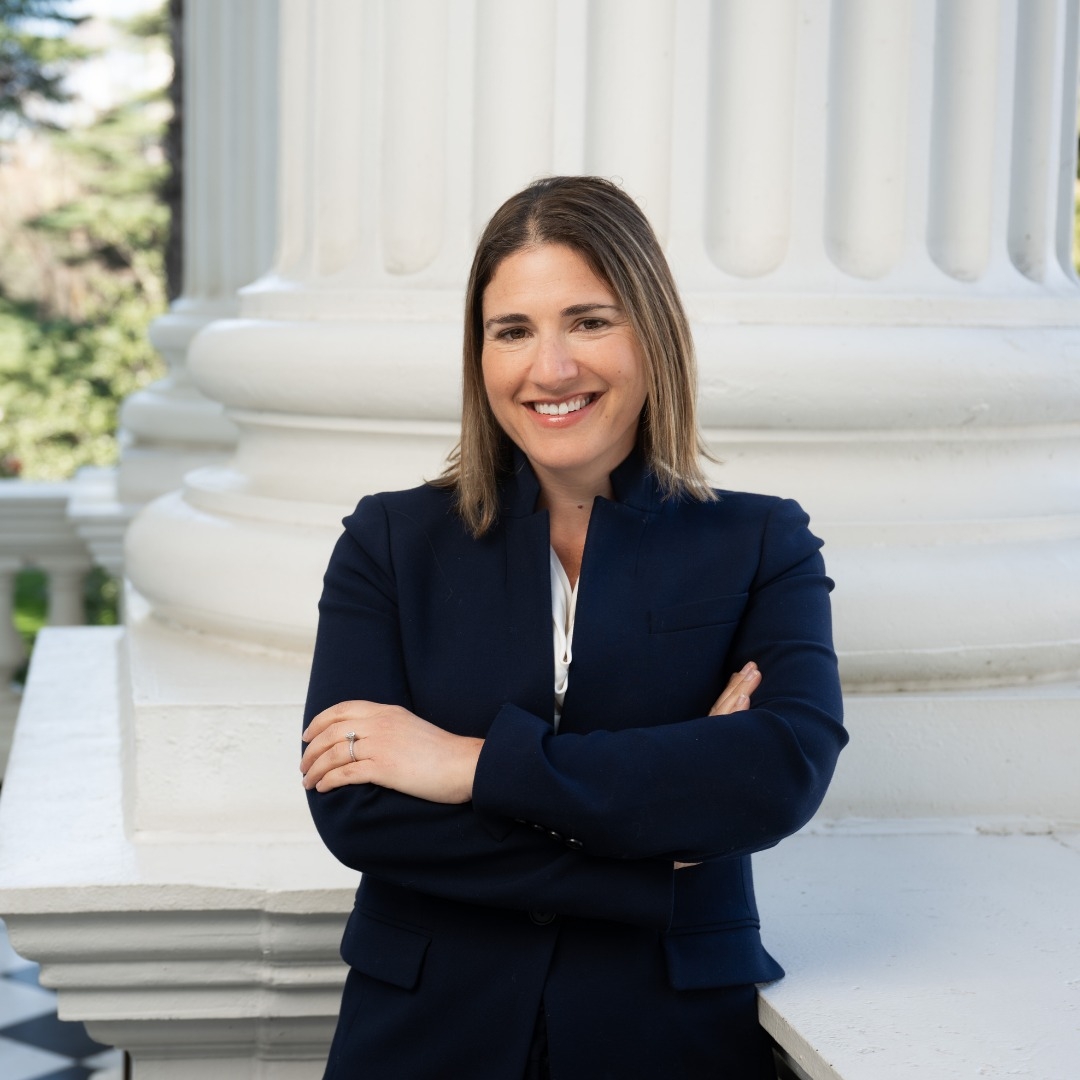
Asm. Rebecca Bauer-Kahan
Sponsored bills
Existing law specifies the content of a certificate of death, including the full name of the father, birthplace of the father, the full maiden name of the mother, and birthplace of the mother. This bill would, instead, require the certificate of death to include the current first and middle names, birth last names, and the birthplaces of the parents, without reference to the parents' gendered relationship to the decedent. The bill would require the State Registrar to electronically capture information on the parents' relationship to the decedent and any additional last names used by the parents, which would not be transcribed onto the actual hard copy of the death certificate. The bill would require the State Registrar to implement the changes made by the bill no later than July 1, 2024.
Existing law subjects a minor between 12 and 17 years of age, inclusive, who violates any federal, state, or local law or ordinance, who persistently or habitually refuses to obey the reasonable and proper orders or directions of the minor's parents, guardian, or custodian, or who is beyond the control of that person, who violates an ordinance establishing a curfew or is truant, and a minor under 12 years of age who is alleged to have committed specified serious offenses, to the jurisdiction of the juvenile court, which may adjudge the minor to be a ward of the court. When a minor is adjudged to be a ward of the court, as previously described, and is placed under the supervision of the probation officer or committed to the care, custody, and control of the probation officer, existing law authorizes the court to make any and all reasonable orders for the conduct of the ward, and to impose and require any and all reasonable conditions that it may determine fitting and proper to the end that justice may be done and the reformation and rehabilitation of the ward enhanced. This bill would limit to 6 months the period of time a ward may remain on probation, except that a court may extend the probation period for a period not to exceed increments of 6 months after a noticed hearing and upon proof by a preponderance of the evidence that it is in the ward's best interest. The bill would require the probation agency to submit a report to the court detailing the basis for any request to extend probation at the noticed hearing. The bill would require the court to provide the ward and the prosecuting attorney with the opportunity to present relevant evidence, as specified. The bill would require the court to hold a noticed hearing for the ward not less frequently than every 6 months for the remainder of the wardship period if the court extends probation. The bill would additionally require, among other things, that conditions of probation for a ward be individually tailored, developmentally appropriate, and reasonable. Existing law authorizes the court, as part of the order adjudging the minor to be a ward of the court, to order the ward to pay restitution, to pay a fine up to $250 for deposit in the county treasury if the court finds the minor has the financial ability to pay, or to participate in an uncompensated work program. This bill would remove the authority of the court to order the minor to pay the $250 fine or participate in an uncompensated work program in lieu of restitution. Existing law requires the court, for specified offenses, to order certain actions as a condition of a minor's probation including attending counseling, repairing property, repaying the cost of apprehension to the city or county, and performing community service. This bill would, in specified instances, no longer require the court to order certain actions as a condition of a minor's probation. The bill would instead impose requirements on the conditions of a minor's probation ordered by the court. Existing law requires a court to order a minor who is subject to the jurisdiction of the juvenile court to pay restitution to the victim and a restitution fine that is deposited in the Restitution Fund, as specified. Under existing law, the board of supervisors of a county may, at its discretion, impose a fee to cover the actual administrative cost of collecting the restitution fine, as specified, with the proceeds deposited in the general fund of the county. This bill would remove the authority of the board of supervisors of a county to impose this fee.
Existing law establishes the California Conservation Corps in the Natural Resources Agency and requires the corps to implement and administer the conservation corps program. Existing law authorizes the Director of the California Conservation Corps to establish the Education and Employment Reentry Program within the corps to develop, partner with, and create opportunities for certain forestry corps program objectives, collaborate with the Employment Development Department to provide access to workforce services, collaborate with nongovernmental organizations dedicated to providing access to counseling, mentorship, supportive housing, health care, and educational opportunities, and employ collaborations and partnerships available to the corps, as specified. This bill would require the director, upon appropriation by the Legislature in the annual Budget Act or another statute, in partnership with the Department of Forestry and Fire Protection and the Department of Corrections and Rehabilitation, to establish a forestry training center in northern California to provide enhanced training, education, work experience, and job readiness for entry-level forestry and vegetation management jobs. The bill would require the training center to include counseling, mentorship, supportive housing, health care, and educational services and authorize the training center to provide training modules on specified activities. The bill would require the director to enroll at the training center formerly incarcerated individuals and to prioritize enrollment for those formerly incarcerated individuals who have either successfully served on a California Conservation Camp program crew and were recommended by the Director of Forestry and Fire Protection and the Secretary of the Department of Corrections and Rehabilitation, as provided, or successfully served on a hand crew at the county level and were recommended for participation by the county probation and county fire departments. The bill would provide that successful completion of a training program at the training center constitutes qualifying experience for an entry-level forestry or vegetation management position at a state agency. This bill would make legislative findings and declarations as to the necessity of a special statute for northern California.
Existing law, the Sherman Food, Drug, and Cosmetic Law, provides for the regulation of various subjects relating to the processing, labeling, advertising, and sale of food, drugs, and cosmetics, including dietary supplements, under the administration and enforcement of the State Department of Public Health. A violation of those provisions is a crime. Under existing law, it is a misdemeanor for any manufacturer, wholesaler, retailer, or other person to sell, transfer, or otherwise furnish a dietary supplement containing ephedrine group alkaloids or other specified substances to a person under 18 years of age, and a seller is required to request a valid identification of prospective purchasers who reasonably appear to be under 18 years of age. This bill would prohibit a retail establishment from selling, transferring, or otherwise furnishing dietary supplements for weight loss or over-the-counter (OTC) diet pills, as defined, to any person under 18 years of age without a prescription, by requiring the retail establishment to follow a specified identification check. The bill would, to the extent not in conflict with federal law, require the department to develop a notice stating that certain dietary supplements for weight loss or OTC diet pills may contribute to specified health conditions or death. The bill would require a retail establishment that sells those products to post that notice. The bill would require the department, in consultation with certain entities, to determine which dietary supplements for weight loss and OTC diet pills would be subject to these provisions, in a manner consistent with specified criteria. The bill would make a person who violates these provisions liable for a civil penalty of no more than $1,000 for each violation, as specified. The bill would exempt a retail clerk from any civil penalties, or disciplinary action or discharge by the retail establishment, for a violation of these provisions, except as specified. Under the bill, the above-described criminal penalty would not apply to a violation of these provisions. The bill would make these provisions operative on July 1, 2023, and would make the provisions severable.
Existing law prohibits the dumping of waste matter upon a road or highway or in other locations, as specified. A violation of this prohibition, generally, is an infraction punishable by specified fines that escalate for subsequent convictions. Under existing law, the court may, as a condition of probation, order the convicted person to remove, or pay for the removal of, the waste matter. Under existing law, the dumping of commercial quantities of waste, as defined, is punishable as a misdemeanor and also includes escalating fines. This bill would increase the maximum fine for the dumping of commercial quantities of waste by a business that employs more than 10 employees from $3,000 to $5,000 for the first conviction, from $6,000 to $10,000 for the second conviction, and from $10,000 to $20,000 for the third and any subsequent convictions. The bill would require a court, when imposing a fine, to consider the defendant's ability to pay, as specified. This bill would also require, instead of authorize, the court to order a person convicted of dumping commercial quantities of waste to remove, or pay for the removal of, the waste matter that was illegally dumped. The bill would require the court to notify the issuing entity of certain professional or business licenses or permits held by the convicted person, that are related to the illegal dumping activity for which the person has been convicted, if applicable, and would require those entities to post information regarding these convictions on their internet website, as specified. The bill would retain the authorization for the court to order the defendant to pay for cleanup or perform specified community service, but would remove the requirement that it be ordered as a condition of probation.
Existing law subjects a minor between 12 and 17 years of age, inclusive, who violates any federal, state, or local law or ordinance to, and a minor under 12 years of age who is alleged to have committed specified serious offenses to, the jurisdiction of the juvenile court, which may adjudge the minor to be a ward of the court. Existing law authorizes a probation officer to release a minor who has been taken into temporary custody because they have been alleged to have committed an offense back to the custody of their parent, legal guardian, or responsible relative on home supervision under the supervision of the probation officer, except as specified. Existing law authorizes the use of electronic monitoring in criminal court under a home detention program for inmates held in a county jail or other correctional facility or granted probation, or inmates participating in a work furlough program, under certain conditions, in lieu of confinement. Existing law also requires that for all felony and misdemeanor sentences, when the defendant has been in custody, that all days of custody of the defendant, including days served in home detention under electronic monitoring, are to be credited upon the defendant's term of imprisonment, or credited to any base fine, as specified. This bill would entitle a minor to have one day credited against the minor's maximum term of confinement for each day, or fraction thereof, that the minor serves on electronic monitoring. This bill would, if electronic monitoring is imposed for a period of greater than 30 days, require the court to hold a hearing every 30 days to ensure that the minor does not remain on electronic monitoring for an unreasonable length of time, as specified. The bill would prohibit electronic monitoring devices from being used to converse with a minor or to eavesdrop or record any conversation. Existing law requires the Department of Justice to collect certain criminal justice data from specified persons and agencies, and to make available to the public information relating to criminal statistics through the department's OpenJustice Web portal, to be updated at least once per year. Existing law requires those criminal statistics on the portal to include the administrative actions taken by law enforcement, judicial, penal, and correctional agencies or institutions, including those in the juvenile justice system, in dealing with criminals or delinquents. This bill would also require the Department of Justice, in complying with those reporting requirements, to include data regarding the use of electronic monitoring in juvenile court, as specified.
(1) Existing law, commonly known as the California Family Rights Act, makes it an unlawful employment practice for a California public employer or an employer with 5 or more employees to refuse to grant a request from an employee who meets specified requirements to take up to a total of 12 workweeks in any 12-month period for family care and medical leave, as defined. This bill would expand the class of people for whom an employee may take leave to care for to include a designated person. The bill would define "designated person" to mean any individual related by blood or whose association with the employee is the equivalent of a family relationship. The bill would authorize a designated person to be identified at the time the employee requests the leave. The bill would authorize an employer to limit an employee to one designated person per 12-month period. (2) Existing law, the Healthy Workplaces, Healthy Families Act of 2014, generally entitles an employee who works in California for the same employer for 30 or more days within a year to paid sick days, as specified, including the use of paid sick days for diagnosis, care, or treatment of an existing health condition of, or preventive care for, an employee or an employee's family member. Existing law defines "family member" for this purpose to include individuals who share a prescribed relationship with the employee. This bill would expand the definition of the term "family member" to include a designated person, which, for purposes of these provisions, would mean a person identified by the employee at the time the employee requests paid sick days, subject to limitation by the employer, as prescribed.
(1) Existing law, the Warren-911-Emergency Assistance Act, requires every local public agency, as defined, to have an emergency communication system and requires the digits "911" to be the primary emergency telephone number within the system. Existing law specifies provisions governing the operation and financing of community mental health services for the mentally disordered in every county through locally administered and locally controlled community mental health programs. Existing law specifies that county mental health services should be organized to provide immediate response to individuals in precrisis and crisis and to members of the individual's support system on a 24-hour, 7-day-per-week basis and authorizes provision of crisis services offsite as mobile services. Existing federal law, the National Suicide Hotline Designation Act, designates the 3-digit telephone number "988" as the universal number within the United States for the purpose of the national suicide prevention and mental health crisis hotline system operating through the 988 Suicide and Crisis Lifeline maintained by the Assistant Secretary for Mental Health and Substance Abuse and the Veterans Crisis Line maintained by the Secretary of Veterans Affairs. This bill would enact the Miles Hall Lifeline and Suicide Prevention Act. The bill would require the Office of Emergency Services to verify, no later than July 16, 2022, that technology that allows for transfers between 988 centers as well as between 988 centers and 911 public safety answering points, is available to 988 centers and 911 public safety answering points throughout the state. The bill would require, no later than 90 days after passage of the act, the office to appoint a 988 system director, among other things. The bill would require, no later than July 1, 2024, the office to verify interoperability between and across 911 and 988. The bill would require the office to consult with specified entities on any technology requirements for 988 centers. This bill would require the California Health and Human Services Agency to create, no later than December 31, 2023, a set of recommendations to support a 5-year implementation plan for a comprehensive 988 system. The bill would require that agency to convene a state 988 advisory group, as described, for purposes of advising the agency on the set of recommendations. The bill would require the agency to report annually, on or before December 31, beginning December 31, 2024, and until December 31, 2029, to the Legislature on the status of 988 implementation in the state, as described. The Administrative Procedure Act generally governs the procedure for the adoption, amendment, or repeal of regulations by state agencies and for the review of those regulatory actions by the Office of Administrative Law. The bill would provide that regulations and other similar instruments made pursuant to these provisions by the Office of Emergency Services and the California Health and Human Services Agency are not subject to the rulemaking provisions of the Administrative Procedure Act. (2) Existing law, the Knox-Keene Health Care Service Plan Act of 1975, provides for the licensure and regulation of health care service plans by the Department of Managed Health Care and makes a willful violation of the act a crime. Existing law also provides for the regulation of health insurers by the Department of Insurance. Existing law requires a health care service plan contract or disability insurance policy issued, amended, or renewed on or after January 1, 2021, to provide coverage for medically necessary treatment of mental health and substance use disorders, as defined, under the same terms and conditions applied to other medical conditions. This bill would require health care service plans and insurers to cover medically necessary treatment of a mental health or substance use disorder, including behavioral health crisis services, provided by a 988 center or mobile crisis team, regardless of whether the service is provided by an in-network or out-of-network provider, at the in-network cost-sharing amount, as defined. By creating a new crime under the Knox-Keene Act, this bill would impose a state-mandated local program. (3) Existing law, the Emergency Telephone Users Surcharges Act, generally imposes a surcharge on each access line for each month or part thereof for which a service user subscribes with a service supplier, at an amount no greater than $0.80, based on the Office of Emergency Services' estimate of the number of access lines to which the surcharge will be applied per month for a calendar year period that it estimates, pursuant to a specified formula, will produce sufficient revenue to fund the current fiscal year's 911 costs. Existing law imposes a surcharge on the purchase of prepaid mobile telephony services at the time of each retail transaction in this state, at the rate equal to the monthly surcharge amount per access line, to be paid by prepaid consumers and collected by sellers, as defined. Existing law exempts certain lines from the surcharge, including lines supplying lifeline service. Existing law requires the surcharge to be remitted to, and administered by, the California Department of Tax and Fee Administration, in accordance with specified provisions. Existing law makes certain violations of the Emergency Telephone Users Surcharge Act a crime. Existing law requires amounts to be paid to the state pursuant to the Emergency Telephone Users Surcharge Act to be deposited into the State Emergency Telephone Number Account and that the amounts deposited, upon appropriation by the Legislature, be spent solely for specified purposes, including payment for the installation of, and ongoing expenses for, a basic system. This bill would create a separate surcharge, beginning January 1, 2023, on each access line for each month or part thereof for which a service user subscribes with a service supplier. The bill would set the 988 surcharge for the 2023 and 2024 calendar years at $0.08 per access line per month and, for years beginning January 1, 2025, at an amount based on a specified formula, but no greater than $0.30 per access line per month. This bill would make applicable relevant provisions of the Emergency Telephone Users Surcharge Act to the 988 surcharge, as provided, including existing surcharge exemptions. The bill would authorize the 911 and 988 surcharges to be combined into a single-line item, as described. The bill would provide for specified costs to be paid by the fees prior to distribution to the Office of Emergency Services. The bill would make conforming changes in regard to the 988 surcharge. This bill would create the 988 State Suicide and Behavioral Health Crisis Services Fund and would require the fees to be deposited along with other specified moneys into the fund. The bill would provide that the funds be used, upon appropriation by the Legislature, for specified purposes and in accordance with specified priorities. The bill would require the Office of Emergency Services to require an entity seeking moneys available through the fund to annually file an expenditure and outcomes report containing specified information. (4) This bill would appropriate $300,000 from the General Fund to the 988 State Suicide and Behavioral Health Crisis Services Fund for expenditure by the California Department of Tax and Fee Administration in the 2022–23 fiscal year for purposes of implementing the amendments to the Emergency Telephone Users Surcharge Act. (5) This bill would incorporate additional changes to Section 41100 of the Revenue and Taxation Code proposed by SB 1496 to be operative only if this bill and SB 1496 are enacted and this bill is enacted last. (6) By expanding the scope of crimes imposed by the Emergency Telephone Users Surcharge Act, this bill would impose a state-mandated local program. The California Constitution requires the state to reimburse local agencies and school districts for certain costs mandated by the state. Statutory provisions establish procedures for making that reimbursement. This bill would provide that no reimbursement is required by this act for a specified reason. (7) This bill would declare that it is to take effect immediately as an urgency statute.
(1) The United States Constitution generally requires a state to give full faith and credit to the public acts, records, and judicial proceedings of every other state. Existing law authorizes, upon the demand made by another state, the extradition of a person charged with committing an act in this state that results in a crime in the demanding state, as specified. Existing law sets forth procedures by which a person may enforce a judgment for the payment of money and child custody orders issued by the court of a state other than California. Existing law authorizes a California court or attorney to issue a subpoena if a foreign subpoena has been sought in this state. Existing law generally prohibits a provider of health care, a health care service plan, or a contractor from disclosing medical information regarding a patient, enrollee, or subscriber without first obtaining an authorization, unless a specified exception applies, including that the disclosure is in response to a subpoena. This bill would prohibit a provider of health care, a health care service plan, or a contractor from releasing medical information related to a person or entity allowing a child to receive gender-affirming health care or gender-affirming mental health care in response to a criminal or civil action, including a foreign subpoena, based on another state's law that authorizes a person to bring a civil or criminal action against a person or entity that allows a child to receive gender-affirming health care or gender-affirming mental health care. The bill additionally would prohibit law enforcement agencies from knowingly making or participating in the arrest or extradition of an individual pursuant to an out-of-state arrest warrant based on another state's law against providing, receiving, or allowing a child to receive gender-affirming health care or gender-affirming mental health care in this state, as specified. (2) Existing law, known as the Uniform Child Custody Jurisdiction and Enforcement Act, provides the state exclusive jurisdictional basis for making an initial child custody determination, and permits a California court to assume temporary emergency jurisdiction in specified circumstances. Existing law permits a court to decline to exercise its jurisdiction if it determines that it is an inconvenient forum and a court in another state is a more appropriate forum. Existing law permits a California court to decline to exercise its jurisdiction if the petitioner has wrongfully taken the child from another state or engaged in similar reprehensible conduct, except as specified. Existing law prohibits a court from considering the taking or retention of a child from a person who has legal custody of the child if there is evidence that the taking or retention was a result of domestic violence. The bill would prohibit the enforcement of an order based on another state's law authorizing a child to be removed from their parent or guardian based on that parent or guardian allowing their child to receive gender-affirming health care or gender-affirming mental health care. The bill would prohibit a court from finding that it is an inconvenient forum where the law or policy of another state that may take jurisdiction limits the ability of a parent to obtain gender-affirming health care or gender-affirming mental health care, as defined, and the provision of such care is at issue in the case before the court. The bill would authorize a court to take temporary jurisdiction because a child has been unable to obtain gender-affirming health care. The bill would additionally prohibit a court from considering the taking or retention of a child from a person who has legal custody of the child, if the taking or retention was for obtaining gender-affirming health care or mental health care. The bill would declare its provisions to be severable. (3) This bill would incorporate additional changes to Sections 2029.300 and 2029.350 of the Code of Civil Procedure proposed by AB 2091 to be operative only if this bill and AB 2091 are enacted and this bill is enacted last.