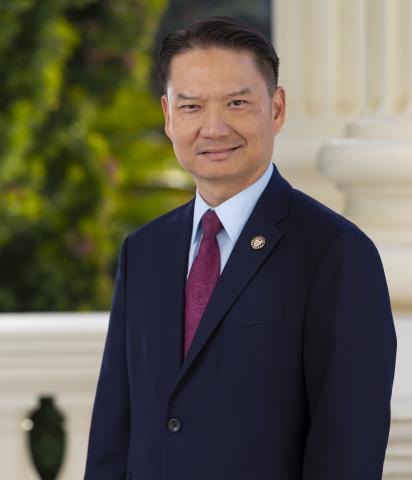
Existing law establishes the Medi-Cal program, which is administered by the State Department of Health Care Services and under which qualified low-income individuals receive health care services. The Medi-Cal program is in part governed by, and funded pursuant to, federal Medicaid program provisions. Existing law sets forth various procedures, including the submission of an application package, for provider enrollment, continuing enrollment, or enrollment at a new location or a change in location under the Medi-Cal program. Existing law requires an applicant or provider who is a natural person and is licensed or certificated under provisions relating to healing arts, the Osteopathic Initiative Act, or the Chiropractic Initiative Act, or is a professional corporation, to comply with the above-described procedures and to be enrolled in the Medi-Cal program as either an individual provider or as a rendering provider in a provider group for each application package that is submitted and approved. This bill would also apply the above-described provision to a nonprofit public benefit corporation that has been granted tax-exempt status and through which licensed providers enumerated in the Medicaid state plan provide nonspecialty mental health services, as specified.
This measure would call on the state's Representatives in Congress to continue to support investments in the federal Local Food for Schools and Child Care program and would call on the President of the United States to work with Congress to support family farmers who produce fresh, locally sourced food for school meals.
This California House Resolution declares September 2026 as Neonatal Intensive Care Unit (NICU) Awareness Month to highlight the challenges faced by families with newborns requiring extended hospital care. The bill notes that approximately 17,500 to 22,500 infants in the state experience NICU stays longer than two weeks each year, which can strain parental bonding and financial stability. It encourages individuals, businesses, and organizations to support parents in securing adequate time for bonding and home care after discharge. The resolution also directs copies of the text to be sent to the Governor and the Director of Employment Development for distribution.
California House Resolution 130 recognizes March 21, 2026, as the United Nations International Day for the Elimination of Racial Discrimination. The resolution cites historical context and current challenges in education, employment, criminal justice, and healthcare to highlight the impact of racial bias. It formally declares racism a public health crisis and commits the Assembly to actively participating in efforts to dismantle it.
SCR 7 is a Senate resolution (not a law) that formally acknowledges the health benefits of adopting permanent standard time instead of changing clocks for daylight saving time. It cites medical evidence linking biannual time changes to health issues like medical errors, heart attacks, and sleep disruption, particularly affecting shift workers and students. The resolution notes support from medical associations and references how Arizona, Hawaii, and other regions already use permanent standard time. It does not change timekeeping laws but urges consideration of permanent standard time as a health and safety measure.
Existing law establishes the Medi-Cal program, which is administered by the State Department of Health Care Services and under which qualified low-income individuals receive health care services through fee-for-service or managed care delivery systems. The Medi-Cal program is in part governed by, and funded pursuant to, federal Medicaid program provisions. Existing law provides for the licensure of hospice agencies by the State Department of Public Health to provide hospice services to an individual who is experiencing the last phase of life due to a terminal illness, as defined. Under existing law, hospice services are covered under the Medi-Cal program, subject to utilization controls and the availability of federal financial participation, as specified. The State Department of Health Care Services administratively requires, effective March 2, 2026, a hospice provider to use a certain online attestation form to notify the department when a Medi-Cal fee-for-service member has elected to receive hospice services, as specified. This bill would codify and recast those departmental procedures relating to the online form. The bill would require the hospice provider to submit the online form within 5 calendar days after the member's election to receive hospice services, and to submit the form in conjunction with counseling, receipt of informed consent, and completion of a separate election notice form, as specified. The bill would make these provisions applicable only to the Medi-Cal fee-for-service delivery system. In the case of Medi-Cal managed care, the bill would require a hospice provider to instead follow its assigned Medi-Cal managed care plan's submission requirements, as specified.
California House Resolution 128 designates October 23, 2026, as Aromatic L-Amino Acid Decarboxylase (AADC) Deficiency Awareness Day. The resolution aims to increase public and medical community awareness of this ultrarare genetic condition, which prevents the body from producing dopamine and causes severe developmental delays. By highlighting the challenges faced by patients and their caregivers, the bill encourages Californians to learn more about the disease to support earlier diagnosis and continued research into treatments.
California Assembly Resolution 131 proclaims October 11 through 17, 2026, as Student Cancer Education, Detection, and Prevention Week. The resolution encourages middle schools, high schools, colleges, public health agencies, pediatricians, and community health providers to promote educational campaigns on cancer prevention and detection. These efforts aim to inform students about risk factors, warning signs, and the importance of timely screenings to support better health outcomes for young people in the state.
Existing law provides for the licensure and regulation of health facilities, including general acute care hospitals, by the State Department of Public Health. Existing law authorizes a general acute care hospital to be approved to offer special services, including, among others, cardiac surgery. Existing regulation requires, when a general acute care hospital is providing cardiovascular operative service, that a minimum of 3 surgeons constitute a surgical team if the procedure requires extracorporeal bypass. This bill would require the department, on or before January 1, 2030, to update that regulation to reflect current professional standards of care relating to extracorporeal bypass surgery.
Existing law, the Knox-Keene Health Care Service Plan Act of 1975, provides for the licensure and regulation of health care service plans by the Department of Managed Health Care and makes a willful violation of the act a crime. Existing law also provides for the regulation of health insurers by the Department of Insurance. Existing law authorizes health care service plans and health insurers that cover prescription drugs to utilize reasonable medical management practices, including prior authorization and step therapy, consistent with applicable law. This bill would prohibit a health care service plan contract or a health insurance policy that is issued, amended, or renewed on or after January 1, 2027, from imposing step therapy as a prerequisite to authorizing coverage of any prescription drug used for the treatment of a serious mental illness or substance use disorder, as those terms are defined, except as specified. The bill would specify that the prohibition on step therapy does not apply when the United States Food and Drug Administration-labeled indications and usage of a drug indicate that some prior medication must be taken. Because a willful violation of this provision by a health care service plan would be a crime, the bill would impose a state-mandated local program. The California Constitution requires the state to reimburse local agencies and school districts for certain costs mandated by the state. Statutory provisions establish procedures for making that reimbursement. This bill would provide that no reimbursement is required by this act for a specified reason.