

Maddy summarySB 1441 would require school board elections in Arizona to be nonpartisan by removing political party designations from ballots for school district governing board candidates. The bill would amend election statutes to place school board candidates in a "Nonpartisan Ballot" section, listing their names without party labels or partisan titles. This change would directly affect all Arizona school districts and candidates running for school board positions by eliminating party affiliations from the ballot. The bill passed the legislature in April 2025 but was vetoed by the governor, so it did not become law.
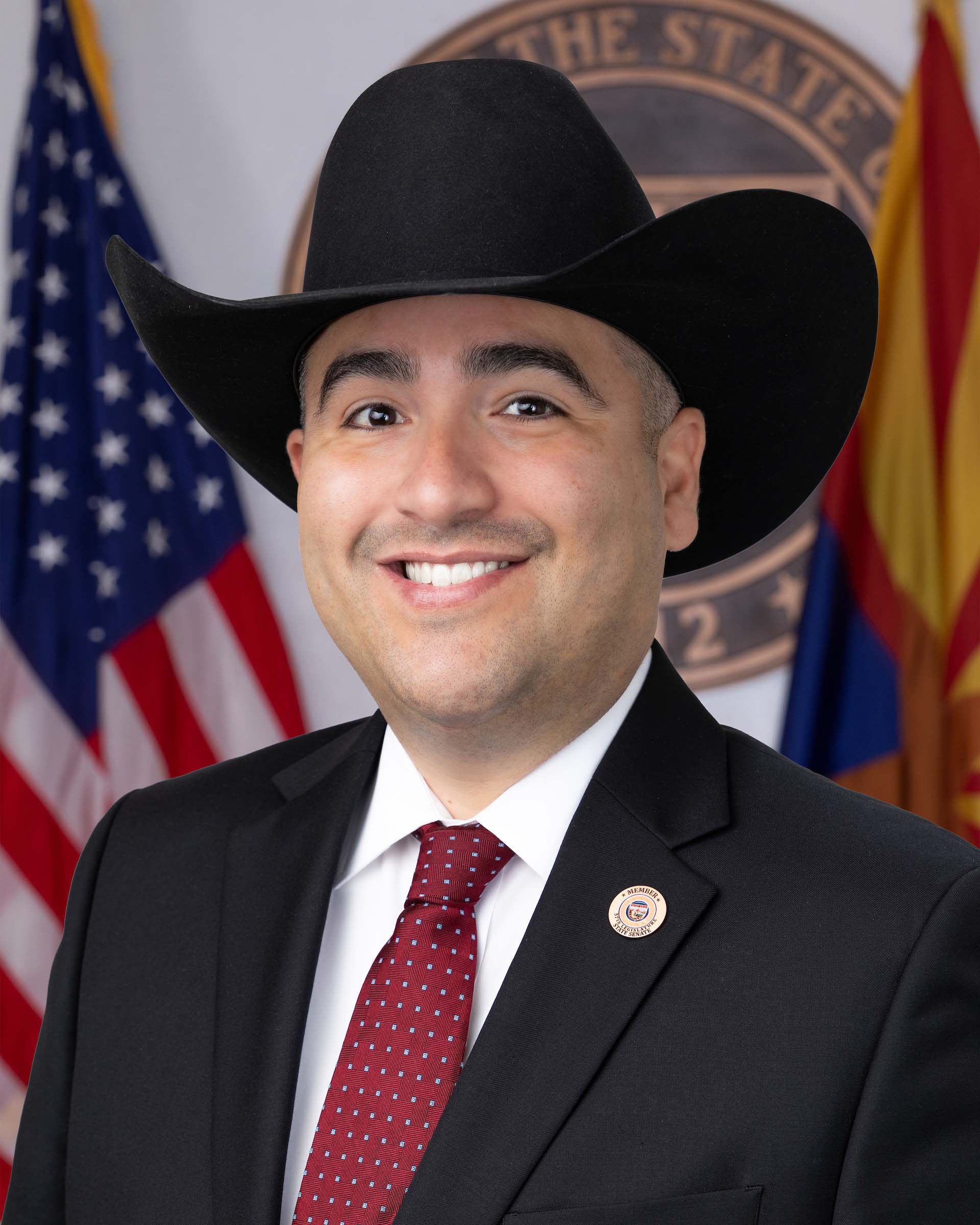
Sen. T.J. Shope
Sponsored bills
Maddy summarySB 1344 requires Arizona hospitals to screen newborns for specific congenital disorders and hearing loss, reporting results to the state Department of Health Services. The law establishes a statewide newborn screening program that includes all conditions on the federal recommended screening panel, maintains a confidential database of results, and provides follow-up services to connect families with care if issues are detected. It defines "newborn" as infants under 28 days and "infant" as up to two years old, and mandates health insurers to adjust hospital rates to cover screening costs. The program also creates an annual advisory committee to review screening best practices.
Maddy summarySB 1393 amends Arizona law to clarify water supply requirements for land developers selling or leasing new subdivisions in designated water management areas. It requires developers to obtain either a "certificate of assured water supply" from the state director or a written water service commitment from a designated city, town, or private water company before plat approval or land sales. The bill adds a technical correction allowing reduced water demand calculations for projects using approved gray water reuse systems, while exempting mineral extraction and industrial developments from these requirements. This directly affects land developers, local governments approving subdivisions, and water providers in Arizona's active management areas.
Maddy summarySB 1214 allows Arizona pharmacists to independently order, perform, and interpret specific health tests (like for flu, strep throat, or COVID-19) and initiate treatment for certain conditions without a doctor's direct order, under a statewide protocol approved by the Arizona State Board of Pharmacy. Pharmacists must use federally approved tests, follow evidence-based guidelines (like CDC recommendations), refer patients to primary care providers if treatment fails or isn't suitable, and notify primary care providers within 72 hours of treatment. The bill requires pharmacists to maintain detailed records for seven years, prohibit opioid treatments, obtain parental consent for minors, and inform patients that care is provided without physician oversight - recommending follow-up with a primary care provider.
Maddy summarySB 1134 sets strict time limits for Arizona agencies to review license applications, requiring written notices of completeness or deficiencies within defined periods. If deficiencies are found, the review process pauses until missing information is submitted, and applications deemed incomplete without timely notice are automatically considered complete. The bill also updates water supply certification rules for land developers, requiring a "certificate of assured water supply" from the Arizona Department of Water Resources (ADWR) before subdivided lands can be sold or leased in certain areas, unless a city/town or private water provider has an approved water commitment. Additionally, it allows reduced water demand calculations for projects using approved gray water systems, directly affecting developers, local governments, and water providers in active management areas.
Maddy summarySB 1437 requires school employees (including teachers, substitute teachers, and administrators) to immediately report suspected child abuse, neglect, or physical injury of minors they reasonably believe occurred. It expands mandatory reporting duties to cover school personnel who develop such reasonable beliefs during their employment, while maintaining exemptions for clergy confessions and accidental playground injuries during school hours. The law mandates immediate electronic or phone reports containing specific details (minor’s identity, nature of harm, etc.) to child safety authorities, and allows school staff to take photographs or arrange forensic interviews during investigations. It also clarifies that school administrators must report only if they believe a required reporter hasn’t already done so, and specifies that medical records must be shared confidentially with investigators upon written request.
Maddy summaryArizona's SB 1495 requires the state's National Guard to stay within Arizona unless Congress formally declares war or takes specific action under the U.S. Constitution (Article I, Section 8, Clause 15) to call the Guard for specific purposes like enforcing federal law or repelling invasion. The bill defines "active duty combat" as participating in armed conflict, performing hazardous duties related to conflict abroad, or using "instrumentality of war." It mandates the governor to ensure compliance with these requirements before deploying the Guard. This bill directly affects Arizona's National Guard deployment decisions and the governor's authority to release troops. The measure is procedural, focusing on constitutional requirements for Guard mobilization.
Maddy summaryHB 2456 appropriates $6.5 million from Arizona's general fund for a fire incident management grant program, directly funding municipal fire departments and fire districts. The bill requires grant recipients to use funds for secure technology systems that standardize incident command (including clear chains of command and shared terminology), enable real-time resource tracking, and allow secure communication and collaboration during emergencies - like sharing maps or managing mass casualty incidents. Grants fully cover the cost of these systems for three years, awarded on a first-come basis, with no more than $250,000 used for program administration. The system must work offline, support federal emergency management standards, and include features like firefighter safety monitoring and smartphone apps for responders.
Maddy summarySB 1124 creates a new role for "oral preventive assistants" in Arizona dental practices. To qualify, dental assistants must complete a 120-hour board-approved training course (including CPR and specific certifications) and work only under dentist or hygienist supervision (dentists may supervise up to three assistants). These assistants can only remove plaque and tartar on periodontally healthy patients or those with mild gingivitis, using specific tools and avoiding air polishing or medically complex cases. The bill requires dental boards to collect data on these assistants until 2028, after which the law expires. It directly affects dental assistants seeking this role, supervising dentists/hygienists, and patients receiving preventive dental services.
Maddy summarySB 1617 appropriates $49 million from the state general fund for the Arizona Department of Transportation (ADOT) to construct an overpass at Riggs Road and State Route 347, primarily affecting local commuters and traffic flow in that area. The bill reallocates $25 million originally designated for fiscal year 2020-2021 and $24 million for 2022-2023 (transferred from the highway fund) to fund the project in fiscal year 2025-2026. It modifies prior funding adjustments to ensure the overpass project receives full financial support from existing state funds. The legislation directly impacts ADOT's infrastructure planning and construction timeline for this specific transportation improvement.