

Maddy summarySB 1097 requires Arizona schools to close on election days, with teachers and staff attending in-service training instead of taking leave, while allowing school districts to provide time off for voting. It updates election rules to permit counties to establish voting centers (where any registered voter in the county can cast a ballot) and emergency voting centers for specific elections, with clear guidelines for location changes and voter identification. The bill also provides criteria for consolidating polling places when early voting patterns suggest reduced turnout at certain locations, mandating advance voter notifications about changes. These provisions directly affect voters, school districts, and county election boards by streamlining election logistics.
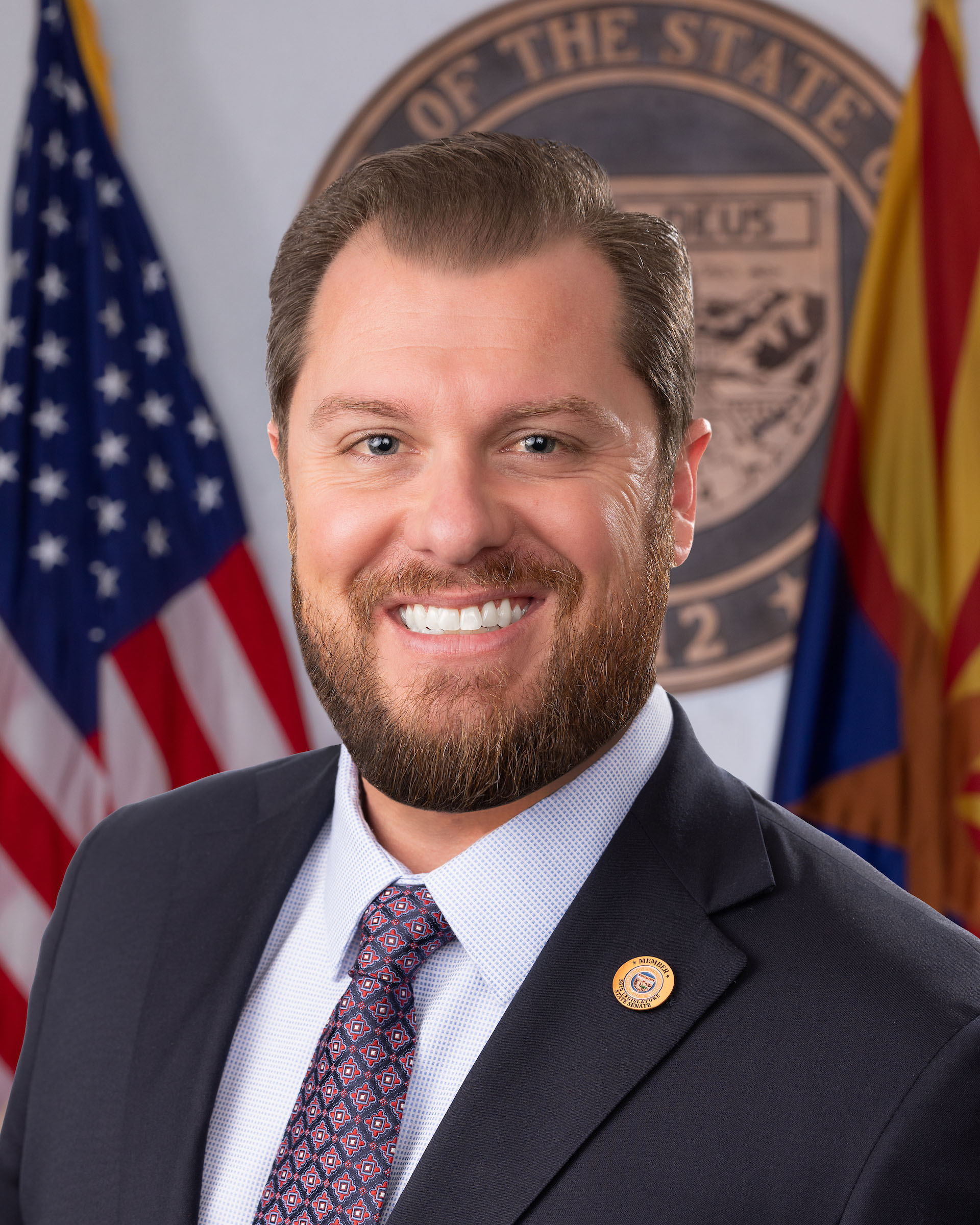
Sen. Jake Hoffman
Sponsored bills
Maddy summarySB 1091 requires Arizona school districts to hold voter-approved elections (override elections) when proposing budget increases exceeding state limits. It mandates that districts provide voters with a detailed informational pamphlet 35 days before the election, including the proposed budget amount, current budget, alternate budget, tax impact estimates for different property types, and balanced arguments for and against the increase (submitted with signed, sworn statements). The bill directly affects school districts needing budget approvals and voters deciding on tax increases. Key provisions include standardized pamphlet content, strict rules for public arguments, and clear disclosure of how proposed increases would be funded (e.g., property taxes vs. other revenue). The bill was passed by the legislature in May 2025 but vetoed by the Governor.
Maddy summarySB 1098 requires voters to present identification when dropping off early ballots at designated voting centers. The bill amends election law to allow voting centers (locations for election day voting) to also accept early ballots, mandating that the same identification rules apply as for in-person voting. This affects voters who use these centers for early ballot drop-off and election day voting, as well as election officials managing the centers. The bill also extends these identification requirements to emergency voting centers established during elections.
Maddy summarySB 1094 prohibits Arizona financial institutions, insurers, and credit reporting agencies from discriminating against consumers based on political affiliation or "social credit," environmental, social justice, or governmental scores. The bill requires these entities to fully disclose any subjective standards used in services before contracts are signed, while allowing refusal of service only for physical safety reasons. It directly affects consumers interacting with banks, insurance providers, and credit agencies in Arizona. The legislature states such discrimination threatens democratic foundations and public welfare, though the bill does not define or regulate the specific "scores" it references.
Maddy summarySB 1095 prohibits the use of federally recognized central bank digital currency (CBDC) as legal tender or for payments in Arizona, affecting all contracts, securities, and commercial transactions within the state. The bill amends escrow and trust laws to ban CBDC-backed transfers, requiring all payments to settle exclusively in U.S. dollars through traditional means like wire transfers or checks. It defines "legal tender" to exclude CBDC and explicitly states that distributed ledger technology transfers must maintain dollar-based value stability without CBDC backing. The bill passed the legislature on May 5, 2025, but was vetoed by the governor on May 12, 2025, so it remains unenforced.
Maddy summarySB 1088 requires Arizona cities, counties, and state agencies to comply with federal immigration laws and cooperate with U.S. Immigration and Customs Enforcement (ICE), Customs and Border Protection (CBP), and the Department of Homeland Security (DHS). It mandates that contracts with independent contractors include a clause voiding the agreement if the contractor violates these requirements. The bill also allows private citizens to sue for enforcement and permits the Attorney General to investigate local governments upon legislative request. These provisions are scheduled to expire on December 31, 2028.
Maddy summaryHB 2439 requires Arizona's Department of Health Services and health care system to post specific resources on their public website by December 1, 2025. It mandates links to agencies supporting pregnant women (excluding abortion providers) and creates a dedicated AdoptionOption.AZ.gov page listing adoption agencies, free ultrasounds, counseling, and adoption steps. The bill directs agencies to provide addresses, contact info, and multilingual resources for pregnancy support and adoption options. The legislation was passed by the Arizona legislature on April 29, 2025, but was vetoed by the Governor on May 6, 2025, preventing it from becoming law.
Maddy summarySB 1089 requires Arizona's Department of Transportation (ADOT) director to issue quarterly reports to legislative leaders about construction project contracts. The reports must disclose every instance where the lowest qualified bidder wasn't selected for a project and explain why. This bill directly affects state construction projects funded under ADOT's authority by increasing transparency in contract award decisions. The bill passed the legislature in April 2025 but was vetoed by the governor on May 2, 2025, preventing it from becoming law.
Maddy summarySB 1086 establishes performance standards for Arizona's transportation planning, requiring the Arizona Department of Transportation (ADOT) to prioritize specific metrics when selecting projects and allocating funds. For highway projects, it mandates weighting congestion reduction (40%) and mobility (40%) most heavily, with safety improvements (20%) as a secondary factor; for transit projects, it sets minimum ridership thresholds (70% of system average, or 50% for privately operated lines). The bill prohibits considering vehicle travel mile reduction targets and requires non-discriminatory application of these standards. It was passed by the legislature in April 2025 but vetoed by the Governor on May 2, 2025, preventing it from becoming law.
Maddy summarySB 1256 prohibits Arizona state agencies from using diversity, equity, and inclusion (DEI) programs for hiring, training, or promotion decisions, requiring employee participation in such programs, or making participation a condition of contracts. It mandates the state department to monitor hiring practices to ensure DEI programs aren't used in employment decisions and defines a "DEI program" as any activity justifying differential treatment based on protected characteristics like race or gender identity. The bill directly affects all state employees and agencies by banning the use of DEI initiatives in employment processes. The legislation passed the Arizona legislature in April 2025 but was vetoed by the Governor on May 2, 2025.