

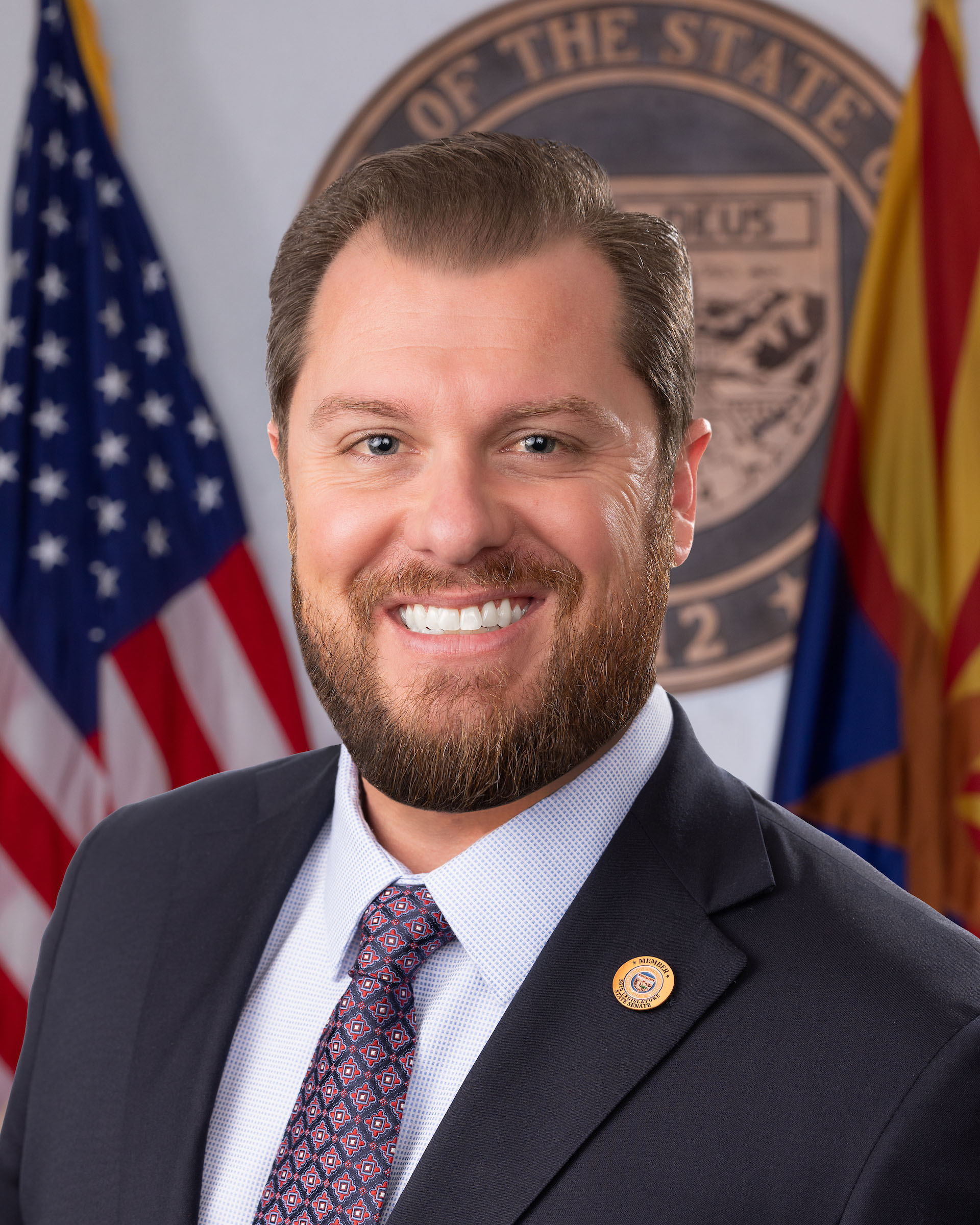
Photo of Jake Hoffman
R Arizona Senate · District 15 On the 2026 ballot

Sen. Jake Hoffman

Compare
Total votes
4,324
all sessions
Attendance
93%
306 missed
Near the chamber average
With party
75%
of cast votes
Lower than 100% of chamber peers
Bipartisan score
14%
some cross-party votes
Higher than 96% of chamber peers
Sponsored
307
bills & resolutions
Lower than 94% of chamber peers
Committees
3
assignments
307 bills and resolutions

Sponsored bills

Total
307
Primary
131
Co-sponsor
176
This page
307
matching current filters
Co-sponsor SCR 1054
Passed · Arizona Senate · Co-sponsor
Mark Brnovich; death resolution

Maddy summaryThis resolution honors the late Mark Brnovich, a former Arizona Attorney General who passed away in January 2026. It formally expresses the state legislature's regret over his death and extends condolences to his family and friends. The document does not create new laws or policies but serves as a ceremonial tribute to his public service career. It acknowledges his contributions as a prosecutor and government official without altering any legal provisions.

Passed Mar 3, 2026 1 co-sponsor
Primary SB 1569
In committee · Arizona Senate · Lead sponsor
special election boards; voter registration

Maddy summarySB 1569 modifies Arizona's election procedures to improve voting access for voters who are ill or have disabilities. It allows these voters to request in-person ballot delivery by a special election board (appointed with one member from each top political party in the state) instead of using mailed ballots, with requests due by 5:00 p.m. the Friday before an election. The bill also permits last-minute requests if voters become ill or hospitalized before election day, requiring a signed statement and ID. This directly affects eligible voters with temporary health issues and county election offices managing ballot delivery.

In committee Mar 3, 2026 0 co-sponsors
Primary SCR 1041
In committee · Arizona Senate · Lead sponsor
reporting; teacher salary increases; schools.

Maddy summarySCR 1041 is a referendum bill that would require charter schools to publicly report average teacher salaries annually, including year-over-year dollar and percentage increases. If approved by voters, it would establish a "teacher pay fund" using state land trust distributions to mandate base salary increases for eligible teachers in all school districts and charter schools, with increases applied uniformly regardless of experience. The bill also requires schools to submit detailed salary data to the state education department and prohibits reducing base salaries below 2026-2027 levels without corresponding budget adjustments. This measure directly affects public school employees and school districts, focusing on transparency and standardized salary increases funded through state resources.

In committee Feb 18, 2026 0 co-sponsors
Primary SB 1571
Introduced · Arizona Senate · Lead sponsor
school district budgets; two years

Maddy summarySB 1571 allows common school districts and high school districts with overlapping boundaries to form unified districts without requiring a public vote. It mandates that school boards provide property tax estimates to households for different home values before unification, ensures teachers’ salaries and experience are preserved in the new district, and establishes a five-member governing board with staggered terms (two members serving two-year terms initially). The bill also requires unified districts to maintain existing tax overrides until expiration and adjust student enrollment counts for state funding based on the combined districts. This affects school districts, teachers, and property owners in Arizona by changing how districts merge and manage budgets.

Introduced Feb 18, 2026 0 co-sponsors
Primary SB 1433
In committee · Arizona Senate · Lead sponsor
Maricopa county; division; new counties

Maddy summarySB 1433 amends Arizona statutes to redefine the boundaries of Gila, Maricopa, Pinal, and Yavapai counties using specific geographic descriptions. It details exact boundary lines through landmarks like city limits, rivers, and survey points (e.g., the Gila River, Interstate 10, and city boundaries). The bill directly affects residents and local governments within these counties by clarifying jurisdictional lines. This is a technical boundary adjustment, not a policy change, with no impact on services or laws beyond defining county limits.

In committee Feb 11, 2026 0 co-sponsors
Primary SB 1434
In committee · Arizona Senate · Lead sponsor
Maricopa county; new counties; division

Maddy summarySB 1434 proposes to redefine Maricopa County's boundaries in Arizona through detailed geographic descriptions, including specific survey points, rivers, and landmarks. It also creates two new counties - Hohokam County (with described boundaries) and Mogollon County (boundaries referenced but not fully detailed) - by dividing existing county areas. The bill primarily affects geographic jurisdiction within Maricopa, Pinal, and Gila counties, with no policy changes beyond boundary adjustments. This is a procedural boundary amendment, not a substantive policy bill, and remains in early legislative stages (Senate First Reading).

In committee Feb 11, 2026 0 co-sponsors
Primary SB 1570
Introduced · Arizona Senate · Lead sponsor
diversity; equity; inclusion; training; prohibition

Maddy summaryArizona's SB 1570 prohibits state agencies, boards, commissions, or departments from using diversity, equity, and inclusion (DEI) programs in hiring, training, or promotion decisions. It bans requiring employees to participate in DEI training or conditioning contracts on such participation. The bill defines a "DEI program" as any activity focusing on justifying differential treatment based on protected characteristics like race, gender, or sexual orientation. The state department must monitor hiring practices to ensure compliance. The bill was introduced in the Senate in 2026 but was withdrawn (W/D) after second reading.

Introduced Feb 5, 2026 0 co-sponsors
Co-sponsor HCR 2013
Passed · Arizona House · Co-sponsor
early ballots; deadlines; foreign money

Maddy summaryHCR 2013 is a proposed law requiring Arizona counties to verify voters' addresses before mailing early ballots and restricting foreign funding in election administration. It mandates that large counties (500,000+ population) require voters to confirm their address each election cycle via mail, phone, or online portal before receiving an early ballot, while smaller counties must do so every four years. The measure also prohibits government election administration from using funds from foreign governments or non-U.S. individuals, requiring vendors to certify annually they receive no such funds and imposing misdemeanor penalties for violations. This referendum failed to pass in June 2025 and would require voter approval to become law.

Passed Jun 25, 2025 1 co-sponsor
Primary SCR 1004
Passed · Arizona Senate · Lead sponsor
prohibit tax; monitoring; vehicle mileage

Maddy summaryThis constitutional amendment (SCR 1004) prohibits Arizona state and local governments from imposing taxes or fees based on vehicle miles driven, or enacting rules to monitor or limit miles traveled without a person's voluntary consent. It specifically bans policies like mileage-based road usage fees while allowing exceptions for interstate commercial vehicle fuel tax agreements and vehicles owned by government entities. If approved by voters, it would amend Arizona's constitution to block these measures. The bill passed both legislative chambers in 2025 and will now be submitted to voters for approval.

Passed Jun 16, 2025 0 co-sponsors
Co-sponsor HB 2700
Vetoed · Arizona House · Co-sponsor
academic standards; social studies; geography

Maddy summaryHB 2700 requires Arizona high school students to meet specific social studies standards for graduation, directly affecting all public high school students in the state. It mandates that geography instruction include "the gulf of America" and adds a civics test requirement: students must correctly answer at least 60 of 100 questions (for 2025 graduates) or 70 of 100 questions (for 2026+ graduates) on a test identical to the U.S. citizenship civics exam. Students in grades 7-8 may take the test early to satisfy the requirement without retaking it later in high school. The bill specifies that schools must document only "pass" or "fail" on transcripts for this test, with no other policy changes detailed in the provided text.

Vetoed May 13, 2025 1 co-sponsor
Showing 21 to 30 of 307 bills
Previous 1 2 3 4 31 Next