

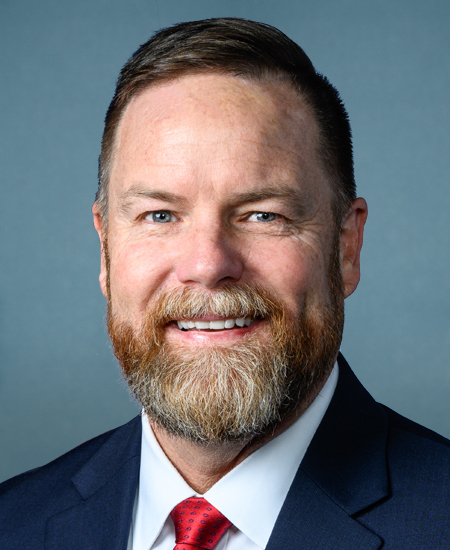
Photo of Aaron Bean
R United States House · District 4 · Florida On the 2026 ballot

Rep. Aaron Bean

Compare
Total votes
1,860
all sessions
Attendance
100%
6 missed
Higher than 97% of chamber peers
With party
92%
of cast votes
Lower than 89% of chamber peers
Bipartisan score
5%
crosses aisle rarely
Higher than 88% of chamber peers
Sponsored
458
bills & resolutions
Near the chamber average
Committees
4
assignments
458 bills and resolutions

Sponsored bills

Total
458
Primary
45
Co-sponsor
413
This page
458
matching current filters
Primary HR 8777
In committee · Alaska House · Lead sponsor
CUTS Act

Maddy summaryThis bill rescinds unspent funds from specific federal programs. It targets leftover money from pandemic relief (like the CARES Act and American Rescue Plan) and certain infrastructure initiatives (including education stabilization funds and transportation programs like the Congestion Mitigation Program). The rescission is limited to amounts already allocated for Israel, Ukraine, and Indo-Pacific security supplements under recent appropriations. Unspent funds must be returned to the Treasury, with no new spending created.

In committee Jun 18, 2024 0 co-sponsors
Co-sponsor HRES 1303
In committee · Alaska House · Co-sponsor
Condemning the Biden administration's politically motivated ban on liquefied natural gas exports to non-free trade agreement countries.

Maddy summaryHRES 1303 is a resolution passed by the U.S. House of Representatives on June 14, 2024, that condemns the Biden administration's suspension of pending approvals for liquefied natural gas (LNG) exports to countries without free trade agreements with the U.S. The resolution argues this action is politically motivated, citing studies showing economic benefits of LNG exports and noting that previous administrations conducted similar environmental reviews without halting permits. It calls for lifting the suspension to restore confidence in the energy sector, prioritize U.S. workers and communities, and align with the administration's stated goals of economic growth. As a non-binding resolution, it does not change policy but formally expresses congressional disapproval of the administration's approach.

In committee Jun 14, 2024 1 co-sponsor
Co-sponsor HR 8761
In committee · Alaska House · Co-sponsor
Ensuring Distance Education Act

Maddy summaryHR 8761, the Ensuring Distance Education Act, amends the Higher Education Act to clarify that revenue from distance education programs (offered wholly or partially online, regardless of location) counts toward the 90/10 rule. This directly affects colleges and universities that receive federal financial aid, as it changes how their revenue from online programs is calculated for compliance with the 90/10 rule. The key provision inserts a specific phrase into the law, explicitly including distance education funds in the calculation of the 90% revenue limit from federal aid. This ensures institutions cannot avoid the 90/10 rule by shifting programs online. The bill does not create new programs or alter funding levels, only clarifies existing revenue treatment.

In committee Jun 14, 2024 1 co-sponsor
Co-sponsor HR 7984
Passed · Alaska House · Co-sponsor
Rural Small Business Resilience Act

Maddy summaryThe Rural Small Business Resilience Act requires the Small Business Administration (SBA) to ensure rural disaster victims have full access to existing disaster assistance within one year of the law's passage. It directly affects small business owners and individuals in rural areas (as defined by the Small Business Act) who live in regions with federally declared disasters. The key provision mandates the SBA to provide targeted outreach and marketing materials to these rural residents to overcome barriers in accessing current disaster aid programs. This is a concrete policy change to improve access to existing resources, not a new funding program.

Passed Jun 12, 2024 1 co-sponsor
Co-sponsor HR 537
Passed · Alaska House · Co-sponsor
Forgotten Heroes of the Holocaust Congressional Gold Medal Act

Maddy summaryHR 537 authorizes a Congressional Gold Medal to honor 60 diplomats who saved Jewish lives during the Holocaust by issuing visas and passports against their governments' orders, risking expulsion and personal danger. The medal will be presented to the next of kin of these diplomats, alongside representatives from their home countries, and permanently displayed at the United States Holocaust Memorial Museum. The bill also permits the sale of bronze duplicates to cover production costs, with proceeds going to the U.S. Mint. This legislation recognizes the diplomats' humanitarian actions without creating new government programs or altering existing laws.

Passed Jun 12, 2024 1 co-sponsor
Co-sponsor HJRES 166
In committee · Alaska House · Co-sponsor
Providing for congressional disapproval under chapter 8 of title 5, United States Code, of the rule submitted by the Department of Labor relating to "Defining and Delimiting the Exemptions for Executive, Administrative, Professional, Outside Sales, and Computer Employees".

Maddy summaryHJRES 166 is a joint resolution seeking congressional disapproval of a Department of Labor rule that would have changed overtime exemption standards for certain salaried workers. The rule, published in April 2024, aimed to redefine how executive, administrative, professional, outside sales, and computer employees are classified for overtime pay under federal law. If enacted, this resolution would block the rule from taking effect, preserving the existing classification system for these workers.

In committee Jun 5, 2024 1 co-sponsor
Co-sponsor HR 5403
Passed · Alaska House · Co-sponsor
CBDC Anti-Surveillance State Act

Maddy summaryHR 5403, the CBDC Anti-Surveillance State Act, prohibits the Federal Reserve from issuing or facilitating central bank digital currency (CBDC) directly or indirectly to individuals through financial institutions. It specifically bans Federal Reserve banks from offering digital products to individuals, maintaining individual accounts, or using CBDC for monetary policy implementation. The bill also clarifies that its restrictions do not apply to existing physical cash or private, permissionless digital payment systems. This bill directly affects the Federal Reserve's ability to develop or deploy a government-run digital dollar. The law aims to prevent the Federal Reserve from creating a digital currency that could enable transaction tracking or government oversight of personal financial activity.

Passed Jun 3, 2024 1 co-sponsor
Co-sponsor HR 895
In committee · Alaska House · Co-sponsor
Combating Organized Retail Crime Act of 2023

Maddy summaryHR 895, the Combating Organized Retail Crime Act of 2023, expands federal law to better prosecute organized retail theft by amending sections 2314 and 2315 of Title 18. It clarifies that crimes involving stolen goods valued at $5,000 or more over 12 months - including retail theft - can be prosecuted under existing federal statutes, and broadens definitions to include goods taken via "any facility of interstate or foreign commerce." The bill also creates a new Organized Retail Crime Coordination Center within Homeland Security, requiring it to coordinate federal, state, and local law enforcement efforts, share threat information with retailers, and produce annual public reports on trends. This directly affects law enforcement agencies, retailers, and criminal justice systems by standardizing prosecution thresholds and enhancing interagency collaboration.

In committee May 23, 2024 1 co-sponsor
Co-sponsor HJRES 138
In committee · Alaska House · Co-sponsor
Providing for congressional disapproval under chapter 8 of title 5, United States Code, of the rule submitted by the Centers for Medicare & Medicaid Services relating to "Clarifying the Eligibility of Deferred Action for Childhood Arrivals (DACA) Recipients and Certain Other Noncitizens for a Qualified Health Plan through an Exchange, Advance Payments of the Premium Tax Credit, Cost-Sharing Reductions, and a Basic Health Program".

Maddy summaryHJRES 138 is a joint resolution seeking congressional disapproval of a Centers for Medicare & Medicaid Services (CMS) rule that would have clarified eligibility for health insurance subsidies under the Affordable Care Act for Deferred Action for Childhood Arrivals (DACA) recipients and certain noncitizens. The rule, submitted on May 8, 2024, aimed to allow these individuals to access premium tax credits, cost-sharing reductions, and health plans through ACA marketplaces. This resolution, if enacted, would block the rule from taking effect under the Congressional Review Act, directly preventing DACA recipients and the specified noncitizens from qualifying for these benefits. The bill does not create new policy but halts an existing regulatory clarification.

In committee May 17, 2024 1 co-sponsor
Co-sponsor HJRES 147
In committee · Alaska House · Co-sponsor
Providing for congressional disapproval under chapter 8 of title 5, United States Code, of the rule submitted by the Occupational Safety and Health Administration relating to "Worker Walkaround Representative Designation Process".

Maddy summaryHouse Joint Resolution 147 seeks to disapprove an Occupational Safety and Health Administration (OSHA) rule that would have established a process for workers to designate a representative to accompany OSHA inspectors during workplace safety inspections. The rule, published in the Federal Register on April 1, 2024, aimed to formalize this "walkaround" representative process during inspections. Under a federal disapproval procedure (Chapter 8 of Title 5, U.S. Code), this resolution would invalidate the rule if passed. As a result, the designated representative process would not take effect, meaning OSHA inspections would proceed without this specific worker representation mechanism.

In committee May 16, 2024 1 co-sponsor
Showing 301 to 310 of 458 bills
Previous 1 30 31 32 46 Next