

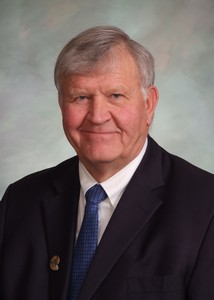
Photo of Lloyd Larsen
R Wyoming House · District 54 On the 2026 ballot

Rep. Lloyd Larsen

Compare
Total votes
3,093
all sessions
Attendance
98%
45 missed
Near the chamber average
With party
81%
of cast votes
Lower than 97% of chamber peers
Bipartisan score
11%
some cross-party votes
Higher than 93% of chamber peers
Sponsored
174
bills & resolutions
Near the chamber average
Committees
3
assignments
174 bills and resolutions

Sponsored bills

Total
174
Primary
59
Co-sponsor
115
This page
174
matching current filters
Co-sponsor HB 149
Introduced · Wyoming House · Co-sponsor
Home school prohibition-parents with convictions.

Maddy summaryHB 149 prohibits individuals convicted of specific offenses against minors or under investigation for child abuse/neglect from administering home-based educational programs in Wyoming. It bans parents/guardians with recent convictions (within 7 years) for offenses like child abuse, sexual assault, or crimes involving minors (as listed in subsection 21-4-102(b)(i)), unless the conviction was reversed, annulled, or pardoned. The bill also restricts anyone advised by child protective services not to start home schooling during an active abuse/neglect investigation. Parents already running home schools before an investigation may continue, but must appeal restrictions through administrative hearings if challenged.

Introduced Feb 14, 2026 1 co-sponsor
Co-sponsor HB 192
Introduced · Wyoming House · Co-sponsor
DUI penalties-refusal of a chemical test.

Maddy summaryWyoming's HB 192 proposes changes to penalties for drivers who refuse chemical tests after a DUI arrest when a search warrant has been obtained. The bill increases penalties for refusal to include up to six months in jail, a $750 fine, and mandatory license suspension (30 days to one year) for all drivers, including those under 21 and commercial drivers. It also allows refusal to be used as evidence in court and requires offenders to complete substance use disorder assessments and treatment at their own expense. The bill would take effect on July 1, 2026, if passed.

Introduced Feb 14, 2026 1 co-sponsor
Co-sponsor HB 173
Introduced · Wyoming House · Co-sponsor
Juvenile discipline-parental obligations.

Maddy summaryWyoming's HB 173 amends laws to increase parental responsibility for minors' actions. It allows property owners (including schools) to seek up to $5,000 in damages from parents if a child aged 10-17 maliciously damages property. Parents who fail to comply with court orders regarding juvenile discipline may face fines up to $1,000 or 120 days in jail. The bill also requires parents to post bonds of up to $1,000 if their lack of supervision directly causes a juvenile's delinquent behavior, with forfeited funds first covering damages and then going to school districts or county treasuries. The law would take effect July 1, 2026.

Introduced Feb 14, 2026 1 co-sponsor
Co-sponsor HB 74
Failed · Wyoming House · Co-sponsor
Public schools to provide feminine hygiene products.

Maddy summaryHB 74 requires Wyoming public school districts to provide free feminine hygiene products (like tampons and pads) in restrooms designated exclusively for female students, starting with the 2026-2027 school year. It directly affects schools serving students in grades 6-12, mandating that districts ensure these products are available, accessible, and that students are informed of their location. The bill appropriates $487,500 to reimburse schools based on actual costs, with limits of $1,100 per 100 female students for 2026-2027 and $850 per 100 for 2027-2028. The bill is pending (failed introduction on Feb. 11, 2026) and would take effect July 1, 2026, if enacted.

Failed Feb 11, 2026 1 co-sponsor
Co-sponsor HB 279
Signed into law · Wyoming House · Co-sponsor
Property tax exemptions-order of application.

Maddy summaryHB 279 clarifies the order in which multiple property tax exemptions apply to a single property in Wyoming. It requires the Department of Revenue to apply exemptions sequentially: percentage-based exemptions (like senior citizen discounts) must be applied from smallest to largest percentage, while non-percentage exemptions (like homestead exclusions) come after. This affects property owners who qualify for more than one exemption, ensuring consistent application without conflicting reductions. The bill does not change existing exemptions but mandates a specific, transparent process for their combined use. It takes effect immediately upon becoming law.

Signed into law Mar 17, 2025 1 co-sponsor
Co-sponsor SF 153
Failed · Wyoming House · Co-sponsor
Residential real property-taxable value.

Maddy summaryThis bill establishes a uniform 9.5% property tax rate for all residential real property in Wyoming, including owner-occupied primary residences, single-family homes, condos, mobile homes, and related land (up to 35 acres). It defines "owner occupied primary residence" as property where the owner lives at least six months annually and clarifies "residential real property" to include dwellings for up to four families. The change applies to all residential property classes, replacing prior differentiated rates, and takes effect for tax year 2025. It directly affects Wyoming homeowners and property assessors by standardizing the tax calculation method.

Failed Mar 6, 2025 1 co-sponsor
Co-sponsor SF 100
Signed into law · Wyoming House · Co-sponsor
Child witnesses-courtroom procedures.

Maddy summarySF 100 allows children under 16 who are victims of incest, sexual assault, human trafficking, or certain violent crimes to testify remotely in court to reduce emotional distress. The court must hold a hearing and find that in-person testimony would cause more than minimal distress before permitting remote testimony, which uses closed-circuit technology to let the child testify separately from the defendant and jury. The bill also requires courts to provide accommodations like breaks, a supportive adult present (not a witness), or a therapeutic dog to help the child feel comfortable during testimony. It ensures defendants maintain real-time communication with their attorney during the child’s testimony and may exclude the jury from the child’s testimony room if needed. The law takes effect July 1, 2025.

Signed into law Mar 6, 2025 1 co-sponsor
Co-sponsor HB 122
Signed into law · Wyoming House · Co-sponsor
Senior citizen service districts-authorization and renewal.

Maddy summaryHB 122 amends Wyoming law governing senior citizen service districts by changing how mill levies for these districts are renewed. It requires counties to submit renewal mill levy propositions to voters every four years (starting two years after initial approval) instead of the previous timeline, and specifies that levies continue until voters approve rescission. To end a levy, county commissioners must either adopt a rescission resolution or receive a verified petition signed by at least 15% of voters who participated in the last general election. This bill directly affects counties operating senior service districts and their residents who vote on funding renewals. (Effective July 1, 2025)

Signed into law Mar 4, 2025 1 co-sponsor
Co-sponsor HB 300
died · Wyoming House · Co-sponsor
Electrical generation tax.

Maddy summaryHB 300 imposes a 3.5% tax on electricity producers in Wyoming, effective January 1, 2026, based on their annual gross energy earnings from electricity generated within the state. It directly affects utility companies and power generators, while exempting electricity produced by the federal or state government and small personal use (under 500 kWh daily). Producers must report annual revenue by February 1 and pay the tax by the same deadline, with penalties of 5% per 30 days for late filing. The tax revenue will be collected by the Wyoming Department of Revenue and distributed per the bill’s provisions.

died Mar 4, 2025 1 co-sponsor
Co-sponsor SF 87
died · Wyoming House · Co-sponsor
Prescriptive easement for electricity delivery.

Maddy summaryThis bill establishes a legal process for electric utilities to gain a prescriptive easement (a legal right to use land) for power lines after five years of continuous, uninterrupted use without landowner permission. It directly affects landowners whose property is used for power lines and electric utilities that maintain delivery systems. Key provisions require utilities to provide 30 days' written notice to landowners before recording the easement, maintain the system while minimizing disruption (including 72-hour notice for temporary infrastructure removal), and compensate landowners for direct damages. The easement width must match industry standards for safe operation, and the law explicitly states it doesn’t override existing easements or property rights.

died Mar 3, 2025 1 co-sponsor
Showing 11 to 20 of 174 bills