

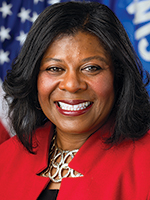
Photo of LaTonya Johnson
D Wisconsin Senate · District 6

Sen. LaTonya Johnson

Compare
Total votes
695
all sessions
Attendance
96%
31 missed
Near the chamber average
With party
98%
of cast votes
Near the chamber average
Bipartisan score
1%
crosses aisle rarely
Near the chamber average
Sponsored
1,105
bills & resolutions
Near the chamber average
Committees
5
assignments
1,105 bills and resolutions

Sponsored bills

Total
1,105
Primary
1,105
Co-sponsor
0
This page
1,105
matching current filters
Primary SB 619
Failed · Wisconsin Senate · Lead sponsor
Relating to: electronic copies of operators’ licenses and identification cards. (FE)

Maddy summarySB 619 allows drivers and ID card holders to obtain electronic copies of their license or ID card from the department. It requires the department to issue these electronic copies for a $10 fee, while permitting drivers to display them on phones or devices during traffic stops. The bill ensures officers can only view the license/ID image, not other phone content, and specifies that the $10 fee applies only to electronic copies (not physical duplicates). This directly affects individuals who choose to use digital versions of their license or ID instead of physical cards. The law creates new fee structures and privacy protections for electronic document display.

Failed Mar 23, 2026 0 co-sponsors
Primary SB 568
Failed · Wisconsin Senate · Lead sponsor
Relating to: payments for pupils who withdraw from a parental choice program, the Special Needs Scholarship Program, or an independent charter school. (FE)

Maddy summarySB 568 changes how leftover scholarship funds are handled when students leave private school choice programs or charter schools. If a student withdraws mid-year from a Parental Choice Program, Special Needs Scholarship Program, or independent charter school and enrolls in a public school district, the state must pay the remaining scholarship amount to that public district instead of the original private school or charter operator. This applies to all covered programs and ensures public school districts receive funds for students who switch during the school year. The bill takes effect July 1, 2026.

Failed Mar 23, 2026 0 co-sponsors
Primary SB 605
Failed · Wisconsin Senate · Lead sponsor
Relating to: housing and homelessness; emergency rental assistance program; indigent civil legal services; workforce development; community action agencies; poverty reports; mental health; economic security; reimbursement for nonemergency medical transportation services; urban mass transit aid; lead exposure and abatement services; lead service line replacement; providing an exemption from emergency rule procedures; granting rule-making authority; and making an appropriation. (FE)

Maddy summarySB 605 restructures funding for multiple social services programs. It creates a new lead service line replacement program for public water systems, establishes an emergency rental assistance program for households earning ≤80% of county median income (with $5 million allocated for 2026-27), and expands indigent civil legal services funding by $43 million annually. The bill also mandates annual reports on improving homeless services access and creates new grants for housing support, workforce development, and internet assistance programs. These changes directly affect low-income residents, homeless individuals, and legal aid clients through specific funding allocations and program requirements.

Failed Mar 23, 2026 0 co-sponsors
Primary SB 598
Failed · Wisconsin Senate · Lead sponsor
Relating to: coverage under the Medical Assistance program for incarcerated individuals. (FE)

Maddy summarySB 598 would require the state health department to seek a federal Medicaid waiver enabling coverage for incarcerated individuals in the Medical Assistance program (state Medicaid) up to 90 days before release. It specifically covers case management, medication-assisted treatment for substance use disorders, and a 30-day supply of prescription medications for those already eligible for Medical Assistance. If approved, the federal government would fund the program’s share of these services, with the state covering its portion. This bill directly affects incarcerated individuals transitioning to community care, aiming to improve continuity of health services upon release.

Failed Mar 23, 2026 0 co-sponsors
Primary SB 644
Failed · Wisconsin Senate · Lead sponsor
Relating to: prohibiting individuals under age 21 from accessing intoxicating hemp products and providing a penalty. (FE)

Maddy summarySB 644 prohibits the sale of intoxicating hemp products to anyone under age 21. It defines "intoxicating hemp products" as those containing specific cannabinoids (like delta-8 or delta-9 THC) above 0.3% concentration in solids or 1mg per 12oz beverage. The bill requires manufacturers to test products, provide certificates of analysis via QR codes, and package products in child-resistant, tamper-evident containers with clear age warnings and ingredient labels. Retailers must verify ages, display age restriction signs, and avoid vending machines accessible to minors. This directly affects hemp product manufacturers, retailers, and consumers under 21 in the state.

Failed Mar 23, 2026 0 co-sponsors
Primary SB 664
Failed · Wisconsin Senate · Lead sponsor
Relating to: reducing the eligibility threshold to claim the veterans and surviving spouses property tax credit. (FE)

Maddy summarySB 664 lowers the disability rating requirement for veterans and surviving spouses to qualify for the state property tax credit. Previously, claimants needed a 100% service-connected disability rating; this bill reduces that threshold to 70% or higher. It also creates a new provision allowing the credit amount to be calculated as a percentage of the full credit based on the veteran's actual disability rating (e.g., a 70% rating would yield 70% of the full credit). The bill directly affects veterans and surviving spouses with service-connected disabilities rated between 70% and 99%, who now qualify for a proportional tax credit. The change applies to taxable years beginning in the year the bill takes effect.

Failed Mar 23, 2026 0 co-sponsors
Primary SB 642
Failed · Wisconsin Senate · Lead sponsor
Relating to: creating a landlord fire prevention grant program, granting rule-making authority, and making an appropriation. (FE)

Maddy summarySB 642 creates a program providing grants to residential landlords for fire safety upgrades, including installing sprinklers and fire extinguishers in rental properties. Landlords can receive grants covering up to 50% of eligible costs, with a total program cap of $10 million. Grants are awarded on a first-come, first-served basis, and the Department of Insurance will establish eligibility rules and application procedures. The $10 million funding is allocated from a new budget appropriation for the 2025-26 fiscal year.

Failed Mar 23, 2026 0 co-sponsors
Primary SB 574
Failed · Wisconsin Senate · Lead sponsor
Relating to: funding for the supplemental food program for women, infants and children during the federal government shutdown and making an appropriation. (FE)

Maddy summarySB 574 creates a state funding mechanism to maintain Wisconsin's WIC (Women, Infants, and Children) program benefits during federal government shutdowns. It requires the Department of Health Services to continue providing WIC benefits at pre-shutdown levels if federal funding lapses, specifically referencing the October 1, 2025 funding gap. The bill ensures uninterrupted access to nutrition support for low-income pregnant women, new mothers, infants, and young children who rely on WIC. This temporary provision expires on October 1, 2026, and is repealed upon federal funding restoration. The measure directly affects WIC participants and state budgeting during federal funding interruptions.

Failed Mar 23, 2026 0 co-sponsors
Primary SB 264
Signed into law · Wisconsin Senate · Lead sponsor
Relating to: coverage of breast cancer screenings by the Medical Assistance program and health insurance policies and plans. (FE)

Maddy summarySB 264 requires health insurance plans and the Medical Assistance program to cover specific breast cancer screenings without out-of-pocket costs for enrollees. It defines two key types of screenings: "diagnostic breast examinations" (used to evaluate symptoms or abnormalities, like mammograms) and "supplemental breast screening examinations" (for high-risk individuals without symptoms, using MRI or ultrasound). The bill prohibits cost-sharing (such as copays) for all diagnostic screenings and for the first supplemental screening per year, while allowing limited cost-sharing for additional supplemental screenings in the same year. This directly affects individuals with health insurance or Medical Assistance who require these screenings, particularly those at higher risk for breast cancer.

Signed into law Mar 19, 2026 0 co-sponsors
Primary SB 466
Signed into law · Wisconsin Senate · Lead sponsor
Relating to: age for the issuance of a Missing Child Alert.

Maddy summarySB 466 raises the age threshold for issuing a Missing Child Alert from under 10 to under 12 years. It directly affects minors aged 10 or 11 who go missing and are deemed unable to return home without assistance due to a disability or condition. The bill amends statute 175.51(1m)(a)2 to change the age requirement from "not attained the age of 10 years" to "not attained the age of 12 years." This adjustment ensures children in this age group qualify for alerts when their safety is at risk. The change applies to alerts issued when a minor's location is unknown and other alert criteria aren't met.

Signed into law Mar 9, 2026 0 co-sponsors
Showing 251 to 260 of 1,105 bills
Previous 1 … 25 26 27 … 111 Next