

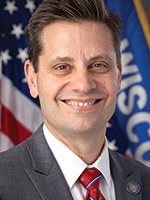
Photo of Chris Kapenga
R Wisconsin Senate · District 33 On the 2026 ballot

Sen. Chris Kapenga

Compare
Total votes
595
all sessions
Attendance
100%
2 missed
Near the chamber average
With party
91%
of cast votes
Lower than 97% of chamber peers
Bipartisan score
5%
crosses aisle rarely
Higher than 93% of chamber peers
Sponsored
279
bills & resolutions
Near the chamber average
Committees
3
assignments
279 bills and resolutions

Sponsored bills

Total
279
Primary
279
Co-sponsor
0
This page
279
matching current filters
Primary SB 242
Failed · Wisconsin Senate · Lead sponsor
Relating to: required ratio of journeyworkers to apprentices in apprenticeship programs and contracts.

Maddy summarySB 242 sets a maximum ratio of one journeyworker (skilled tradesperson) for every two apprentices in apprenticeship programs and contracts. It prohibits state agencies from requiring a stricter ratio (e.g., more journeyworkers per apprentice) through rules, program approvals, or contracts. The bill directly affects apprenticeship programs, contractors, and unions operating under collective bargaining agreements. It takes effect when existing collective bargaining agreements expire or are renewed, modifying how these agreements must align with the new ratio standard.

Failed Mar 23, 2026 0 co-sponsors
Primary SB 384
Passed · Wisconsin Senate · Lead sponsor
Relating to: requirements for children born alive following abortion or attempted abortion and providing a penalty.

Maddy summarySB 384 requires health care providers to provide the same standard of care and immediate hospital transport for any child born alive after an abortion or attempted abortion, as they would for any newborn of the same gestational age. Violating these requirements is a Class H felony, but the mother cannot be prosecuted for the incident. The bill also allows affected women to seek triple the cost of the abortion as civil damages, plus attorney fees, while protecting their identity through court confidentiality orders. It explicitly states the law does not create or recognize a right to abortion.

Passed Mar 23, 2026 0 co-sponsors
Primary SJR 94
Failed · Wisconsin Senate · Lead sponsor
Relating to: prohibiting governmental entity discrimination (second consideration).

Maddy summarySJR 94 proposes adding Section 27 to the state constitution to prohibit government agencies from discriminating against or giving preferential treatment to individuals or groups based on race, sex, color, ethnicity, or national origin. This would apply to public employment, education, contracting, and administration. The bill is a constitutional amendment requiring voter approval, with a ballot question scheduled for the November 2026 election. If approved by voters, it would create a new constitutional standard for state and local government actions. This is a second legislative attempt to submit this amendment to voters after a prior proposal in 2023.

Failed Mar 23, 2026 0 co-sponsors
Primary SJR 88
Passed · Wisconsin Senate · Lead sponsor
Relating to: honoring the life and legacy of Charlie Kirk.

Maddy summarySJR 88 is a symbolic resolution honoring Charlie Kirk, founder of Turning Point USA, following his assassination. It expresses the Wisconsin Legislature's gratitude for his dedication to "faith, liberty, and truth," his work inspiring young Americans, and his commitment to family. The resolution commends his legacy as a "beacon of conviction and courage" and joins in prayer for his family and the nation. As a commemorative measure, it has no binding policy changes or direct impact on constituents.

Passed Mar 23, 2026 0 co-sponsors
Primary SB 151
Failed · Wisconsin Senate · Lead sponsor
Relating to: requests for information from employers about unemployment insurance claims.

Maddy summarySB 151 requires employers to respond in writing to unemployment insurance agencies' requests about benefit claims within 12 business days. It directly affects employers who receive unemployment claims filed against them, giving them a clear deadline to provide information on eligibility disputes. The bill also clarifies that agencies may directly seek information from employees about their eligibility, employment, or wages. This change streamlines the process for verifying claims by setting a specific timeframe for employer responses, starting for claims filed after the bill's effective date.

Failed Mar 23, 2026 0 co-sponsors
Primary SB 452
Failed · Wisconsin Senate · Lead sponsor
Relating to: pupil eligibility for parental choice programs based upon participation by a sibling or a dependent child of the pupil's parent or guardian. (FE)

Maddy summarySB 452 would expand eligibility for Wisconsin's private school choice programs to students whose siblings or younger dependent children (e.g., younger siblings) attended participating private schools the previous year. Currently, only students themselves must have attended such schools to qualify. The bill applies to students in grades K-12 outside city school districts (under Section 118.60) and within cities (under Section 119.23). It would take effect for the 2026-27 school year.

Failed Mar 23, 2026 0 co-sponsors
Primary SB 600
Failed · Wisconsin Senate · Lead sponsor
Relating to: participating in the federal tax credit program for contributions to scholarship granting organizations.

Maddy summarySB 600 would enable Wisconsin to participate in a federal tax credit program that allows individuals to deduct contributions to scholarship granting organizations (SGOs) from their state taxes. The bill requires the state education department to annually submit a list of qualifying SGOs meeting federal standards and certify Wisconsin's eligibility to the U.S. Treasury. It gives the governor until July 1, 2026, to decide whether to join the program, which would take effect for tax years beginning after December 31, 2026. The bill does not create new tax benefits but establishes the state's administrative process to align with the federal program.

Failed Mar 23, 2026 0 co-sponsors
Primary SB 555
Failed · Wisconsin Senate · Lead sponsor
Relating to: zero-based biennial budget requests by executive branch agencies. (FE)

Maddy summarySB 555 requires Wisconsin's executive branch agencies to submit biennial budget requests using "zero-based budgeting" for 20% of agencies each fiscal biennium, starting in 2027-29. This means agencies must justify every budget line item based on current needs and goals, rather than relying on previous funding levels. The bill also mandates that agencies analyze whether past appropriations met their intended goals and explain any shortfalls, with these reports posted online. It directly affects all state executive agencies submitting budget requests, shifting how they justify spending. The changes take effect for the 2027-29 budget cycle.

Failed Mar 23, 2026 0 co-sponsors
Primary SJR 4
Failed · Wisconsin Senate · Lead sponsor
Relating to: the freedom to gather in places of worship during a state of emergency (second consideration).

Maddy summarySJR 4 proposes a constitutional amendment to protect religious gatherings during emergencies. It would amend the state constitution to prohibit state or local governments from closing places of worship or banning gatherings there during a declared state of emergency, including public health crises. This directly affects religious organizations and government entities with emergency authority. The amendment requires voter approval in the November 2026 election, with the ballot question asking if the constitution should be changed to prevent closures of places of worship during emergencies. It is a proposed constitutional change, not a law.

Failed Mar 23, 2026 0 co-sponsors
Primary SB 467
Passed · Wisconsin Senate · Lead sponsor
Relating to: local wheel tax referenda. (FE)

Maddy summarySB 467 requires municipalities and counties to hold voter referendums before imposing or continuing local annual registration fees on motor vehicles kept within their boundaries. The bill mandates that new fees must be approved by a majority of voters in a regular election, with the referendum question specifying the fee amount. For existing fees implemented before the law's effective date, a referendum must be held within 18 months, allowing voters to decide whether to continue the fee. This directly affects local governments seeking to collect such fees and vehicle owners in those jurisdictions.

Passed Mar 23, 2026 0 co-sponsors
Showing 31 to 40 of 279 bills
Previous 1 3 4 5 28 Next