

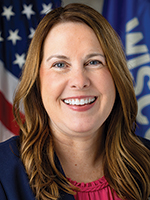
Photo of Dianne Hesselbein
D Wisconsin Senate · District 27 On the 2026 ballot

Sen. Dianne Hesselbein

Compare
Total votes
802
all sessions
Attendance
100%
of floor votes
Near the chamber average
With party
98%
of cast votes
Near the chamber average
Bipartisan score
1%
crosses aisle rarely
Near the chamber average
Sponsored
1,223
bills & resolutions
Near the chamber average
Committees
4
assignments
1,223 bills and resolutions

Sponsored bills

Total
1,223
Primary
1,223
Co-sponsor
0
This page
1,223
matching current filters
Primary SB 811
Failed · Wisconsin Senate · Lead sponsor
Relating to: increasing the number of authorized positions for the Department of Agriculture, Trade and Consumer Protection for regional farmer support and making an appropriation. (FE)

Maddy summarySB 811 would increase funding for the Department of Agriculture, Trade and Consumer Protection to add two full-time equivalent positions focused on regional farmer support. The bill proposes adding $150,400 for fiscal year 2025-26 to authorize these positions and $200,500 for fiscal year 2026-27 to cover their operational costs. These positions would provide direct on-the-ground assistance to farmers across different regions of the state. The bill, introduced in January 2026, is currently pending in the Agriculture and Revenue Committee.

Failed Mar 23, 2026 0 co-sponsors
Primary SB 856
Failed · Wisconsin Senate · Lead sponsor
Relating to: climate change scholarships and making an appropriation. (FE)

Maddy summarySB 856 creates a new $5 million annual scholarship program (biennially) to support Wisconsin students pursuing climate-related education. It directly affects Wisconsin residents enrolled in eligible higher education institutions - such as UW System campuses, technical colleges, tribal colleges, or private nonprofits - who study fields addressing climate change. The program awards up to $5,000 per academic year, with half of scholarships based on merit and half on financial need. Funding comes from the state's Higher Educational Aids Board budget, and students with unresolved child support liens may qualify only if they provide approved payment agreements.

Failed Mar 23, 2026 0 co-sponsors
Primary SB 854
Failed · Wisconsin Senate · Lead sponsor
Relating to: county conservation staff for climate change resiliency purposes and making an appropriation. (FE)

Maddy summarySB 854 creates a new funding line to support county conservation staff focused on climate change resiliency. It directly affects counties with approved land and water resource management plans, requiring them to request funding for climate-focused personnel in annual grant applications. The bill adds a specific appropriation of $1.8 million for the 2026-27 fiscal year under statute 20.115(7)(f) for "soil and water management; climate change personnel." This establishes a dedicated funding mechanism for counties to hire or retain staff addressing climate impacts, separate from existing conservation program funding.

Failed Mar 23, 2026 0 co-sponsors
Primary SB 852
Failed · Wisconsin Senate · Lead sponsor
Relating to: the reimbursement rate for special education costs and school age parents programs and making an appropriation. (FE)

Maddy summarySB 852 adjusts the state's reimbursement rate for special education and school-age parent programs costs. For the 2025-26 school year, eligible costs will be reimbursed at 42% of total costs; starting in 2026-27, this rate increases to 45%. The bill directly affects school districts and programs that provide special education services and school-age parent programs under specific statutes. This change modifies how state funds are distributed to cover these eligible costs, without altering the total appropriation amount.

Failed Mar 23, 2026 0 co-sponsors
Primary SB 827
Failed · Wisconsin Senate · Lead sponsor
Relating to: creating a stretch energy code. (FE)

Maddy summarySB 827 creates a framework allowing counties, cities, villages, and towns to adopt stricter energy efficiency standards for buildings than the state's current baseline code. It establishes a state working group to develop a "stretch energy code" by December 2026, with separate residential and commercial requirements exceeding existing minimums. Local governments can then choose to adopt these stricter standards through local ordinances. The bill does not set specific energy requirements but enables future adoption of higher-efficiency building standards.

Failed Mar 23, 2026 0 co-sponsors
Primary SB 858
Failed · Wisconsin Senate · Lead sponsor
Relating to: on-bill financing of energy improvements and granting rule-making authority. (FE)

Maddy summarySB 858 creates a program allowing public utilities to finance energy improvements (like solar panels or insulation) at residential properties. Utilities would recover these costs over time by adding a periodic surcharge to customers' monthly utility bills for that specific home. The Public Service Commission must develop rules to implement this program. This directly affects homeowners who participate in the program and the utilities offering it, with no upfront costs required from residents.

Failed Mar 23, 2026 0 co-sponsors
Primary SB 815
Failed · Wisconsin Senate · Lead sponsor
Relating to: synthetic digital representations and providing a penalty.

Maddy summarySB 815 prohibits creating and sharing AI-generated content that mimics a real person's face, voice, or other identifying features without their consent, if intended to harass, intimidate, or defraud for financial gain. It establishes a Class A misdemeanor for misuse to coerce or harass, and a Class I felony for profit-driven misuse. The law includes key exceptions: tech companies, news content, and creators who clearly label AI-generated material (e.g., "This content generated by AI" in videos, images, or audio). It directly affects individuals whose likenesses are exploited without consent and sets clear penalties for malicious use of synthetic media.

Failed Mar 23, 2026 0 co-sponsors
Primary SB 801
Failed · Wisconsin Senate · Lead sponsor
Relating to: early canvassing of absentee ballots and providing a penalty. (FE)

Maddy summarySB 801 modifies Wisconsin election laws to require early canvassing of absentee ballots by municipal boards in certain jurisdictions, shifting processing from polling places to dedicated canvassing meetings. It sets a strict 8 p.m. election day deadline for delivering absentee ballots to election inspectors or canvassing boards, with specific procedures for military and overseas voters. The bill also establishes penalties for violations, though the exact penalties aren't detailed in the provided text. These changes directly affect municipal clerks, election boards, and voters requesting absentee ballots.

Failed Mar 23, 2026 0 co-sponsors
Primary SB 840
Failed · Wisconsin Senate · Lead sponsor
Relating to: the agricultural conservation easement purchase program and making an appropriation. (FE)

Maddy summarySB 840 creates new funding streams to support Wisconsin's Agricultural Conservation Easement Purchase Program, which helps farmers protect working land by restricting development. The bill allocates funds from the "working lands fund" and "capital improvement fund" to cover costs for purchasing conservation easements, with a maximum $25 million public debt limit for these purchases. It directly affects farmers who participate in the program and the Department of Agriculture, Trade and Consumer Protection, which administers the easement acquisitions. The legislation modifies existing statutes to establish these funding mechanisms and streamline payments related to easement agreements.

Failed Mar 23, 2026 0 co-sponsors
Primary SB 817
Failed · Wisconsin Senate · Lead sponsor
Relating to: healthy food incentive program funding, payment processing equipment and services for farmers’ markets and farmers, and making an appropriation. (FE)

Maddy summarySB 817 creates a state program to provide electronic payment processing equipment and services (including SNAP/food stamp processing) to farmers' markets and farmers selling directly to consumers. It allocates $367,500 biennially for this purpose and increases the healthy food incentive program appropriation by $1 million annually for fiscal years 2025-26 and 2026-27. The bill requires payment processors to handle both SNAP transactions and local purchasing incentives funded by third parties. It directly affects farmers' markets, vendors, and SNAP participants by improving access to electronic payments. The program is administered by the Department of Health Services with new staffing support.

Failed Mar 23, 2026 0 co-sponsors
Showing 91 to 100 of 1,223 bills
Previous 1 … 9 10 11 … 123 Next