

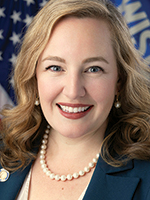
Photo of Kelda Roys
D Wisconsin Senate · District 26

Sen. Kelda Roys

Compare
Total votes
595
all sessions
Attendance
96%
24 missed
Near the chamber average
With party
95%
of cast votes
Near the chamber average
Bipartisan score
3%
crosses aisle rarely
Near the chamber average
Sponsored
1,084
bills & resolutions
Near the chamber average
Committees
5
assignments
1,084 bills and resolutions

Sponsored bills

Total
1,084
Primary
1,084
Co-sponsor
0
This page
1,084
matching current filters
Primary SJR 149
Failed · Wisconsin Senate · Lead sponsor
Relating to: proclaiming April 2026 as family strengthening month in Wisconsin.

Maddy summaryThis bill proposes designating April 2026 as Family Strengthening Month in Wisconsin to raise awareness about preventing child abuse and neglect. It does not create new laws or funding but serves as a symbolic resolution to highlight the importance of family support and community involvement. The measure references research on protective factors like parental resilience and social connections that help build safe environments for children. Ultimately, the bill aims to encourage public and government commitment to strengthening families through awareness rather than policy changes.

Failed Mar 30, 2026 0 co-sponsors
Primary SB 1096
Failed · Wisconsin Senate · Lead sponsor
Relating to: allowing private individuals, families, and private employers to elect health care coverage through plans offered by the Group Insurance Board, granting rule-making authority, and making an appropriation. (FE)

Maddy summaryThis bill allows private individuals, families, and private employers to choose health care coverage through plans offered by the Group Insurance Board, expanding options beyond traditional state employee plans. It creates new statutory provisions for health savings accounts for both state employees and private sector participants who select high-deductible health plans, with separate accounts established to track funds from each group. The legislation grants the Group Insurance Board rule-making authority to manage enrollment, premium collection, and coverage procedures for these expanded options. Additionally, the bill authorizes the collection of administrative fees from state agencies, individuals, and private employers to fund the operation of these health savings account programs.

Failed Mar 30, 2026 0 co-sponsors
Primary SB 1090
Failed · Wisconsin Senate · Lead sponsor
Relating to: the distribution of the Wisconsin Blue Book and highway maps. (FE)

Maddy summaryThis bill modifies how Wisconsin distributes the state Blue Book and highway maps to legislative members. It requires legislative offices to request specific quantities of the Blue Book before printing, with each Senator capped at 600 copies and each Assembly Representative at 350 copies. The bill also establishes free distribution limits for highway maps, providing 50 service maps and 500 folded maps to each legislator without charge, while allowing paid requests for additional copies. Additionally, it mandates that audit report summaries be distributed using the same method as the Blue Book.

Failed Mar 30, 2026 0 co-sponsors
Primary SB 1170
Failed · Wisconsin Senate · Lead sponsor
Relating to: prohibitions on postemployment nonsolicitation clauses in employment contracts.

Maddy summaryThis bill prohibits employers from including postemployment nonsolicitation clauses in employment contracts, which would prevent former employees from recruiting their current coworkers for other jobs. The law declares such provisions illegal, void, and unenforceable because they impose an unreasonable restraint on trade after employment ends. Employers must post notices in conspicuous locations and on their websites explaining that these clauses are unenforceable. The restrictions apply to contracts entered into, extended, modified, or renewed on the bill's effective date.

Failed Mar 30, 2026 0 co-sponsors
Primary SB 1114
Failed · Wisconsin Senate · Lead sponsor
Relating to: permitting certain qualified individuals to make a request for medication for the purpose of ending their lives and providing a penalty. (FE)

Maddy summaryThis bill, titled the "Our Care, Our Options Act," would create a legal process allowing mentally capable adults with terminal illnesses to request medication to end their lives within six months of diagnosis. It requires patients to make both oral and written requests to their doctors, with a 15-day waiting period between the initial and final requests, though this wait can be waived if death is expected within 15 days. Two separate medical providers must confirm the patient's diagnosis, prognosis, and mental capacity, while also ensuring the patient understands all treatment options and risks before proceeding. The legislation defines specific protections against coercion or undue influence and establishes penalties for violations, while also clarifying that providers who object to participating may refer patients to other qualified providers without facing disciplinary action.

Failed Mar 30, 2026 0 co-sponsors
Primary SB 1185
Failed · Wisconsin Senate · Lead sponsor
Relating to: a tax credit for local newspaper subscriptions. (FE)

Maddy summaryThis bill creates a state tax credit for individuals who purchase subscriptions to qualifying local newspapers, which are defined as newspapers eligible to print legal notices. The credit allows taxpayers to claim 50 percent of their subscription costs as a credit against their state income tax, with a maximum benefit of $250 per year or $125 for married individuals filing separate returns. To use the credit, taxpayers must file a claim within the standard tax filing period for the year in which they paid for the subscriptions. The legislation applies to taxable years beginning after December 31, 2024, and follows existing administrative procedures for similar tax credits.

Failed Mar 30, 2026 0 co-sponsors
Primary SB 947
Failed · Wisconsin Senate · Lead sponsor
Relating to: a requirement to report lost or stolen firearms and providing a penalty. (FE)

Maddy summarySB 947 requires firearm owners to report lost or stolen guns to local law enforcement within 24 hours. Law enforcement must then forward these reports to a state database for tracking, and owners must report recovery of a firearm as soon as possible. Failure to report a lost or stolen firearm carries penalties: a Class A misdemeanor for a first offense, escalating to a Class I felony for repeat violations. Additionally, sellers must provide new buyers written notice of these reporting requirements and penalties at the time of sale. The bill directly affects firearm owners, sellers, and law enforcement agencies.

Failed Mar 30, 2026 0 co-sponsors
Primary SB 946
Failed · Wisconsin Senate · Lead sponsor
Relating to: containers or trigger locks provided at a firearm sale and providing a penalty.

Maddy summarySB 946 requires firearm sellers in Wisconsin to provide a specific written warning about child access risks and either a secure container or trigger lock during retail sales or transfers. The warning must state: "IF YOU LEAVE A LOADED FIREARM WITHIN THE REACH OR EASY ACCESS OF A CHILD YOU MAY BE FINED OR IMPRISONED OR BOTH..." The bill directly affects retail firearm sellers, mandating these provisions at the point of sale. Violations carry penalties of up to $500 fine, 30 days in jail, or both. The legislation focuses on preventing accidental firearm access by children through mandatory seller actions during transactions.

Failed Mar 30, 2026 0 co-sponsors
Primary SB 1066
Failed · Wisconsin Senate · Lead sponsor
Relating to: use of artificial intelligence to deny prior authorization for medical necessity or experimental status.

Maddy summarySB 1066 prohibits health insurance companies (including disability insurance and self-insured plans) from using artificial intelligence to deny prior authorization for medical treatments or experimental procedures. Instead, the bill requires a licensed healthcare provider to review these requests before a denial can be issued. It directly affects insurers that currently use AI for these decisions and healthcare providers who seek approval for patient care. The law takes effect in the fourth month after publication, with specific transition rules for plans under collective bargaining agreements.

Failed Mar 30, 2026 0 co-sponsors
Primary SB 1039
Failed · Wisconsin Senate · Lead sponsor
Relating to: broadband expansion grants for cities, villages, towns, and counties and telecommunications-related construction projects of cities, villages, and towns. (FE)

Maddy summarySB 1039 modifies state grant programs to support broadband expansion in underserved areas. It repeals outdated sections of law and amends statutes to allow cities, villages, towns, and counties to apply for grants covering infrastructure construction, project planning (including feasibility reports), and up to 50% of costs for hiring a dedicated broadband director. The bill directly affects local governments seeking to expand high-speed internet access in areas without reliable service. Grants will be funded from specific state appropriations allocated for broadband projects. This bill focuses on streamlining funding mechanisms for local broadband development.

Failed Mar 30, 2026 0 co-sponsors
Showing 31 to 40 of 1,084 bills
Previous 1 3 4 5 109 Next