

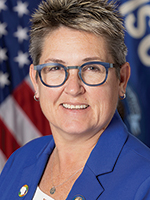
Photo of Kristin Dassler-Alfheim
D Wisconsin Senate · District 18

Sen. Kristin Dassler-Alfheim

Compare
Total votes
191
all sessions
Attendance
100%
of floor votes
Near the chamber average
With party
95%
of cast votes
Near the chamber average
Bipartisan score
3%
crosses aisle rarely
Near the chamber average
Sponsored
349
bills & resolutions
Near the chamber average
Committees
2
assignments
349 bills and resolutions

Sponsored bills

Total
349
Primary
349
Co-sponsor
0
This page
349
matching current filters
Primary SB 330
Failed · Wisconsin Senate · Lead sponsor
Relating to: waiting period for purchase of handguns.

Maddy summarySB 330 extends the waiting period for handgun purchases from 48 hours to a maximum of 5 working days when a background check reveals uncertainty about a buyer's eligibility under state or federal law. It requires the Department of Justice to complete its verification within this 5-day window and notify the firearms dealer of the results. This change directly affects handgun buyers whose background checks initially show unclear eligibility and firearms dealers who must wait for the department's final determination. The bill modifies existing statutes to clarify the timeline for resolving ambiguous background check results.

Failed Mar 23, 2026 0 co-sponsors
Primary SB 396
Failed · Wisconsin Senate · Lead sponsor
Relating to: the Veterans Outreach and Recovery Program and making an appropriation. (FE)

Maddy summarySB 396 increases funding for the Veterans Outreach and Recovery Program by $512,900 for fiscal year 2025-26 (adding 7 staff positions) and $602,800 for fiscal year 2026-27. This directly expands services provided to veterans through the Department of Veterans Affairs by authorizing additional staff to support outreach and recovery efforts. The bill makes specific appropriations to the department without creating new program requirements or altering eligibility. It affects veterans seeking outreach services and the department’s capacity to deliver them.

Failed Mar 23, 2026 0 co-sponsors
Primary SB 385
Failed · Wisconsin Senate · Lead sponsor
Relating to: the veterans housing and recovery program and making an appropriation. (FE)

Maddy summarySB 385 increases funding for Wisconsin's Veterans Housing and Recovery Program. It adds $900,000 for fiscal year 2025-26 and $1,050,000 for 2026-27 to cover program supplies, services, and leasing a new facility in Chippewa Falls. The additional funds address space limitations and facility deficiencies at the current location. This bill directly affects veterans participating in the housing program by ensuring continued support through improved resources and accommodations. The changes are purely fiscal, with no new policy requirements for veterans or service providers.

Failed Mar 23, 2026 0 co-sponsors
Primary SB 398
Failed · Wisconsin Senate · Lead sponsor
Relating to: requiring universal changing stations in certain buildings, creating a tax credit for installation of the stations, and making an appropriation. (FE)

Maddy summarySB 398 creates a tax credit for small businesses to install universal changing stations in certain buildings. The credit covers 50% of installation costs, up to $5,125, for businesses with annual gross receipts under $1 million or 30 or fewer full-time employees. The bill amends tax statutes to allow this credit against state income tax, with credits calculated based on entity payments and distributed to owners proportionally for partnerships and similar entities. It requires stations to meet specific standards defined in the law and includes funding through an appropriation account.

Failed Mar 23, 2026 0 co-sponsors
Primary SB 332
Failed · Wisconsin Senate · Lead sponsor
Relating to: prohibition against undetectable firearms, possessing a frame or receiver of a firearm without a serial number, and providing a penalty.

Maddy summarySB 332 prohibits the possession, sale, or manufacture of undetectable firearms (those not detectable by standard metal detectors or security scanners) and unmarked firearm frames/receivers (the core components of a gun). It creates new felony penalties: Class G for possessing undetectable firearms, Class H for sharing manufacturing plans, and Class I for possessing unmarked frames/receivers. The law applies to the general public but includes exemptions for law enforcement officers, military personnel, and licensed manufacturers acting within their official duties. This directly affects individuals who own or attempt to build such firearms, aiming to enhance public safety through stricter firearm tracking and detection requirements.

Failed Mar 23, 2026 0 co-sponsors
Primary SB 436
Failed · Wisconsin Senate · Lead sponsor
Relating to: the Warren Knowles-Gaylord Nelson stewardship 2000 program and making an appropriation. (FE)

Maddy summaryThis bill updates the Warren Knowles-Gaylord Nelson stewardship program by creating a governing board with specific membership requirements, including representatives from environmental groups, hunting/fishing organizations, tribal nations, and local government. It establishes annual funding for grants to nonprofit conservation organizations and a tribal co-management program, with set spending limits for the program through 2031. The bill also adjusts debt authorization and funding mechanisms for the program's capital improvement fund. These changes directly affect the program's operations and the organizations receiving financial support.

Failed Mar 23, 2026 0 co-sponsors
Primary SB 145
Failed · Wisconsin Senate · Lead sponsor
Relating to: the procedure for adding federal newborn screening recommendations to the state-required newborn screenings, granting rule-making authority, and providing an exemption from emergency rule procedures. (FE)

Maddy summarySB 145 establishes a process for Wisconsin to add federal newborn screening recommendations to its state-required list. It requires the Department of Health Services (DHS) to evaluate new federal disorders within 18 months, conduct annual reviews of excluded disorders, and begin rule-making to include them if appropriate. The bill grants DHS authority to create new screening rules and exempts these rules from standard emergency rule procedures. It directly affects newborns in Wisconsin by potentially expanding screening tests for certain disorders, with testing for newly added disorders required to begin within six months of rule publication. The law applies to federal recommendations approved after January 1, 2025, and includes specific timelines for evaluation and implementation.

Failed Mar 23, 2026 0 co-sponsors
Primary SB 180
Failed · Wisconsin Senate · Lead sponsor
Relating to: modifications to housing programs under the Wisconsin Housing and Economic Development Authority. (FE)

Maddy summarySB 180 modifies Wisconsin's housing programs under the Wisconsin Housing and Economic Development Authority (WHEDA). It allows WHEDA to offer loans with interest rates at or below market rate minus 1% (or no interest) and requires newly constructed workforce or senior housing to remain affordable for 10 years after initial occupancy. For owner-occupied homes, it restricts resale prices to the original purchase price plus annual inflation (capped at 5% per year), with these rules recorded on property deeds and published online by WHEDA. The bill directly affects developers receiving WHEDA loans and future homeowners purchasing qualifying affordable housing units, applying to new loans starting January 1, 2026.

Failed Mar 23, 2026 0 co-sponsors
Primary SB 492
Failed · Wisconsin Senate · Lead sponsor
Relating to: coverage of nonopioid drug alternatives for the treatment and management of pain.

Maddy summarySB 492 requires health insurance plans and self-insured employers to cover nonopioid pain treatment options equally with opioids. It mandates coverage for at least two nonopioid prescription drugs (approved by the FDA and not controlled substances) and three non-drug pain management options, such as physical therapy. The bill prohibits health plans from imposing stricter prior authorization or step therapy rules on nonopioid drugs compared to opioids. It also requires annual public reporting of pain management coverage details on plan websites. This affects all health plans covering prescription drugs in Wisconsin, directly impacting patients seeking nonopioid pain treatment options.

Failed Mar 23, 2026 0 co-sponsors
Primary SB 496
Failed · Wisconsin Senate · Lead sponsor
Relating to: verification of a pupil’s family income for participation in a parental choice program.

Maddy summarySB 496 amends income eligibility rules for families using parental choice programs (school vouchers) to attend private schools. It raises the income threshold from 2.2 times the federal poverty level to 3.0 times for most students, replacing previous lower limits for certain districts. The bill repeals outdated provisions requiring verification of income increases and updates how family income is calculated for program eligibility. These changes apply starting in the 2026-27 school year, directly affecting low-income families seeking private school options under existing programs.

Failed Mar 23, 2026 0 co-sponsors
Showing 221 to 230 of 349 bills
Previous 1 … 22 23 24 … 35 Next