

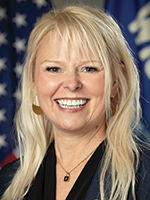
Photo of Sarah Keyeski
D Wisconsin Senate · District 14

Sen. Sarah Keyeski

Compare
Total votes
191
all sessions
Attendance
100%
of floor votes
Near the chamber average
With party
92%
of cast votes
Near the chamber average
Bipartisan score
5%
crosses aisle rarely
Near the chamber average
Sponsored
248
bills & resolutions
Near the chamber average
Committees
3
assignments
248 bills and resolutions

Sponsored bills

Total
248
Primary
248
Co-sponsor
0
This page
248
matching current filters
Primary SB 1117
Failed · Wisconsin Senate · Lead sponsor
Relating to: entering into an agreement among the states to elect the president and vice president of the United States by means of a national popular vote.

Maddy summaryThis bill proposes to join an interstate compact that would allow states to elect the U.S. president and vice president based on the national popular vote rather than the Electoral College. It would take effect only when enough states have joined the agreement to collectively hold a majority of Electoral College votes. The bill amends state election laws to implement the compact's provisions, which require member states to count all popular votes nationwide and award all Electoral College votes to the candidate who wins the most popular votes across all participating states. The agreement includes provisions for state withdrawal, dispute resolution in case of ties, and termination if the Electoral College is abolished.

Failed Mar 23, 2026 0 co-sponsors
Primary SB 1146
Failed · Wisconsin Senate · Lead sponsor
Relating to: a dairy agriculture resilience investment now grant pilot program, granting rule-making authority, and making an appropriation. (FE)

Maddy summaryThis bill establishes a pilot grant program to help smaller dairy farms improve their operations and resilience. It provides up to $1.5 million in annual funding for grants aimed at dairy producers with fewer than 1,000 milking cows. The program allows the Department of Agriculture to create rules for administering grants that support projects enhancing operational efficiency and farm resilience. The legislation also authorizes the department to make rules necessary to manage the program and includes the funding appropriation in the 2026 budget schedule.

Failed Mar 23, 2026 0 co-sponsors
Primary SB 1154
Failed · Wisconsin Senate · Lead sponsor
Relating to: the definition of political action committee for campaign finance purposes.

Maddy summaryThis bill updates the legal definition of a political action committee for campaign finance purposes in the state statutes. It specifies that a group qualifies as a PAC if it spends more than $1,000 in a 12-month period on express advocacy, referendum support or opposition, or contributions to candidates, legislative committees, or political parties. The definition explicitly excludes fundraising and administrative expenses from the spending calculation. This change affects how organizations are classified and regulated under campaign finance laws without altering existing spending limits or reporting requirements.

Failed Mar 23, 2026 0 co-sponsors
Primary SB 1157
Failed · Wisconsin Senate · Lead sponsor
Relating to: reporting a contributor’s place of employment.

Maddy summaryThis bill requires political committees and candidates to report the name and address of the principal place of employment for individual contributors who donate more than $100 in a calendar year, down from the previous $200 threshold. The change applies to contributions made to candidate committees, political parties, legislative campaign committees, political action committees, independent expenditure committees, recipient committees, referendum committees, and recall committees. By lowering the reporting threshold, the bill expands the number of donors whose employment information must be publicly disclosed in campaign finance records. The legislation directly affects political organizations and committees that collect and report contribution data to state election authorities.

Failed Mar 23, 2026 0 co-sponsors
Primary SB 1156
Failed · Wisconsin Senate · Lead sponsor
Relating to: contributions by corporations, cooperative associations, labor organizations, and federally recognized American Indian Tribes.

Maddy summaryThis bill would allow corporations, cooperatives, labor organizations, and federally recognized American Indian Tribes to contribute up to $12,000 per year to political segregated funds, while maintaining a ban on contributions to other types of political committees. The law applies to both foreign and domestic entities and specifically permits these groups to support candidates through segregated funds, which are different from independent expenditure or referendum committees. The provision is designed to clarify and codify existing rules about political contributions from these specific types of organizations.

Failed Mar 23, 2026 0 co-sponsors
Primary SB 1155
Failed · Wisconsin Senate · Lead sponsor
Relating to: coordination of mass communications.

Maddy summaryThis bill amends Wisconsin election laws to clarify how mass communications are defined and regulated in relation to political campaign spending. It creates new definitions for "mass distribution," "mass electronic communication," and "mass telephoning," each requiring 500 or more substantially identical messages, while excluding bona fide polls from these definitions. The legislation updates rules on when independent groups must report coordinated spending by clarifying that coordination occurs when a candidate or their party has control over or engages in substantial discussions about the content, timing, or other details of the communication. Additionally, it prohibits certain mass communications that reference clearly identified candidates during the 60-day period before an election if they are coordinated with the candidate or their party in violation of contribution limits.

Failed Mar 23, 2026 0 co-sponsors
Primary SB 1150
Failed · Wisconsin Senate · Lead sponsor
Relating to: net zero emissions, carbon-free and renewable energy standards, and creating an office of sustainability and clean energy, granting rule-making authority, making an appropriation, and providing a penalty. (FE)

Maddy summaryThis bill establishes a state goal to achieve 100 percent clean electricity and net zero carbon emissions by 2050, creating a new Office of Sustainability and Clean Energy to oversee implementation. It sets specific milestones requiring the state to reach at least 50 percent carbon-free electricity by 2030, 65 percent by 2035, 80 percent by 2040, 90 percent by 2045, and full carbon-free status by 2050. The legislation also directs the state to develop a detailed decarbonization roadmap using sector-based modeling and provides funding for technology needed to meet these targets. Additionally, the bill clarifies definitions for renewable and carbon-free resources and includes provisions for agencies to consider technical feasibility and cost-effectiveness when meeting these energy standards.

Failed Mar 23, 2026 0 co-sponsors
Primary SB 1158
Failed · Wisconsin Senate · Lead sponsor
Relating to: reporting of mass communications.

Maddy summaryThis bill establishes reporting requirements for political committees that make mass communications, such as distributing 500 or more identical pieces of material, sending 500 or more identical emails, making 500 or more identical phone calls, or disseminating messages during the 60 days before an election. It requires political action committees, independent expenditure committees, political parties, and legislative campaign committees to file registration statements and detailed expenditure reports when they spend money on these mass communications. The bill defines specific thresholds and timing for when committees must register and report, ensuring transparency around spending on large-scale communications that appeal to voters to support or oppose candidates.

Failed Mar 23, 2026 0 co-sponsors
Primary SB 1087
Failed · Wisconsin Senate · Lead sponsor
Relating to: disrupting access to a reproductive health service facility or place of religious worship and providing a penalty.

Maddy summaryThis bill creates new criminal penalties and civil remedies for intentionally disrupting access to reproductive health service facilities or places of religious worship. It prohibits actions such as using force or physical obstruction to injure, intimidate, or interfere with individuals seeking or providing reproductive health services, as well as damaging property at these locations. Violations are classified as a Class A misdemeanor for first offenses and a Class I felony for repeat offenses. The legislation also allows affected individuals and entities to file civil lawsuits seeking injunctive relief, damages, and attorney fees, while permitting prosecutors to seek civil forfeitures ranging from $10,000 to $25,000 depending on the severity and frequency of the violation.

Failed Mar 23, 2026 0 co-sponsors
Primary SB 1129
Failed · Wisconsin Senate · Lead sponsor
Relating to: unfair sales practices at publicly funded stadiums.

Maddy summaryThis bill establishes rules to limit price markups on food and drinks sold at publicly funded stadiums in the state. It defines a stadium as a facility with at least 3,000 seats that receives public financial support, while excluding schools and charter schools from these requirements. The law prohibits stadium operators and concessionaires from charging more than the retail cost of items plus a 20 percent markup. Violations of these pricing limits would be classified as unfair trade practices under state law.

Failed Mar 23, 2026 0 co-sponsors
Showing 21 to 30 of 248 bills
Previous 1 2 3 4 25 Next